
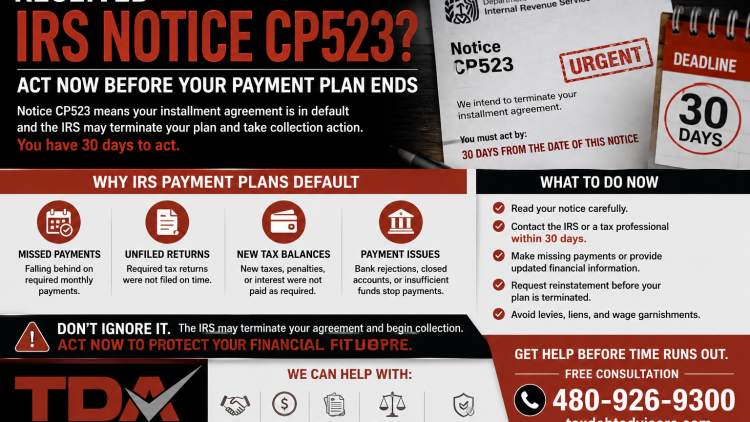
IRS Notice CP523: What To Do Before Your Payment Plan Ends
What Does IRS Notice CP523 Mean?
An IRS payment plan can create breathing room, but it does not run on autopilot. A missed payment, unfiled return, or new unpaid tax balance can place the arrangement in default. The first clear warning may be IRS Notice CP523.
CP523 is serious because the IRS is proposing to terminate the installment agreement. It also warns that collection action may follow if the problem is not corrected. The notice should not be ignored or treated as an ordinary monthly bill.
Read the Reason and Deadline First
The notice explains why the IRS considers the agreement to be in default. It also provides a termination date and a telephone number for the department handling the account.
The IRS advises taxpayers to respond as soon as possible and no later than 30 days from the notice date. Waiting until the final days can make it harder to gather records or correct a payment problem.
Check the tax periods, balance, recent payments, and contact information. Keep the envelope and copy every page. When a payment was made recently, collect the confirmation number, bank statement, or cancelled check before calling.
Understand Why Payment Plans Default
A missed monthly payment is one common reason, but it is not the only one. Taxpayers in an installment agreement must remain current with future filing and payment obligations. A new unpaid balance, late return, missed estimated payment, or unpaid federal tax deposit can put the agreement at risk.
Direct debit problems also happen. A closed account, changed routing number, insufficient funds, or bank rejection can interrupt a payment even when the taxpayer believed everything was current.
Compare the notice with account records and recent activity rather than assuming either the IRS or the taxpayer must be correct.
Correct the Problem Before the Agreement Ends
The IRS says making the required payment before the termination date may prevent the agreement from ending. In other cases, the taxpayer may need to contact the IRS and request reinstatement.
Reinstatement can involve a user fee, updated financial information, or payment of a new tax liability. The correct approach depends on why the default occurred and whether the original monthly amount is still affordable.
Someone whose income has fallen should not promise a payment that cannot be maintained. The IRS states that a changed financial condition may support a lower monthly amount, although documentation may be requested.
Do Not Ignore the Levy Warning
When no action is taken, the IRS may terminate the agreement and resume collection. That can include a Notice of Federal Tax Lien or a levy against wages and bank accounts.
An immediate levy does not normally occur the day the notice arrives. IRS rules generally restrict levy action while an installment agreement remains in effect, for 30 days after termination, and while a timely appeal is pending. Those protections provide time to act, not a reason to wait.
Know When an Appeal May Be Available
A taxpayer who disagrees with the proposed termination can speak with the IRS using the number on the notice. When the disagreement remains unresolved, appeal rights may be available through the IRS Independent Office of Appeals.
An appeal should be supported by records. A payment may have posted incorrectly, a return may not have been recorded, or corrective action may already be complete. The taxpayer should still call after fixing the problem so the IRS can confirm the account and consider reinstatement.
Protect the Next Agreement
Once the default is resolved, review why it happened. Update bank information, arrange reminders, file every required return, and plan for current taxes so another balance does not develop.
The monthly amount also needs to be realistic. A full financial review can determine whether a revised installment agreement or another collection alternative better fits the taxpayer’s circumstances.
Get Help With IRS Notice CP523 in Mesa
Tax Debt Advisors, Inc. has helped Arizona taxpayers resolve IRS collection problems since 1977. Scott Allen, EA, can review the notice, account history, payment records, filing compliance, and available resolution options before the deadline passes. Call 480 926 9300 for a free consultation and help responding to a defaulted IRS payment plan.
Live References
Tax Debt Advisors: IRS Payment Plans
https://taxdebtadvisors.com/blog/category/irs-tax-payment-plan
Internal Revenue Service: Understanding Your CP523 Notice
https://www.irs.gov/individuals/understanding-your-cp523-notice
Internal Revenue Service: What If I Cannot Pay My Installment Agreement?
https://www.irs.gov/newsroom/what-if-i-cant-pay-my-installment-agreement
Internal Revenue Service: Letters and Notices Offering an Appeal Opportunity
https://www.irs.gov/appeals/letters-and-notices-offering-an-appeal-opportunity
Internal Revenue Manual: Installment Agreements