IRS Automatic Exemption From Penalty Explained
IRS Automatic Exemption From Penalty: What Changed in 2026?
IRS penalty relief changed in 2026. For years, eligible taxpayers generally had to contact the IRS and request First Time Abate after a failure to file, failure to pay, or failure to deposit penalty appeared. The IRS is now moving toward Automatic Exemption from Penalty, known as AEP.
The change can prevent penalties from being assessed when the taxpayer has a strong compliance history. It does not erase the tax, remove every penalty, or replace reasonable cause relief.
AEP Rewards a Clean Compliance History
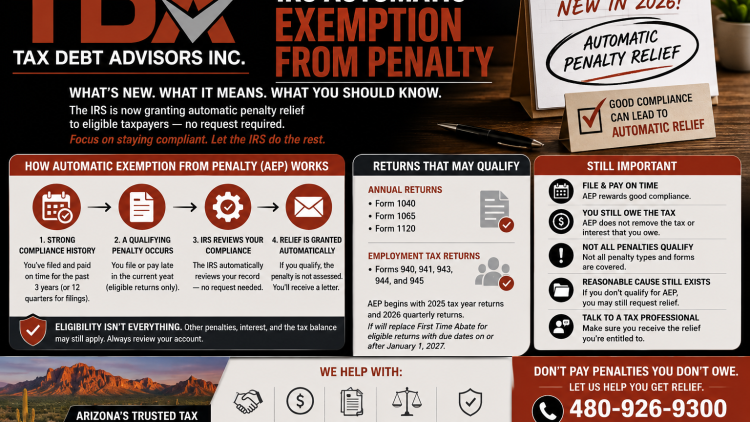
AEP is intended for taxpayers who filed and paid on time during the three prior years. Quarterly filers generally need 12 consecutive compliant quarters.
When an eligible taxpayer files or pays late in the current period, the IRS reviews the prior record. When the return and penalty type qualify, the applicable penalty is not assessed. The IRS sends a letter explaining that relief was granted.
Unlike traditional First Time Abate, the taxpayer does not need to telephone the IRS or submit a separate request to receive AEP.
Know Which Returns May Qualify
The IRS lists Forms 1040, 1065, and 1120 among the annual returns considered for AEP. Several employment tax returns can also qualify, including Forms 940, 941, 943, 944, and 945.
The automatic process begins with eligible 2025 tax year returns and 2026 quarterly returns. AEP will replace First Time Abate for eligible original returns with due dates on or after January 1, 2027.
Not every return is included. Estate tax returns, gift tax returns, many information returns, and penalties outside the covered categories may follow different rules.
The Relief Covers Specific Penalties
AEP applies to certain failure to file, failure to pay, and failure to deposit penalties. It does not cancel the tax shown on the return. Interest on unpaid tax still accrues, and penalties that are not eligible remain due.
Taxpayers should continue filing and paying as promptly as possible. Automatic relief is a safety net for qualifying compliance failures, not permission to delay future obligations.
A taxpayer may receive a penalty notice during the transition when the IRS has not yet applied AEP. The IRS advises people who believe they qualified to contact the agency.
First Time Abate Still Matters During the Transition
First Time Abate may still apply to eligible 2024 tax year returns, eligible 2025 quarterly returns, and some 2025 annual or 2026 quarterly returns processed before AEP begins for that account.
FTA is not automatic. The taxpayer normally needs to call the number on the notice or submit a written request. Older penalty years may also remain under the First Time Abate rules, so the tax period and processing date matter.
Reasonable Cause Is a Separate Route
A taxpayer who does not qualify for AEP may still request penalty relief based on reasonable cause. This route focuses on what happened, when it happened, how the event prevented timely compliance, and what the taxpayer did to correct the problem.
Serious illness, loss of records, natural disaster, or another event beyond the taxpayer’s control may support a request when the facts and documentation are strong. Lack of money by itself does not automatically establish reasonable cause.
The IRS may request hospital records, court documents, written correspondence, receipts, or other evidence. When telephone relief is not approved, Form 843 may be used in some cases to request abatement in writing.
Review the Entire IRS Balance
Penalty relief should be considered as part of the complete tax resolution. Removing a penalty can reduce the balance, but the remaining tax may still require full payment, an installment agreement, an offer in compromise, or hardship status.
Review each tax year separately. A taxpayer may qualify for automatic relief on one period, reasonable cause on another, and no penalty relief on a third.
Ask Tax Debt Advisors About IRS Penalty Relief
Tax Debt Advisors, Inc. has resolved IRS tax debt for Arizona individuals and businesses since 1977. Scott Allen, EA, can review penalty notices, compliance history, tax periods, supporting records, and the remaining balance to identify the relief options that apply. Call 480 926 9300 for a free consultation before paying penalties that may qualify for removal.
Live References
Tax Debt Advisors: IRS Penalty Abatement
Internal Revenue Service: Administrative Penalty Relief
Internal Revenue Service: Automatic Exemption From Penalty
Internal Revenue Service: Reasonable Cause Penalty Relief
Internal Revenue Service: Form 843