

IRS Payment Help in Phoenix AZ
Phoenix AZ IRS Payment Plan Help: How Scott Allen, EA Reduced Anthony’s IRS Payments From $1,279 to $500 Per Month
As the Phoenix Suns begin the 2026–2027 NBA season, one Arizona taxpayer discovers that a successful financial comeback can begin with the right IRS representation.
When an IRS Payment Plan Becomes Too Expensive
As the Phoenix Suns take the court for another exciting NBA season, basketball fans throughout Phoenix, Mesa, Gilbert, Chandler, Scottsdale, and the surrounding Valley are looking forward to fresh opportunities, new strategies, and a successful season.
In professional basketball, a winning team must continually evaluate its strategy, make adjustments, and respond to changing circumstances. A game plan that worked in the first quarter may need to change by the fourth quarter.
The same principle applies to taxpayers struggling with IRS debt.
An IRS payment plan that was affordable when originally established may become financially overwhelming when a taxpayer’s income decreases, living expenses increase, or other financial circumstances change.
Fortunately, IRS installment agreements are not necessarily permanent arrangements that can never be adjusted.
With proper financial documentation and professional IRS representation, some taxpayers may qualify to have their monthly payments reduced.
That is exactly what happened when Scott Allen, EA, of Tax Debt Advisors, Inc., a family-owned Mesa, Arizona tax resolution business established in 1977, helped his client Anthony reduce his monthly IRS payment from $1,279 to just $500.
For Anthony, this successful negotiation meant an additional $779 every month that could remain available for household expenses and other financial obligations.
His experience demonstrates why Arizona taxpayers who are struggling with expensive IRS payment plans should consider having their financial circumstances professionally reviewed before assuming that their current payments cannot be changed.
Anthony’s IRS Payment Plan Was $1,279 Per Month
Anthony was already making payments toward his outstanding federal tax debt through an IRS installment agreement.
His original monthly payment was $1,279.
Although an installment agreement can provide taxpayers with a structured method of resolving unpaid federal taxes, the monthly payment must also be manageable within the taxpayer’s financial circumstances.
Over time, Anthony’s financial situation changed.
The payment arrangement that had previously been established no longer reflected his updated financial information.
Rather than continuing with a monthly obligation that was creating financial pressure, Anthony worked with Scott Allen, EA, of Tax Debt Advisors, Inc. to determine whether the IRS would consider revising the existing agreement.
Scott Allen reviewed Anthony’s updated financial information and worked with the IRS to request a more affordable monthly payment.
The objective was straightforward: establish a revised IRS installment agreement that would better reflect Anthony’s current ability to pay while keeping him on a path toward resolving his outstanding tax obligations.
The IRS Approved Anthony’s Revised Payment Plan
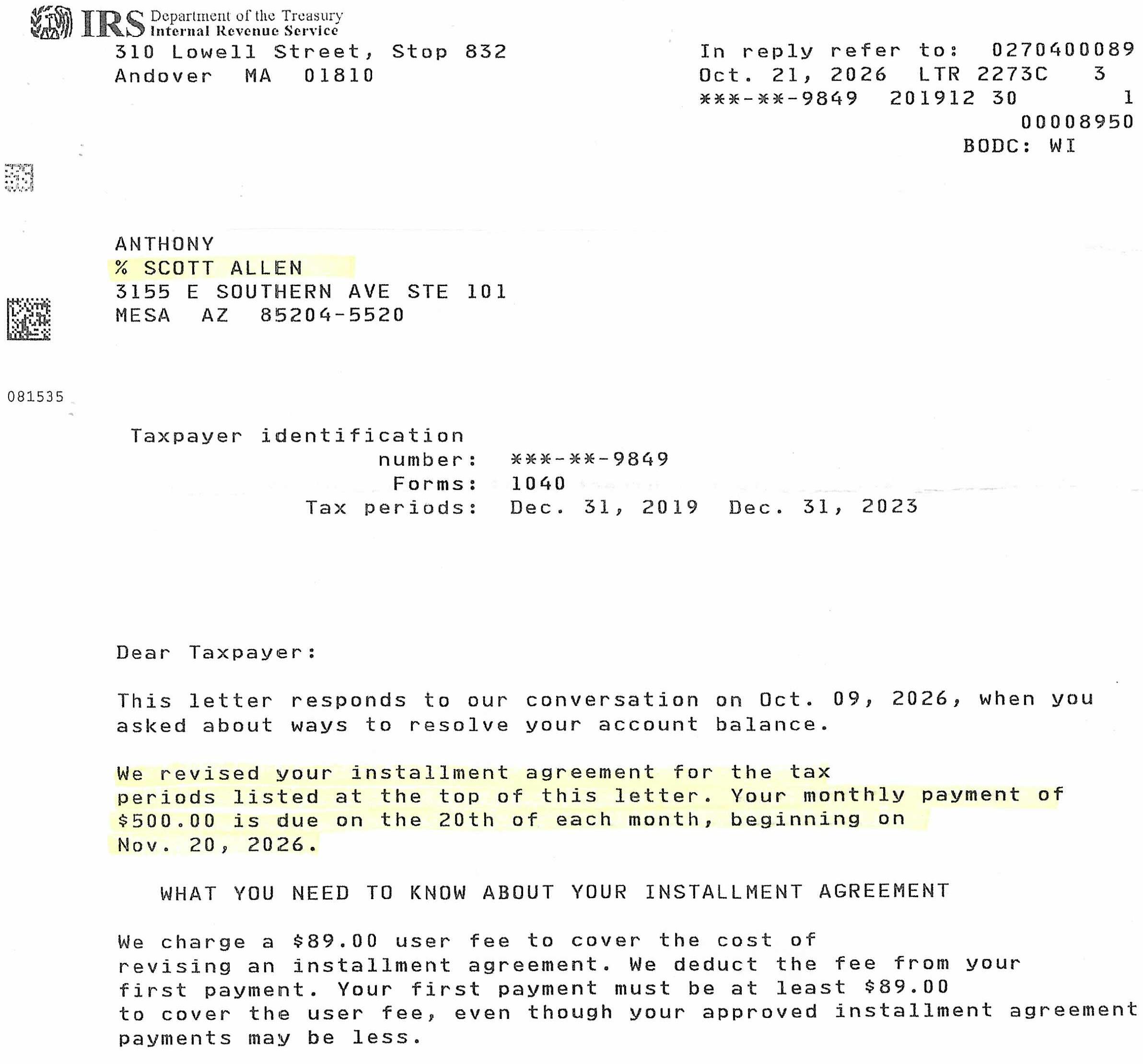
On October 21, 2026, the Internal Revenue Service issued Letter 2273C confirming that Anthony’s installment agreement had been revised.
The IRS letter specifically stated:
“We revised your installment agreement for the tax periods listed at the top of this letter.”
The correspondence confirmed that Anthony’s new monthly payment would be $500, beginning November 20, 2026, with payments due on the 20th of each month.
This was a significant financial improvement.
| Anthony’s IRS Payment Plan | Monthly Amount |
|---|---|
| Previous IRS payment | $1,279 |
| Revised IRS payment | $500 |
| Monthly payment reduction | $779 |
| Percentage reduction | Approximately 61% |
| Annualized cash-flow improvement | $9,348 |
By successfully revising Anthony’s installment agreement, Scott Allen, EA helped his client reduce the required monthly payment by approximately 61%.
That represents $9,348 in potential annual cash-flow relief, assuming the revised payment remains in effect for 12 months.
Importantly, a reduction in monthly payments does not automatically reduce the underlying IRS tax debt. Interest and applicable penalties may continue to accrue, and a longer repayment period may increase the total amount paid over time.
Nevertheless, a manageable monthly payment can make an enormous difference for taxpayers trying to maintain financial stability while addressing their IRS obligations.
Revised IRS Payment Plan for Back Taxes Owed
Just Like the Phoenix Suns, Sometimes a New Game Plan Is Necessary
As the Phoenix Suns open their 2026–2027 basketball season, fans understand that successful teams cannot rely on the same strategy regardless of what happens on the court.
A coach may change defensive assignments, adjust player rotations, or call a timeout when the original approach is no longer producing the desired results.
Taxpayers dealing with the IRS may need to make similar adjustments.
Imagine a Phoenix homeowner who established an IRS payment plan several years ago while earning a higher income. Since that time, the taxpayer may have experienced reduced wages, increased housing costs, unexpected family expenses, or changes in employment.
Continuing to make an unaffordable payment simply because it was originally accepted by the IRS may not be the best financial strategy.
Just as a basketball coach reviews the scoreboard and changes the game plan, an experienced Enrolled Agent can review the taxpayer’s financial situation and determine whether a revised IRS installment agreement may be appropriate.
For Anthony, the successful adjustment was substantial.
His required monthly payment decreased by $779, providing greater flexibility to manage everyday expenses.
And while the Phoenix Suns are working toward victories on the basketball court, Anthony achieved an important financial victory by obtaining a more affordable IRS payment arrangement.
Can the IRS Reduce an Existing Monthly Payment Plan?
Yes. Depending on the taxpayer’s circumstances, the IRS may agree to revise an existing installment agreement.
Many Arizona taxpayers mistakenly believe that once an IRS monthly payment amount has been established, it cannot be changed.
That is not always the case.
The IRS has procedures for reviewing installment agreements when taxpayers experience changes in their financial circumstances.
A taxpayer who previously agreed to pay $1,000, $1,500, or even $2,500 per month may qualify for a lower payment if updated financial information supports the request.
However, a taxpayer cannot simply choose a lower payment amount and assume the IRS will accept it.
The IRS may require documentation establishing the taxpayer’s current financial condition.
Depending on the situation, this may involve reviewing:
- Current household income and employment earnings.
- Mortgage payments or rent.
- Utilities, food, transportation, and other necessary living expenses.
- Health insurance and qualifying medical expenses.
- Bank account balances and other available assets.
- Changes in family size or household financial obligations.
- Other information relevant to the taxpayer’s ability to pay.
The IRS may also apply its collection financial standards when determining allowable living expenses.
An experienced tax representative can help organize this information and present an accurate financial picture to the IRS.
The goal is to determine an appropriate resolution based on the taxpayer’s circumstances and applicable IRS collection rules.
Why Hire Scott Allen, EA, for IRS Payment Plan Help in Phoenix AZ?
Taxpayers searching online for “Phoenix AZ IRS payment plan help” or “Mesa AZ IRS debt settlement” may encounter numerous national tax resolution companies advertising dramatic tax settlements.
However, not every taxpayer needs an Offer in Compromise, and not every IRS problem requires an attorney.
In many cases, an affordable IRS installment agreement may be a practical solution.
Scott Allen, EA, is an Enrolled Agent who is federally authorized to represent taxpayers before the Internal Revenue Service.
Enrolled Agents earn their authority to practice before the IRS through the United States Department of the Treasury.
Their representation authority includes assisting taxpayers with IRS collection matters, tax examinations, appeals, and other federal tax issues within the scope of their practice.
For taxpayers who need help negotiating an IRS installment agreement, an Enrolled Agent can communicate directly with the IRS after receiving the appropriate authorization, typically through IRS Form 2848, Power of Attorney and Declaration of Representative.
Scott Allen, EA provides professional representation to taxpayers who need assistance with:
- Establishing new IRS installment agreements.
- Revising existing IRS payment plans.
- Preparing and filing delinquent federal income tax returns.
- Addressing IRS collection notices.
- Negotiating solutions for unpaid federal taxes.
- Requesting penalty relief when appropriate.
- Resolving IRS wage garnishments and bank levies.
- Evaluating Currently Not Collectible status.
- Reviewing eligibility for an Offer in Compromise.
- Representing taxpayers during qualifying IRS examinations and disputes.
The appropriate strategy depends on each taxpayer’s financial information, filing compliance, and outstanding tax liabilities.
Tax Debt Advisors, Inc.: A Family-Owned Mesa Arizona Business Since 1977
For nearly five decades, Tax Debt Advisors, Inc. has served Arizona taxpayers seeking professional assistance with IRS tax problems.
Founded in 1977, the family-owned business is located in Mesa, Arizona, and serves taxpayers throughout the Phoenix metropolitan area.
Unlike taxpayers who contact national tax resolution companies and may be assigned to different representatives, clients of Tax Debt Advisors, Inc. have the opportunity to meet personally with Scott Allen, EA, to discuss their IRS problems.
Scott Allen can review the taxpayer’s situation, obtain authorization to communicate with the IRS, and work directly on an appropriate resolution.
This local approach is particularly valuable for taxpayers who prefer face-to-face communication and want to understand the process before making important financial decisions.
Tax Debt Advisors, Inc. assists taxpayers in Mesa, Phoenix, Gilbert, Chandler, Scottsdale, Tempe, Queen Creek, and surrounding Arizona communities.
Whether someone owes several thousand dollars or has accumulated a much larger federal tax liability, the first step is understanding the available IRS resolution options.
What Happens When Taxpayers Have Unfiled Back Tax Returns?
Another common problem facing Arizona taxpayers is the combination of unpaid IRS debt and multiple years of unfiled federal income tax returns.
Some taxpayers stop filing because they are concerned about how much they may owe.
Others may have experienced financial hardship, self-employment income complications, or difficulty gathering their tax records.
Unfortunately, ignoring unfiled tax returns can make an IRS collection problem more complicated.
The IRS generally requires taxpayers to satisfy applicable filing compliance requirements before approving many collection alternatives, including installment agreements.
Scott Allen, EA can professionally prepare and file delinquent federal income tax returns and represent taxpayers before the IRS to address their outstanding tax liabilities.
This can be especially helpful when the IRS has prepared a Substitute for Return based on information available to the government.
An IRS Substitute for Return may not reflect all deductions, expenses, credits, or other tax benefits for which the taxpayer is eligible.
Preparing accurate original returns can sometimes substantially change the amount assessed, depending on the facts and applicable IRS procedures.
Once the required returns are filed and the correct liabilities are determined, Scott Allen can evaluate appropriate collection alternatives.
For some taxpayers, the best solution may be a manageable monthly installment agreement.
For others, Currently Not Collectible status, penalty relief, or an Offer in Compromise may be worth considering.
Three Important Reasons to Review an Existing IRS Payment Plan
An IRS payment plan should be reviewed when circumstances suggest that the current agreement may no longer be appropriate.
1. Household Income Has Decreased
A taxpayer who previously earned $120,000 annually may now earn significantly less because of a job change, reduced hours, retirement, or business difficulties.
That reduction in income may justify reviewing the existing payment arrangement.
2. Necessary Living Expenses Have Increased
Arizona households may experience higher mortgage payments, insurance costs, medical expenses, transportation costs, or other necessary expenditures.
Depending on the taxpayer’s circumstances and IRS allowable expense rules, these changes may affect the ability-to-pay calculation.
3. The Existing Payment Is Becoming Unmanageable
Taxpayers who are struggling to maintain an existing installment agreement should consider requesting a review before missing payments.
A defaulted installment agreement may expose the taxpayer to renewed IRS collection activity, subject to applicable notice requirements and taxpayer protections.
Professional assistance can help identify available alternatives and communicate with the IRS before the situation becomes more serious.
Anthony’s IRS Payment Plan Revision Shows Why Professional Representation Matters
Anthony’s experience provides a practical example of how a revised IRS installment agreement can improve a taxpayer’s monthly finances.
His original IRS payment was $1,279 per month.
Following Scott Allen’s review and representation, the IRS approved a new payment of $500 per month.
The reduction was not based on an advertised promise that every taxpayer can settle tax debt for pennies on the dollar.
Instead, the revised agreement was based on Anthony’s updated financial information and the IRS’s review of his circumstances.
That distinction matters.
Successful IRS representation is not about making unrealistic guarantees. It is about understanding IRS collection procedures, reviewing the taxpayer’s financial condition, and pursuing a resolution that is supported by the facts.
Although Anthony’s outcome does not guarantee the same result for another taxpayer, it illustrates why an existing IRS payment plan may deserve a second look.
Phoenix AZ Taxpayers: Don’t Let an Unaffordable IRS Payment Plan Control Your Finances
The beginning of the Phoenix Suns’ 2026–2027 season brings renewed excitement throughout the Valley.
Every new season provides an opportunity to improve, adjust, and pursue better results.
For Arizona taxpayers struggling with IRS back taxes, a similar opportunity may exist.
A taxpayer who is currently paying $800, $1,200, $1,500, or more per month toward an IRS debt may have options worth reviewing.
A revised installment agreement could potentially reduce financial pressure while allowing the taxpayer to remain compliant with IRS payment requirements.
But the right solution requires a careful review of the taxpayer’s income, expenses, assets, filing history, and collection circumstances.
Tax Debt Advisors, Inc. provides that assistance through experienced, local IRS representation.
Schedule a Free Consultation With Scott Allen, EA
Arizona taxpayers who owe back taxes, have unfiled federal income tax returns, or are struggling with an expensive IRS installment agreement can contact Tax Debt Advisors, Inc. for a free initial consultation.
Scott Allen, EA can personally review the taxpayer’s IRS situation and explain which resolution options may be available.
Tax Debt Advisors, Inc.
Family-Owned in Mesa, Arizona Since 1977
Serving Phoenix, Mesa, Gilbert, Chandler, Scottsdale, Tempe, Queen Creek, and Surrounding Communities
Website: https://www.taxdebtadvisors.com
As the Phoenix Suns begin another season, Arizona taxpayers should remember that a financial comeback may start with a better strategy.
For Anthony, that strategy resulted in an IRS payment reduction from $1,279 to $500 per month.
For another taxpayer, the first step toward a more manageable IRS resolution could begin with a free consultation with Scott Allen, EA, of Tax Debt Advisors, Inc.