
Written by Scott Allen

Mesa Arizona Back Tax Returns and Debt

Resolving Back Tax Debt in Mesa, Arizona: How Scott Allen, EA Helps Taxpayers Regain Control and Peace of Mind

Falling behind on tax filings or accumulating unmanageable IRS debt can feel overwhelming. For many individuals and business owners in Mesa, Arizona, dealing with back taxes creates constant anxiety, fear of wage garnishments, bank levies, or federal tax liens. When the Internal Revenue Service (IRS) starts sending collection notices or automated warning letters, taxpayers often feel paralyzed, unsure of where to turn or how to fix a complex tax situation.

Fortunately, resolving tax debt and back tax returns does not have to be an agonizing or solitary experience. Working with a dedicated, local tax professional who understands IRS procedures inside and out can make all the difference. Scott Allen, EA (Enrolled Agent) of Tax Debt Advisors, Inc. has spent decades helping struggling taxpayers navigate IRS complications, prepare unfiled back tax returns, and negotiate realistic, sustainable tax settlements.

The Reality of Unfiled Back Tax Returns and IRS Collection Efforts

When an individual misses a tax deadline—whether for a single year or several consecutive years—the IRS does not simply forget about the debt. Over time, unfiled returns trigger automated assessment routines, accrued failure-to-file and failure-to-pay penalties, and compound interest. In many instances, the IRS will construct a Substitute for Return (SFR) on behalf of the taxpayer.

An SFR is rarely advantageous to the taxpayer. When the IRS prepares a substitute return, it includes income reported via 1099s, W-2s, and other information returns, but it completely excludes legitimate deductions, dependents, credits, or business expenses that the taxpayer is rightfully entitled to claim. As a result, the tax balance calculated under an SFR is almost always drastically higher than what the actual tax liability should be.

Overcoming Missing Records and Documentation Gaps

One of the primary reasons taxpayers delay filing missing tax returns is the lack of organized financial records. Documents get misplaced during moves, lost in digital clutter, or destroyed over time. Many people assume that without original W-2s, 1099s, or receipts, filing back tax returns is impossible.

Scott Allen, EA specializes in solving this exact problem. As an Enrolled Agent with Power of Attorney representation rights, Scott can request official IRS wage and income transcripts directly from the Internal Revenue Service. These official records allow him to reconstruct accurate, fully compliant tax returns for all unfiled years—even if the client has zero personal records on hand. By replacing synthetic IRS estimates or SFR filings with true, accurate tax returns, Scott frequently reduces the client’s perceived tax liability substantially right from the start.

Why You Should Beware of Out-of-State “1-800” Pennies-on-the-Dollar Claims

Turn on late-night radio or television, or search the internet for tax assistance, and you will undoubtedly encounter aggressive advertising campaigns from giant national tax resolution firms. These out-of-state “1-800” tax companies often make extravagant promises, advertising that they can settle tax debts for “pennies on the dollar” through an Offer in Compromise (OIC).

The Truth About “Pennies on the Dollar” Settlements

While an Offer in Compromise is a valid legal remedy provided by the IRS, the qualification criteria are exceedingly strict. The IRS only approves an Offer in Compromise when a taxpayer can demonstrably prove that their net income, assets, and future earning potential make it mathematically impossible for the IRS to collect the full tax debt within the statutory timeline.

In reality, very few taxpayers actually qualify for an Offer in Compromise.

National tax mills frequently take large non-refundable retainers from clients, promise dramatic debt reductions without reviewing their detailed financial standing, and then deliver minimal results or file unqualified OIC applications that are quickly rejected by the IRS. Meanwhile, months pass, penalties continue to accrue, and the client remains in jeopardy.

The Local Advantage: Face-to-Face Accountability in Mesa, Arizona

Choosing to work with a local tax professional like Scott Allen, EA offers distinct advantages that national 1-800 entities cannot replicate:

  1. Direct Communication and Power of Attorney: When hiring Scott Allen, EA, clients work directly with an experienced Enrolled Agent who represents them directly before the IRS under an official Power of Attorney (Form 2848). Clients are never passed between anonymous call-center operators or automated ticket systems.

  2. Personalized, Honest Financial Evaluation: Scott conducts a thorough analysis of actual financial standing, verifying whether an Offer in Compromise, an Installment Agreement, or a Currently Not Collectible status is truly the best fit for unique circumstances.

  3. Local Reputation & Track Record: Serving Mesa and the surrounding East Valley community, Tax Debt Advisors, Inc. builds its practice on long-term trust, verified success stories, and transparent communication.

Real-World Case Study: How Scott Allen, EA Helped Robert Resolve His IRS Debt & Avoid Tax Liens

To understand how professional tax representation works in practice, consider the real-world case of Robert, a client who turned to Scott Allen, EA for help with multiple years of unfiled tax returns and mounting IRS debt.

The Challenge: Multiple Missing Years and Rising Enforcement Risk

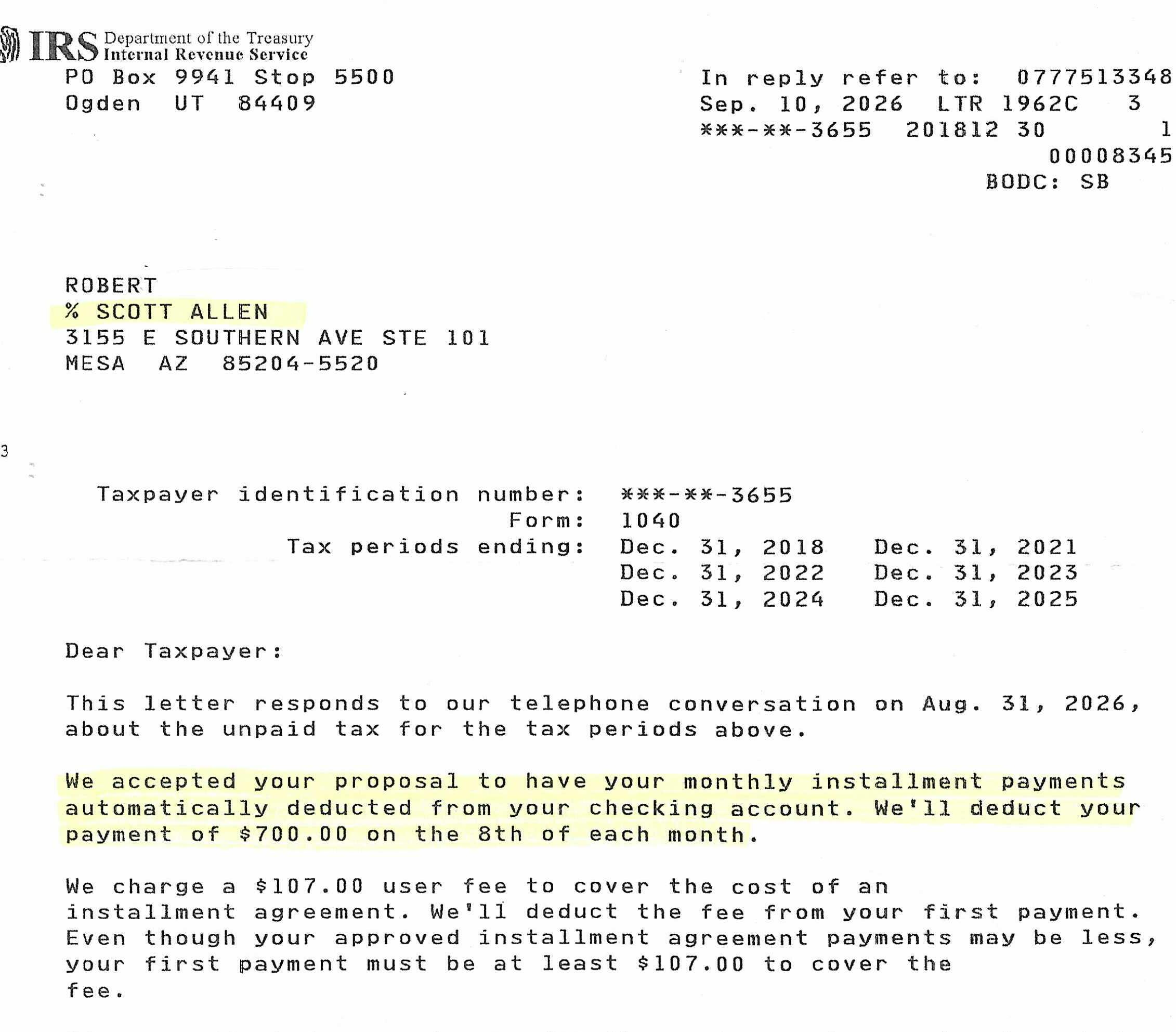
Robert had accumulated unfiled tax returns spanning six tax periods (December 31 of 2018, 2021, 2022, 2023, 2024, and 2025). As the years compounded, so did his stress. With unpaid tax liabilities looming across multiple tax periods, Robert faced severe risks, including potential wage garnishment, bank levies, and the filing of a Notice of Federal Tax Lien.

A Notice of Federal Tax Lien is a formal public document filed by the government to secure its interest in a taxpayer’s real estate or personal assets. Beyond clouding asset titles, a tax lien can severely damage personal and business credit ratings, making financing, leasing, or refinancing virtually impossible.

The Strategic Solution: Preparation, Representation, and Strategic Debt Structuring

Upon being retained under Power of Attorney, Scott Allen, EA executed a step-by-step resolution plan:

  1. IRS Representation via Power of Attorney: Scott assumed full legal representation before the IRS, taking over all direct communications and halting aggressive collection demands against Robert.

  2. Filing All Back Tax Returns: Scott prepared and filed all missing Form 1040 tax returns for the tax periods ending December 31, 2018, 2021, 2022, 2023, 2024, and 2025. By preparing accurate returns with all rightful tax deductions and credits, Robert’s true liability was established.

  3. Lien Prevention Strategy: IRS collection rules allow streamlined installment agreements without mandatory federal tax lien filings if the total unpaid debt is successfully negotiated and structured below $50,000. Scott structured Robert’s filings and debt settlement to bring the total debt safely below this key threshold.

  4. Negotiating an Approved IRS Direct Debit Installment Agreement: Following direct negotiations with the IRS (concluded via telephone consultation), Scott successfully secured an official IRS Installment Agreement acceptance letter (LTR 1962C issued on September 10, 2026).

The Outcome: A Sustainable $700/Month Plan and Complete Lien Protection

The IRS officially accepted Robert’s proposal for an affordable Direct Debit Installment Agreement, deducting $700.00 per month directly from his checking account on the 8th of each month, along with the standard $107.00 agreement user fee.

Because the total debt was structured safely under the $50,000 mark and placed into an automatic direct-debit payment plan, the IRS was prevented from filing a Federal Tax Lien against Robert. Robert achieved full tax compliance, protected his personal credit and property, and gained a clear, predictable path toward complete financial freedom.

Back Tax Return Help In Mesa Arizona

Back Tax Return Help In Mesa Arizona

Key Benefits of Having IRS Power of Attorney Representation

Many taxpayers do not realize that they do not have to speak directly to the IRS themselves. When executing an IRS Power of Attorney with an Enrolled Agent like Scott Allen:

  • No Direct IRS Contact Required: Taxpayers no longer need to endure frustrating hours on hold with the IRS or handle intimidating collection calls. All communications, notices, and settlement negotiations are handled directly by their licensed representative.

  • Immediate Protection: Once Power of Attorney is on file with the IRS Centralized Authorization File (CAF) unit, the IRS is legally required to route collection contacts through the representative.

  • Expert Negotiation Skills: An Enrolled Agent understands the Internal Revenue Manual (IRM), legal rights of taxpayers, and administrative relief programs, ensuring clients receive the absolute best settlement allowable by law.

Steps to Take If You Owe Back Taxes or Have Missing Returns

If you are currently struggling with unfiled tax returns or back tax debt in Mesa, Arizona, taking prompt action is the single most effective way to protect your financial future. Follow these essential steps:

  1. Stop Ignoring IRS Letters: IRS notices operate on strict timelines. Ignoring statutory notices of intent to levy or lien only accelerates enforcement actions.

  2. Avoid Unrealistic Quick-Fix Schemes: Be skeptical of any tax relief company promising guaranteed $0 settlements before analyzing your actual income and asset financials.

  3. Consult a Verified, Local Enrolled Agent: Schedule a consultation with a local practitioner like Scott Allen, EA at Tax Debt Advisors, Inc.

  4. Gather What You Have (or Let Your EA Retrieve Transcripts): Even if you lack complete tax records, a professional Enrolled Agent can obtain official IRS transcripts to complete back returns accurately.

  5. Establish a Compliant Resolution Plan: Whether through a streamlined installment agreement, currently not collectible status, or an offer in compromise (if truly qualified), moving into full compliance stops levies, liens, and severe penalties.

Take Back Control of Your Financial Future Today

Tax debt does not resolve itself, but with the right professional representation, it can be handled efficiently, affordably, and permanently. Scott Allen, EA of Tax Debt Advisors, Inc. brings decades of local expertise, dedicated representation, and proven strategies to taxpayers in Mesa, Arizona and surrounding areas.

By taking control, filing missing back tax returns, and negotiating a manageable payment plan—just as Scott did for Robert—you can protect your assets, prevent tax liens, and enjoy true peace of mind.

Contact Information:

Written by Scott Allen

Chandler AZ IRS Tax Help

IRS Tax Help in Chandler AZ: How Tax Debt Advisors Helped a Local Taxpayer Resolve an IRS Installment Agreement Issue

When taxpayers fall behind with the Internal Revenue Service, the problem can quickly become overwhelming. Unpaid taxes can accumulate over multiple years, interest and penalties can increase the balance, and IRS collection notices can create significant financial stress. For taxpayers in Chandler, Arizona, having a local tax professional who understands IRS collection procedures can make the process much easier to manage.

Scott Allen EA of Tax Debt Advisors, Inc., a locally owned Arizona tax resolution firm, recently represented a taxpayer named James in dealing with his IRS tax debt. The case demonstrates how professional IRS tax help in Chandler AZ can assist taxpayers who need to establish or modify an IRS payment arrangement and communicate with the IRS on their behalf.

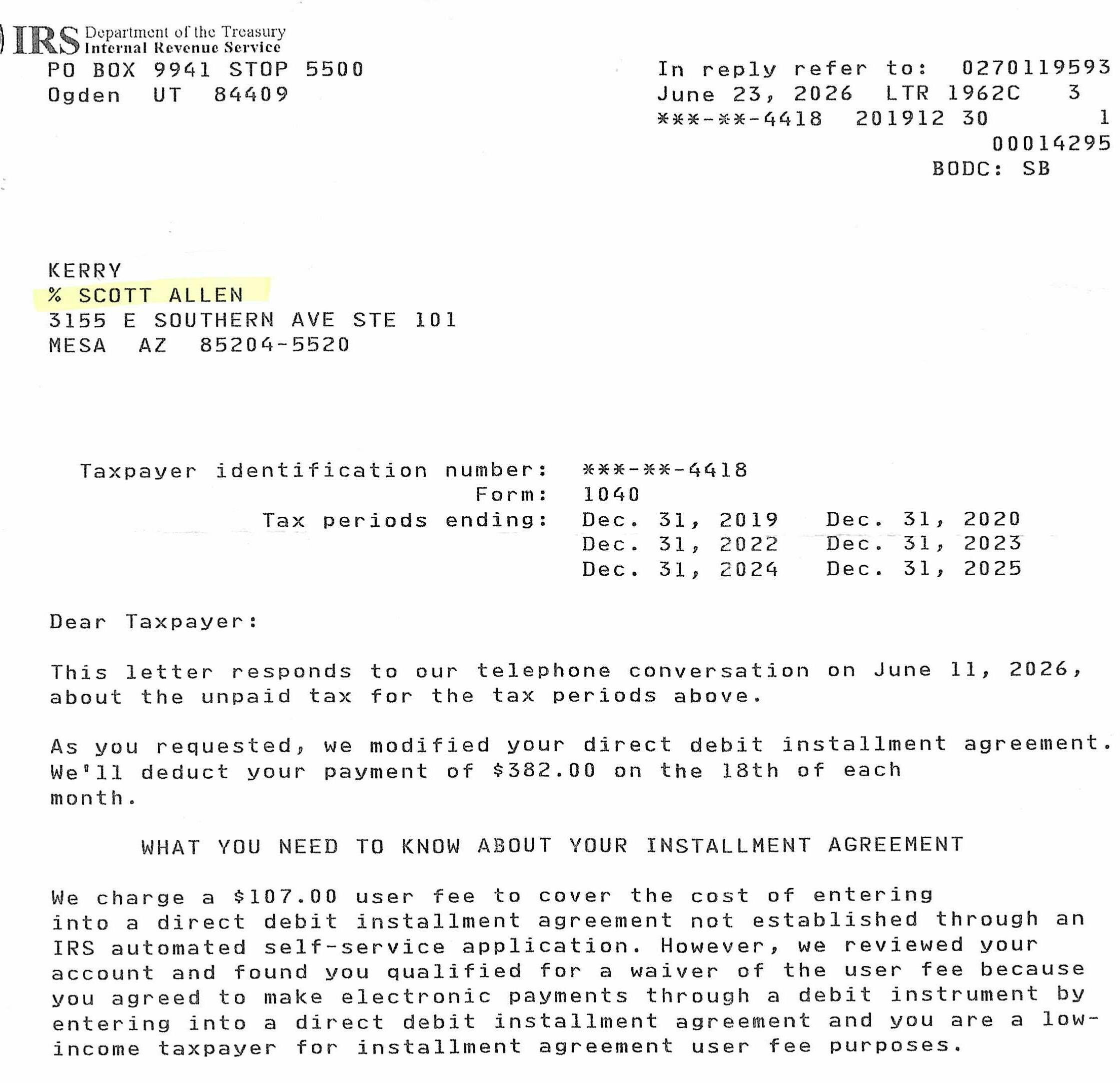
In James’s situation, Tax Debt Advisors worked directly with the IRS regarding unpaid individual income taxes covering multiple tax years. The IRS subsequently issued correspondence confirming that the taxpayer’s direct-debit installment agreement had been modified. Under the revised agreement, the IRS agreed to withdraw $360 per month on the 28th of each month.

For taxpayers struggling with IRS debt, an installment agreement can provide an important alternative to more aggressive collection actions.


IRS Tax Problems Can Become More Complicated Over Time

Many taxpayers initially believe that an unpaid tax balance is something they can resolve later. Unfortunately, waiting too long can make an IRS problem substantially more difficult.

Federal tax debt may continue to grow because of penalties and interest. At the same time, the IRS has significant collection authority. Depending on the circumstances, the IRS may pursue collection through methods such as:

  • Federal tax liens
  • Bank levies
  • Wage garnishments
  • Seizure of certain assets
  • Collection notices
  • Required payment arrangements
  • Other IRS enforcement actions

The IRS letter involved in James’s case specifically explained that failure to comply with an installment agreement could result in the agreement going into default or being terminated. The IRS also warned that enforcement action could potentially include filing a Notice of Federal Tax Lien or placing a levy on wages or bank accounts.

This is one reason obtaining IRS tax help in Chandler AZ can be valuable before a taxpayer’s situation reaches the enforcement stage.

A tax professional can review the taxpayer’s circumstances, communicate with the IRS and help determine what resolution strategy makes the most sense.


A Real-World IRS Installment Agreement Case

James had unpaid federal income tax obligations involving numerous tax periods. Rather than attempting to handle the IRS matter entirely on his own, James worked with Scott Allen EA of Tax Debt Advisors, Inc.

The IRS correspondence dated September 2026 confirms that Tax Debt Advisors had communicated with the IRS regarding the taxpayer’s installment agreement.

The letter states that the IRS responded to a telephone conversation concerning the unpaid tax for the applicable tax periods. Following that communication, the IRS modified the taxpayer’s direct-debit installment agreement.

The new payment amount was established at:

$360 per month

The IRS stated that the payment would be automatically deducted on the 28th of each month.

For a taxpayer dealing with years of unpaid tax obligations, having a predictable monthly payment can provide considerably more financial stability than facing unpredictable collection activity.

This case also illustrates an important point about IRS representation: sometimes the goal is not necessarily to eliminate the entire tax debt immediately. Instead, the appropriate solution may involve negotiating an affordable payment arrangement that allows the taxpayer to remain compliant while addressing the outstanding liability.

IRS Tax Help in Chandler AZ

IRS Tax Help in Chandler AZ


What Is an IRS Installment Agreement?

An IRS installment agreement is an arrangement that allows an eligible taxpayer to pay federal tax debt over time rather than paying the entire balance immediately.

For someone who cannot afford to pay the IRS in full, an installment agreement can be an important collection alternative.

However, getting an installment agreement is only part of the process.

The payment generally needs to be affordable and manageable for the taxpayer’s financial situation. The taxpayer also needs to remain in compliance with the terms of the agreement.

The IRS letter sent to James made this clear. The IRS explained that the taxpayer must meet all of the conditions of the installment agreement.

If the taxpayer fails to comply, the IRS may default or terminate the agreement and potentially resume collection activity.

That is why taxpayers should not simply assume that once an agreement has been established, the IRS problem is permanently over.


Why IRS Representation Can Make a Difference

One of the biggest advantages of working with an experienced tax resolution professional is having someone communicate directly with the IRS.

For many taxpayers, calling the IRS can be frustrating and time-consuming. Taxpayers may be placed on hold, transferred between departments, asked for financial information or told that additional documentation is required.

An enrolled agent can communicate with the IRS on behalf of a taxpayer when properly authorized.

Scott Allen EA of Tax Debt Advisors, Inc. specializes in helping taxpayers deal with IRS collection problems and federal tax debt. The firm can represent taxpayers before the IRS and help evaluate potential solutions based on the taxpayer’s circumstances.

For individuals searching online for IRS tax help in Chandler AZ, working with a local professional can provide the benefit of having someone familiar with IRS procedures available to help navigate the process.


The IRS Can Take Collection Action When Tax Debt Goes Unresolved

The IRS letter in James’s case provides a reminder that installment agreements come with responsibilities.

The correspondence warned that if the installment agreement were not maintained, the IRS could take enforcement action to collect the full amount of the tax liability.

Potential collection actions mentioned by the IRS include a Notice of Federal Tax Lien and a levy on wages or bank accounts.

A federal tax lien is different from a levy.

A lien is essentially the government’s legal claim against a taxpayer’s property as security for unpaid tax debt. A levy is an actual collection action in which the IRS can take property or rights to property, such as funds in a bank account or portions of wages, when legal requirements are met.

Because these collection tools can have serious financial consequences, taxpayers with unresolved IRS debt should take IRS correspondence seriously.


What Should a Taxpayer Do After Receiving an IRS Notice?

The first step is to carefully review the notice and determine exactly what the IRS is requesting.

Taxpayers should pay particular attention to:

  1. The tax years involved
  2. The amount of tax allegedly owed
  3. Any deadlines contained in the notice
  4. Whether the IRS is requesting payment
  5. Whether a payment arrangement already exists
  6. Whether additional financial information is required
  7. Whether collection enforcement is being threatened

If a taxpayer cannot afford to pay the IRS in full, ignoring the notice generally does not make the tax debt disappear.

Instead, the taxpayer may want to explore available IRS resolution options.

Depending on the facts, potential solutions can include an installment agreement, Currently Not Collectible status, an Offer in Compromise, penalty abatement or other tax resolution strategies.

Not every taxpayer qualifies for every option, which is why an individual financial review is important.


Tax Debt Advisors Provides Local IRS Tax Help

Tax Debt Advisors, Inc. is a local Arizona tax resolution firm represented by Scott Allen EA.

The firm helps taxpayers dealing with a variety of federal tax problems, including unfiled tax returns, IRS payment plans, tax liens, levies, wage garnishments and significant IRS balances.

For taxpayers searching for IRS tax help in Chandler AZ, Tax Debt Advisors provides representation for individuals who need professional assistance dealing with the IRS.

Rather than simply telling a taxpayer to call the IRS, professional representation can involve reviewing the taxpayer’s account, determining what the IRS is seeking, communicating with IRS personnel and helping pursue an appropriate resolution.

The firm’s local presence can also be particularly helpful for Arizona taxpayers who prefer to work with a tax professional familiar with the area rather than an anonymous national tax-resolution company.


James’s Case Shows the Importance of Taking Action

James’s situation is a good example of why taxpayers with IRS debt should not assume that there are no options.

The IRS had unpaid tax obligations involving multiple years. Instead of allowing the situation to continue without a plan, James obtained professional representation from Scott Allen EA of Tax Debt Advisors.

Tax Debt Advisors communicated with the IRS and helped modify the taxpayer’s direct-debit installment agreement.

The resulting IRS correspondence confirmed the new payment arrangement of $360 per month, with the payment scheduled for the 28th of each month.

While every taxpayer’s situation is different, the case demonstrates that an IRS problem can sometimes be addressed through negotiation and an appropriate payment arrangement.

Most importantly, taxpayers should understand that an IRS collection problem does not necessarily mean that the IRS will demand immediate payment of the entire balance if the taxpayer qualifies for an alternative resolution.


Finding IRS Tax Help in Chandler AZ

Taxpayers in Chandler and throughout the East Valley who are dealing with IRS debt should consider getting professional advice before ignoring IRS notices or allowing a payment arrangement to default.

The IRS has numerous collection tools available, but taxpayers may also have options for resolving their tax liabilities.

The appropriate solution depends on factors such as income, expenses, assets, tax balance, filing history and the taxpayer’s ability to pay.

For some taxpayers, an installment agreement may be the appropriate solution. For others, a different IRS resolution strategy may provide a better long-term outcome.

The important first step is understanding the taxpayer’s actual IRS situation.

Scott Allen EA and Tax Debt Advisors, Inc. help Arizona taxpayers evaluate their IRS problems and work toward practical solutions.


Contact Tax Debt Advisors for IRS Tax Help in Chandler AZ

James’s experience demonstrates why professional IRS representation can be valuable when dealing with long-standing federal tax debt.

After working with Scott Allen EA of Tax Debt Advisors, Inc., James’s direct-debit installment agreement was modified, resulting in a structured $360 monthly payment to the IRS.

For taxpayers dealing with unpaid federal taxes, IRS collection notices, payment problems, liens or levies, getting professional assistance may help prevent the situation from becoming even more serious.

Taxpayers searching for IRS tax help in Chandler AZ can contact Tax Debt Advisors, Inc. to discuss their IRS tax situation and learn what options may be available.

Tax Debt Advisors, Inc.
Scott Allen EA
Local Arizona IRS Tax Resolution Representation

Written by Scott Allen

IRS CP2000 Audit in Tempe AZ

Overcoming a Massive IRS Audit: How Scott Allen EA Erased Over $274,000 in Disputed Taxes for a Tempe Arizona Taxpayer

Receiving an official document from the Internal Revenue Service (IRS) is stressful for any taxpayer. However, opening an automated audit notice proposing that you owe nearly $300,000 in unpaid taxes, penalties, and interest is a life-altering event. For Kurt, an Arizona homeowner, this nightmare became a reality when the IRS audited his 2021 tax return.

The IRS claimed that Kurt owed a staggering $283,100.88 following an uncalculated real estate transaction. Recognizing that he needed expert local representation to fight an aggressive tax assessment, Kurt turned to Scott Allen EA at Tax Debt Advisors, Inc. Through targeted legal tax representation, strategic document preparation, and direct communication with IRS compliance officers, Scott Allen EA successfully contested the government’s findings—erasing $274,601.00 in tax liabilities and penalties.

Below is an in-depth breakdown of how this massive tax error occurred, how Scott Allen EA resolved a complex Tempe AZ IRS CP2000 audit, and what Arizona taxpayers should do when faced with an unexpected IRS notice or back tax burden.

The Background: A Primary Residence Sale and an IRS System Breakdown

In 2021, Kurt sold his primary residence after having owned and lived in the home as his principal residence for more than two years. Under federal tax law—specifically Internal Revenue Code (IRC) Section 121—taxpayers who sell their primary home are eligible to exclude up to $250,000 (for single filers) or $500,000 (for married couples filing jointly) of capital gains from their taxable income, provided they meet the ownership and use tests.

When a real estate transaction closes, the title company or settlement agent typically issues an IRS Form 1099-S (Proceeds From Real Estate Transactions) reporting the gross sales proceeds to the IRS.

When Kurt’s 2021 tax return was filed, the real estate sale was either omitted or reported without the proper supporting schedules attached. Because the IRS receives an electronic copy of Form 1099-S directly from the closing agent, its automated computer matching system flagged a discrepancy between the income reported by Kurt and the gross proceeds reported on Form 1099-S.

The Problem with IRS Automated Under reporter (AUR) Computers

When the IRS automated system detects an unmatched Form 1099-S, it makes a critical—and often devastating—default assumption: it assumes your cost basis in the property is zero.

Instead of taxing the actual profit or capital gain (and factoring in the Section 121 primary home exemption), the IRS computer treats the entire gross proceeds of the home sale as 100% taxable income. Furthermore, it layers on:

  • Capital Gains Taxes on the full gross sale price.

  • Net Investment Income Tax (NIIT) triggered by the artificially inflated income.

  • Accuracy-Related Penalties under IRC § 6662 for underreporting income.

  • Accumulated Interest retroactively applied from the original tax due date.

This computer-generated error culminated in an IRS CP2000 notice charging Kurt with an astronomical bill of $283,100.88.

Resolving a Tempe AZ IRS CP2000 Audit: The Strategy

When facing a Tempe AZ IRS cp2000 audit, attempting to call the IRS customer service line without professional representation often leads to frustration, lost documentation, or improper responses that result in statutory notices of deficiency. Kurt chose to retain Scott Allen EA of Tax Debt Advisors, Inc. to handle the matter on his behalf.

As an Enrolled Agent (EA) licensed by the United States Department of the Treasury, Scott Allen holds unrestricted rights to represent taxpayers before all administrative levels of the Internal Revenue Service.

Step 1: Securing Power of Attorney and Reviewing Tax Records

Scott Allen EA immediately filed a Power of Attorney (Form 2848) with the IRS. This established Tax Debt Advisors, Inc. as Kurt’s official legal representative, halting direct IRS contacts with Kurt and granting Scott access to Kurt’s complete IRS wage and income transcripts.

Step 2: Protesting the CP2000 Notice with Substantive Evidence

Scott Allen EA reviewed the original 2021 filing and verified that Kurt indeed satisfied the two-out-of-five-year ownership and use rules required under Section 121. To properly protest the CP2000 notice, Scott:

  1. Re-computed the true cost basis of the property, including original purchase price, closing costs, and qualified capital improvements.

  2. Formulated a corrected tax filing utilizing Schedule D (Capital Gains and Losses) and Form 8949 (Sales and Other Dispositions of Capital Assets).

  3. Formally claimed the Section 121 Primary Residence Exclusion to offset the capital gain.

  4. Drafted a formal protest package accompanied by proof of residency (utility bills, property deeds, and settlement statements) sent directly to the IRS Automated Under reporter unit.

Step 3: Negotiating Penalty Relief and Correction

Because the IRS had assessed hefty accuracy-related penalties on top of the proposed tax, Scott Allen EA successfully argued that Kurt’s filing error was not due to willful neglect or intentional fraud, successfully eliminating the failure-to-pay and accuracy penalties associated with the home sale.

The Results: Erasing $274,601.00 from the IRS Bill

After receiving and processing the protest documentation submitted by Scott Allen EA, the IRS formally conceded the audit issue. On August 3, 2026, the IRS issued official confirmation via IRS Notice CP21A.

Financial Category Original IRS Assessment Adjusted Amount After Representation Net Difference / Savings
Gross Amount Demanded $283,100.88 — —
Direct Tax Reduction — -$228,814.00 $228,814.00 Saved
Accuracy-Related Penalty Reduction — -$45,787.00 $45,787.00 Saved
Final Amount Due — $10,653.73 $274,601.00 Total Relief

Instead of facing financial ruin over a $283,100 tax bill, Kurt’s balance was reduced down to a small, manageable tax item of $10,653.73. The IRS adjusted both the investment gains/losses and the net investment income tax, reversing all wrongfully assessed penalties.

Tempe AZ IRS CP2000 Audit

Tempe AZ IRS CP2000 Audit

What Taxpayers Need to Know About IRS Notice CP2000 & CP21A

Understanding the progression of an IRS audit notice is essential for any property owner or small business in Arizona:

  1. IRS Notice CP2000: This is an Inquiry, not a formal bill. It proposes changes to your tax liability based on matching discrepancies between your return and third-party documents (Forms 1099, W-2, 1099-B, 1099-S).

  2. Response Deadline: CP2000 notices generally give taxpayers 30 days to respond. Ignoring a CP2000 notice results in the IRS issuing a Notice of Deficiency (CP3219A), which grants the IRS legal authority to assess the tax automatically.

  3. IRS Notice CP21A: This notice is sent after the IRS accepts an amendment or protest to a previously adjusted account. It outlines the updated balance owed after applying all tax decreases and penalty removals.

Common Triggers for an IRS CP2000 Notice

  • Unreported Real Estate Sales (Form 1099-S): As in Kurt’s case, failing to report home sales or commercial property dispositions.

  • Cryptocurrency and Stock Trading (Form 1099-B): Trading stock or crypto where brokerages report gross proceeds without reporting cost basis to the IRS.

  • Independent Contractor Income (Form 1099-NEC / 1099-K): Discrepancies in gig economy earnings or merchant payment processing totals.

  • Unreported Retirement Distributions (Form 1099-R): Early withdrawals or 401(k) rollovers that were not properly declared as non-taxable events.

Complete Tax Resolution Services by Tax Debt Advisors, Inc.

Resolving a Tempe AZ IRS CP2000 audit is only one aspect of what Tax Debt Advisors, Inc. handles. Since 1977, Scott Allen EA and the team at Tax Debt Advisors, Inc. have assisted thousands of local taxpayers across Tempe, Mesa, Chandler, Gilbert, Phoenix, and Scottsdale in navigating complex IRS tax liabilities.

Whether you are dealing with a single audited return or years of unfiled back taxes, Tax Debt Advisors, Inc. offers comprehensive tax services:

1. Preparing and Filing Back Tax Returns

If you have unfiled tax returns from previous years, the IRS can file a Substitute for Return (SFR) on your behalf. Like Kurt’s CP2000, an SFR return grants you zero deductions, zero exemptions, and maximum tax rates. Tax Debt Advisors, Inc. prepares and files accurate back tax returns to replace SFRs, instantly lowering tax debts.

2. Settling IRS Debts Through Fresh Start Programs

When back taxes are legitimately owed, Scott Allen EA evaluates clients for IRS debt settlement options, including:

  • Offer in Compromise (OIC): Settling your full tax debt for a fraction of what you owe if paying the full balance would cause severe financial hardship.

  • Installment Agreements: Structuring manageable, affordable monthly payment plans that keep the IRS collection machine at bay.

  • Currently Not Collectible (CNC) Status: Halting all IRS collection activities, wage garnishments, and bank levies for taxpayers experiencing temporary financial hardship.

3. Ending Wage Garnishments and Bank Levies

If the IRS has issued a Form 668-W to garnish your wages or levied your bank accounts, Tax Debt Advisors, Inc. works immediately to negotiate release orders and establish a compliant resolution path.

Get Local Representation for Your IRS Audit or Tax Debt

You do not have to fight the IRS alone. Automated computer letters like the CP2000 notice are frequently inaccurate, and accepting the IRS’s initial figures without professional review can cost you tens or hundreds of thousands of dollars.

If you have received an IRS audit letter, notice of underreporting, or are facing back tax issues, contact Scott Allen EA at Tax Debt Advisors, Inc. today.

  • Firm: Tax Debt Advisors, Inc.

  • Lead Representative: Scott Allen EA

  • Address: 3155 E Southern Ave Ste 101, Mesa, AZ 85204

  • Services: CP2000 Audit Representation, Back Tax Filing, IRS Debt Settlement, Wage Garnishment Release

Take control of your tax situation and ensure your rights are protected by contacting a local, experienced Enrolled Agent.

Written by Scott Allen

Successful IRS Settlement for David in Mesa AZ

Resolving Back Taxes in Mesa, AZ: How Scott Allen, EA Delivers Proven IRS Relief

Facing unfiled tax returns or an overwhelming balance of back taxes owed to the Internal Revenue Service (IRS) can feel like carrying an impossible burden. For residents and small business owners throughout Mesa, Arizona, and the broader East Valley, receiving a letter from the IRS often brings immediate stress, uncertainty, and fear of aggressive collection actions like bank levies, wage garnishments, or federal tax liens. However, tax problems rarely resolve themselves with time—in fact, penalties and interest accumulate rapidly, turning a manageable problem into a severe financial crisis.

Fortunately, East Valley taxpayers in Arizona do not have to navigate the complex maze of the IRS tax code alone. For nearly five decades, Tax Debt Advisors, Inc. has served as a trusted beacon of support and financial defense for individuals and businesses struggling with unpaid taxes. Led by Scott Allen, EA, this local, family-owned firm brings decades of hands-on negotiation experience, deep technical expertise, and an unwavering commitment to transparent, honest service.

With more than 116,000 IRS tax debts successfully resolved since 1977, Tax Debt Advisors, Inc. continues to demonstrate how strategic, personalized tax representation can transform overwhelming debt into clear, structured resolution.

The Escalating Burden of IRS Back Taxes and Unfiled Returns

For many individuals living in Mesa, Chandler, Gilbert, Tempe, and Apache Junction, falling behind on tax obligations happens faster than anticipated. Life events such as unexpected job losses, medical emergencies, business downturns, or personal disruptions can cause taxpayers to miss filing deadlines or miss annual payments.

Once a tax return is missed or a balance goes unpaid, the IRS initiating formal collection processes is only a matter of time. Common complications faced by local taxpayers include:

  • Accumulating Penalties and Interest: The IRS assesses separate penalties for failure to file and failure to pay, both of which accrue interest compounded daily until the balance is cleared.

  • Wage Garnishments: The IRS holds authority to legally seize a portion of a taxpayer’s paycheck directly from their employer without needing a court order.

  • Bank Levies: Tax authorities can freeze and seize funds directly from personal or business bank accounts to satisfy back tax liabilities.

  • Federal Tax Liens: A public notice filed by the IRS that attaches to real estate and personal property, significantly damaging credit ratings and complicating property sales or refinancing.

Attempting to resolve these complex legal and financial matters independently often leads to frustration or agreeing to payment arrangements that are financially unsustainable. This is where working with a dedicated Enrolled Agent (EA)—a tax professional recognized by the U.S. Department of the Treasury to represent taxpayers before all administrative levels of the IRS—makes a substantial difference.

Real Results: A Recent Case Study in IRS Debt Resolution

To understand how effective representation works, consider a real-world case recently handled by Scott Allen, EA.

A local taxpayer—referred to here as David—found himself facing substantial unpaid federal tax liabilities spanning multiple tax years: 2019, 2020, 2023, and 2024. Facing mounting pressure from federal collection mechanisms, David turned to Tax Debt Advisors, Inc. for expert guidance and representation.

Scott Allen, EA immediately stepped in as the official representative, stepping between the taxpayer and the IRS to halt aggressive collection tactics and review the exact underlying tax obligations. By carefully analyzing David’s financial posture, income streams, and essential living expenses, Scott prepared and submitted a structured proposal designed to bring the multi-year balance into full compliance while protecting David’s personal finances.

The Successful Settlement Outcome

Following precise negotiations with IRS officials, Scott Allen, EA successfully negotiated a formal Direct Debit Installment Agreement (as documented in IRS Letter 1962C). Under the terms of the approved agreement:

  • Comprehensive Multi-Year Coverage: The settlement resolved all outstanding balances across four separate tax periods (December 31, 2019; December 31, 2020; December 31, 2023; and December 31, 2024).

  • Predictable, Manageable Monthly Payments: Rather than risking immediate account levies or lump-sum collection demands, the IRS accepted an affordable monthly payment plan of $550.00, automatically deducted on the 28th of each month.

  • Restored IRS Compliance: By establishing this official installment plan, the client moved out of active IRS enforcement and back into full tax compliance, protecting his bank accounts and income from further enforcement.

This successful outcome illustrates a core truth about tax resolution: when back taxes are addressed proactively with professional representation, realistic solutions exist that allow taxpayers to settle their accounts while maintaining their quality of life.

Successful IRS Settlement by Tax Debt Advisors, Inc

Why Choose Tax Debt Advisors, Inc.?

In the tax relief industry, national “call center” settlement firms frequently promise unrealistic outcomes through aggressive radio and television ads, only to deliver minimal results at high upfront costs. Tax Debt Advisors, Inc. stands out by taking a fundamentally different approach.

1. Honest, Local, Family-Owned Service

Tax Debt Advisors, Inc. is an honest, local, family-owned business deeply rooted in the East Valley community. When clients contact the firm, they work directly with experienced professionals like Scott Allen, EA, who personally reviews their case, explains options candidly, and handles negotiations directly with federal agents.

2. A Legacy of Success Since 1977

Experience is paramount when navigating complex IRS procedures. Tax Debt Advisors, Inc. has been operating continuously since 1977. Over those nearly five decades, the firm has resolved over 116,000 IRS tax debts, equipping them with an unmatched understanding of IRS administrative policies, relief programs, and negotiation protocols.

3. Clear, Straightforward Communication

Dealing with tax stress requires clarity, not legal jargon or false promises. Scott Allen, EA prioritizes open communication, keeping clients informed at every stage of the process—from the initial consultation through final IRS approval.

Common IRS Relief Pathways Managed by Scott Allen, EA

Depending on a taxpayer’s specific financial circumstances and tax history, several administrative options exist to resolve unpaid back taxes or unfiled returns:

  1. Installment Agreements: Setting up structured, manageable monthly payment programs tailored to fit reasonable living expenses while staying compliant.

  2. Offer in Compromise (OIC): An agreement with the IRS that allows qualifying taxpayers to settle their tax liabilities for less than the full amount owed, based on financial hardship and doubt as to collectibility.

  3. Currently Not Collectible (CNC) Status: Temporarily halting active collection activities if the taxpayer is currently unable to meet basic living costs while making payments.

  4. Penalty Abatement: Requesting the removal or reduction of penalties due to reasonable cause or first-time penalty relief rules.

  5. Filing Unfiled Tax Returns: Preparing accurate past-due returns to ensure taxpayers receive all allowable deductions, tax credits, and adjustments prior to settlement negotiations.

Take the First Step Toward IRS Tax Relief Today

Ignoring IRS notices or delaying action on unfiled tax returns only increases penalties, interest, and the risk of enforcement action. Partnering with a proven, local Enrolled Agent provides immediate protection, peace of mind, and a clear path toward financial recovery.

If you or your business are facing unfiled tax returns or back taxes owed to the IRS in Mesa, Chandler, Gilbert, or across the East Valley, contact Scott Allen, EA at Tax Debt Advisors, Inc. today.

Let a trusted local family business put over 49 years of tax resolution experience to work for you. Reach out today to schedule a consultation and take back control of your financial future.

Written by Scott Allen

Glendale AZ IRS Tax Relief Advocate

Navigating Back Tax Liabilities: How a Glendale AZ IRS Tax Relief Advocate Secures Financial Resolution

Facing a mounting federal tax liability is one of the most stressful financial situations an individual or business owner can experience. The Internal Revenue Service (IRS) possesses extraordinary collection powers, ranging from automated statutory liens to aggressive levies targeting wages, bank accounts, and personal assets. For taxpayers residing in the West Valley, securing a dedicated, local Glendale AZ IRS tax relief advocate is often the critical turning point in transforming an unmanageable financial crisis into a structured, fully compliant resolution plan.

Tax Debt Advisors Inc., a premier family-owned tax resolution firm serving Arizona communities since 1977, specializes in providing this essential advocacy. Led by Scott Allen, EA (Enrolled Agent), the firm consistently represents taxpayers who have fallen behind on their federal compliance obligations. By combining intensive technical knowledge of the Internal Revenue Manual (IRM) with a personal, solution-oriented approach, Scott Allen, EA works tirelessly to shield his clients from aggressive enforcement actions while constructing sustainable negotiation frameworks with the federal government.

The Critical Importance of Local Advocacy: A Real-World Success Story

To understand the practical impact of engaging a seasoned Glendale AZ IRS tax relief advocate, one can look to a recent case successfully handled by Scott Allen, EA for his client, Tim. Tim discovered himself facing a severe tax vulnerability regarding his Form 1040 individual income tax return for the tax period ending December 31, 2023. Unpaid back tax debt quickly compounds due to failure-to-file penalties, failure-to-pay penalties, and daily compounding statutory interest, rendering the total balance due seemingly impossible to resolve without professional intervention.

Recognizing the urgency of his situation, Tim reached out to Scott Allen, EA to serve as his direct representative and advocate before the IRS. Upon taking the case, Scott Allen, EA immediately established formal representation, effectively routing all communications away from Tim’s home and directly into the professional office of Tax Debt Advisors Inc. This crucial first step provided Tim with immediate peace of mind, ensuring he would no longer have to endure stressful phone calls or intimidating automated letters from revenue agents.

Case Study Profile: Tim’s IRS Resolution

  • Taxpayer: Tim

  • Authorized Representative: Scott Allen, EA (Tax Debt Advisors Inc.)

  • Tax Form Involved: Form 1040 (Individual Income Tax Return)

  • Tax Period Settled: Year Ending December 31, 2023

  • Negotiation Date: May 29, 2026

  • IRS Acceptance Notice: Letter 1962C (Issued June 09, 2026)

  • Resolution Outcome: Direct Debit Installment Agreement (DDIA) at $750.00 per month

Following a comprehensive review of Tim’s financial profile, compliance status, and historical data, Scott Allen, EA initiated detailed verbal and written negotiations with the IRS. On May 29, 2026, during an intensive administrative conference with the IRS collection division, Scott Allen, EA successfully negotiated a formal resolution for Tim’s back IRS tax debt. The IRS formally codified this agreement in an official IRS Letter 1962C, dated June 9, 2026, confirming the approval of a sustainable, direct debit installment agreement structured at exactly $750.00 per month, scheduled for automated deduction on the 16th of each month.

GLENDALE AZ IRS TAX RELIEF ADVOCATE

GLENDALE AZ IRS TAX RELIEF ADVOCATE

Deconstructing the Direct Debit Installment Agreement (DDIA)

For many struggling individuals, an outright lump-sum payment of back tax debt is an impossibility. In such circumstances, a qualified Glendale AZ IRS tax relief advocate will evaluate structured payment alternatives. While some taxpayers hope for an immediate Offer in Compromise (OIC), the reality of IRS administrative guidelines is that an installment agreement is often the most legally sound, accessible, and protective strategy available depending on a taxpayer’s reasonable collection potential.

Among the various payment structures recognized by the IRS, the Direct Debit Installment Agreement (DDIA) represents an exceptional option for taxpayers who qualify. Under a DDIA, the IRS automatically processes the agreed-upon monthly payment directly from the taxpayer’s designated checking account. This mechanism offers several significant advantages over traditional payment methods:

1. Elimination of User Error and Avoidance of Default Risk

One of the primary reasons standard installment agreements fail is administrative oversight. If a taxpayer forgets to mail a check, experiences a postal delay, or fails to log into the Electronic Federal Tax Payment System (EFTPS) on time, the IRS can quickly issue a notice of intent to default the agreement. A defaulted installment agreement triggers immediate reinstatement fees and exposes the taxpayer once again to active levies and liens. By utilizing a direct debit mechanism, the transaction executes automatically on a specific day each month—such as the 16th, as negotiated in Tim’s case—minimizing the risk of human error.

2. Waiver or Reduction of IRS User Fees

The IRS charges an administrative user fee to establish any payment program. However, federal regulations actively incentivize the use of automated payment channels. Setting up a standard installment agreement via mail or telephone carries a substantially higher administrative fee than a Direct Debit Installment Agreement. For qualifying individuals, choosing the direct debit pathway lowers the upfront friction and keeps more capital in the taxpayer’s pocket.

3. Mitigation of Future Lien Filings

Federal tax liens can severely degrade a taxpayer’s personal creditworthiness, complicate real estate transactions, and impair professional licensing. In many scenarios, a skilled Glendale AZ IRS tax relief advocate can leverage a DDIA configuration to avoid the initial filing of a Notice of Federal Tax Lien, or can petition for a formal tax lien withdrawal once specific criteria are met (such as maintaining a consistent repayment history and staying under certain liability thresholds). This is a vital defensive benefit that an experienced Enrolled Agent can navigate.

The Foundation of Relief: Filing Back Tax Returns

A fundamental rule of federal tax controversy is that the IRS will completely refuse to negotiate any debt settlement, installment agreement, or hardship status unless the taxpayer is in full compliance with their tax filing obligations. The IRS defines a taxpayer as “compliant” when all required tax returns for the past six consecutive years have been accurately prepared and processed.

Scott Allen, EA specializes heavily in the meticulous reconstruction and filing of back tax returns. Many taxpayers fall into non-compliance because they lack organized financial documentation, missing key forms such as W-2s, 1099s, or 1098s. As a seasoned professional, Scott Allen, EA can secure official IRS transcripts and transcripts of account, allowing his team to reconstruct missing tax years with precision. By ensuring that all legal deductions, exemptions, and business expenses are fully accounted for, Scott Allen, EA prevents the IRS from over-assessing a taxpayer’s liability via a harmful Substitute For Return (SFR), which the IRS routinely files when a taxpayer fails to submit their own paperwork.

Why Choose a Local, Family-Owned Arizona Firm?

The tax resolution industry is unfortunately saturated with national “tax relief mills” that make unrealistic promises over television or radio advertisements. These out-of-state entities routinely demand massive, non-refundable upfront retaining fees, only to assign the file to an anonymous, unbacked customer service representative who possesses no intimate knowledge of the taxpayer’s local reality. Often, these national operations fail to deliver results, leaving the taxpayer in a worse financial position than when they started.

In stark contrast, Tax Debt Advisors Inc. stands as a pillar of trust in the local community. Operating as a family-owned business for nearly five decades out of its permanent physical location in Mesa, Arizona, the firm delivers localized, highly personalized representation. When an individual hires Scott Allen, EA, they are securing a direct professional relationship with a credentialed Enrolled Agent who is fully licensed to practice directly before the IRS in all administrative matters. Clients are treated as neighbors rather than numbers, experiencing clear transparency, legal honesty, and realistic strategic options tailored directly to their personal or business financial constraints.

Take the First Step Toward IRS Resolution Today

If you or someone you know is struggling with unfiled back tax returns, outstanding federal liabilities, or threatening letters from the IRS, do not wait until a bank account levy or a wage garnishment takes place. Early intervention is the absolute key to achieving a successful administrative negotiation like the settlement achieved for Tim.

Scott Allen, EA offers a completely free initial consultation to review your circumstances, assess your outstanding compliance needs, and outline a clear, defensive roadmap toward tax resolution. Contact Tax Debt Advisors Inc. today to see how a dedicated Glendale AZ IRS tax relief advocate can restore your financial security and bring your IRS tax problems to a definitive end.

Written by Scott Allen

Chandler AZ IRS Tax Relief Advocate

Resolving Back Tax Debt: How a Chandler AZ IRS Tax Relief Advocate Secured a Currently Not Collectible Settlement for Ruben

Facing a mountain of back tax debt can feel like carrying an impossible weight. For many individuals, the constant fear of IRS enforcement actions—such as wage garnishments, bank levies, or federal tax liens—creates a state of perpetual anxiety. When tax notices pile up, the natural instinct can be to ignore them, but the Internal Revenue Service has extensive powers to collect what is owed. Fortunately, taxpayers do not have to face the federal government alone. Working with an experienced Chandler AZ IRS tax relief advocate like Scott Allen EA of Tax Debt Advisors Inc can transform a seemingly hopeless financial crisis into a structured, manageable resolution.

A recent success story involving a client named Ruben highlights exactly how effective professional tax representation can be. Ruben was facing a substantial tax burden spanning multiple years, but through diligent intervention, Scott Allen EA successfully negotiated a life-changing settlement: a Currently Not Collectible (CNC) status. This blog post explores Ruben’s case, details the specialized services provided by Tax Debt Advisors Inc, and explains why Currently Not Collectible status is an exceptional relief option for eligible taxpayers.

The Case Study: Ruben’s Path to IRS Relief

To understand the real-world impact of dedicated tax representation, one only needs to look at the official IRS correspondence received by Ruben’s power of attorney. In the accompanying document, titled Chandler AZ IRS Tax Relief Advocate, the IRS formally outlines the resolution achieved by Scott Allen EA.

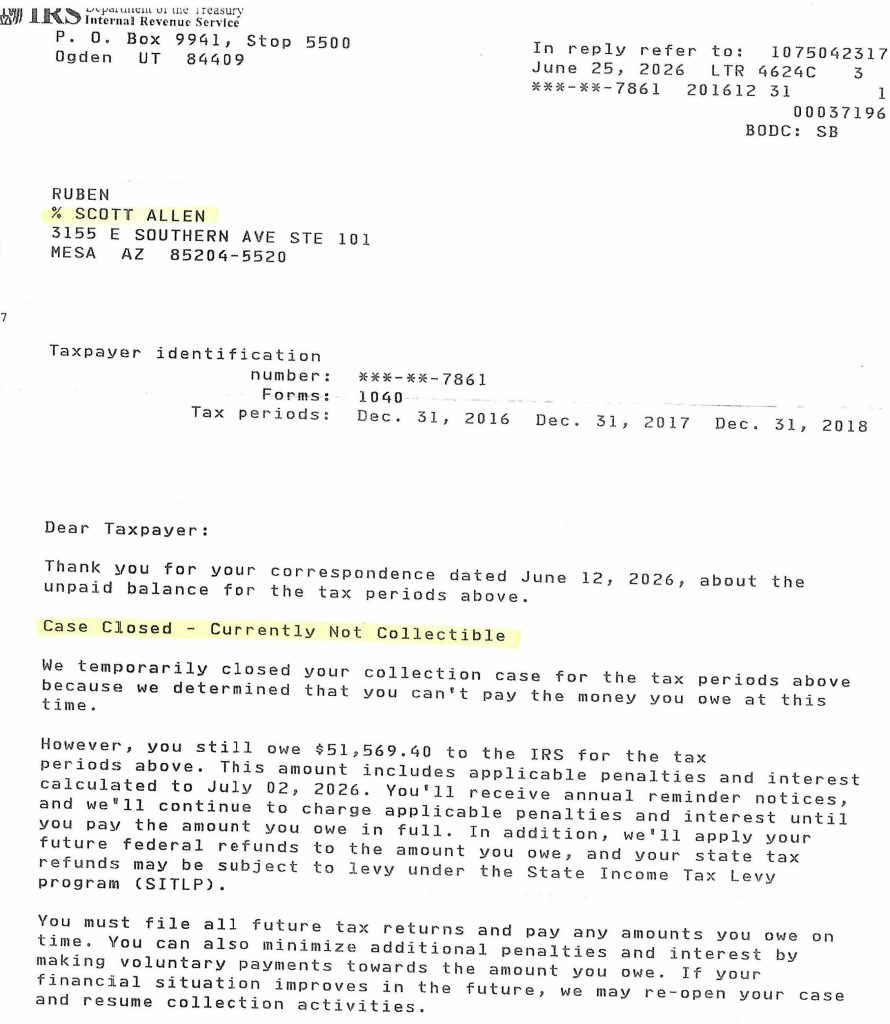
As shown, the IRS issued a letter on June 25, 2026, explicitly stating:

Case Closed – Currently Not Collectible

“We temporarily closed your collection case for the tax periods above because we determined that you can’t pay the money you owe at this time.”

The document reveals that Ruben owed a total of $51,569.40 to the IRS, a balance calculated through July 02, 2026. This extensive debt accumulated over three distinct tax periods ending on December 31, 2016, December 31, 2017, and December 31, 2018.

For years, this massive liability of over $51,000 hung over Ruben’s head. The interest and penalties alone were continuously inflating the balance, making it completely impossible for him to catch up under his current financial circumstances. By stepping in as Ruben’s dedicated Chandler AZ IRS tax relief advocate, Scott Allen EA was able to present a comprehensive financial analysis to the IRS, proving that forced collection would cause severe economic hardship. As a result, the IRS agreed to halt all active collection efforts, closing the case under Currently Not Collectible status and providing Ruben with immediate peace of mind.

Chandler AZ IRS Tax Relief Advocate

Chandler AZ IRS Tax Relief Advocate

The Critical First Step: Filing Back Tax Returns

Before any settlement or hardship program can be negotiated with the IRS, a taxpayer must achieve “tax compliance.” The IRS will strictly refuse to enter into any settlement negotiations—whether it is an Installment Agreement, an Offer in Compromise, or Currently Not Collectible status—if there are missing tax returns.

Scott Allen EA specializes in helping clients look backward, gather historical financial records, and accurately file missing back tax returns. In many cases, when a taxpayer falls behind on filing, the IRS may step in and file a Substitute for Return (SFR) on their behalf. An SFR is rarely favorable to the taxpayer because the IRS calculates the tax owed using the highest possible tax rates without factoring in standard deductions, business expenses, or dependents.

By systematically reviewing Ruben’s past income records, Scott Allen EA ensured that all returns for the 2016, 2017, and 2018 tax periods were legally filed and accurate. Filing these unfiled returns establishes the true base liability, which is the foundational starting point for negotiating IRS debts. Without this specialized preparation work, the IRS would have continued aggressive automated collections.

Understanding Currently Not Collectible (CNC) Status

Many taxpayers are unfamiliar with Currently Not Collectible status, often believing that their only options are to pay the full balance immediately or file for bankruptcy. However, CNC status is a highly effective administrative remedy built into the IRS tax code designed specifically for individuals experiencing genuine financial hardship.

What is CNC Status?

When the IRS places an account into Currently Not Collectible status (specifically under IRS Status Code 53), it means the agency has reviewed the taxpayer’s income, assets, and necessary living expenses and concluded that the taxpayer cannot afford to make any monthly payments toward their tax debt.

Why It Is a Great Option for Many Taxpayers

For those who qualify, achieving CNC status provides several profound benefits:

  • Immediate Cessation of Collection Activity: Once approved, the IRS immediately stops all aggressive collection tactics. This means no active wage garnishments, no bank account levies, and no threatening collection phone calls or letters.

  • Protection of Essential Income: The IRS utilizes strict national and local standards to determine what constitutes a necessary living expense (housing, utilities, food, transportation, and healthcare). CNC status ensures that 100% of the taxpayer’s income goes toward maintaining their household and surviving, rather than being seized by the government.

  • Running the Clock on the Statute of Limitations: This is perhaps the most significant, yet overlooked, benefit of CNC status. The IRS generally has a strict 10-year statutory period to collect back taxes, known as the Collection Statute Expiration Date (CSED). When an account is placed in Currently Not Collectible status, the 10-year clock does not stop ticking. If a taxpayer remains in CNC status until the 10-year expiration date passes, the tax debt is legally wiped out forever, and the IRS can never collect it.

As noted in the above document Chandler AZ IRS Tax Relief Advocate, the IRS will continue to apply future federal refunds to the outstanding balance and will send an annual reminder notice, but the core relief—the total halt on active financial collections—remains firmly in place as long as the taxpayer’s financial situation does not significantly improve.

Why Professional Representation Matters

Navigating the internal revenue manual and presenting a financial disclosure packet (such as Form 433-A or Form 433-F) requires precise professional expertise. The IRS agents are trained to maximize collection potential, and minor errors in listing expenses can result in a denial of hardship status.

Scott Allen EA of Tax Debt Advisors Inc brings decades of family-owned firm experience to the table, dating back to the company’s establishment in 1977. As an Enrolled Agent (EA), Scott holds the highest credential awarded by the IRS, giving him unrestricted rights to represent taxpayers before all administrative levels of the Internal Revenue Service.

When fighting for clients like Ruben, Scott Allen EA acts as a true shield. He manages all direct communications with the IRS, structures the necessary financial documentation perfectly, and advocates aggressively to ensure his clients get the absolute best legal resolution available under tax law.

Take the First Step with a Free Consultation

If you are buried under back taxes, dealing with unfiled tax returns, or terrified of an impending IRS levy, remember that there are viable legal paths forward. Ruben’s case proves that even a massive debt of $51,569.40 across multiple years can be successfully resolved when handled by a qualified professional.

Do not wait for the IRS to take control of your bank accounts or paycheck. Scott Allen EA offers a free initial consultation to review your specific tax situation, analyze your back tax liabilities, and map out a clear, custom strategy for relief. Contact Tax Debt Advisors Inc today to speak with a dedicated IRS tax relief advocate near Chandler AZ and take the first step toward reclaiming your financial freedom.

Written by Scott Allen

Phoenix AZ IRS Tax Relief Advocate

Phoenix AZ IRS Tax Relief Advocate: How Scott Allen EA Resolved Multi-Year Tax Liabilities for Randy

Navigating the complex labyrinth of the Internal Revenue Service (IRS) is a daunting challenge for any taxpayer, particularly those facing multi-year unfiled tax returns and escalating collection notices. When back taxes stack up over consecutive years, the combination of compounding penalties, mounting statutory interest, and aggressive federal enforcement mechanisms can quickly turn a manageable financial problem into an overwhelming crisis. For individuals caught in this high-stress scenario, securing the services of a certified Phoenix AZ IRS tax relief advocate is often the critical turning point needed to reclaim financial stability and piece together a viable resolution plan with the federal government.

Recently, a local taxpayer named Randy found himself facing this precise dilemma. With unpaid liabilities stretching across five separate tax periods—specifically 2017, 2021, 2022, 2023, and 2024—Randy was under immense pressure. Paralyzed by the scale of his tax exposure and the constant threat of enforced collection actions such as bank levies, wage garnishments, and federal tax liens, he recognized the necessity of expert intervention. Randy turned his case over to Scott Allen EA of Tax Debt Advisors Inc., an established family-owned firm that has been safeguarding Arizona taxpayers since 1977. Serving as a dedicated Phoenix AZ IRS tax relief advocate, Scott Allen EA systematically intervened on Randy’s behalf, taking total control of communication with the IRS and securing an affordable, compliant, and sustainable settlement.

The Anatomy of Multi-Year Tax Debt and IRS Collections

When an individual falls behind on multiple tax periods, the Internal Revenue Service does not look at each year in complete isolation. Instead, the agency aggregates the liabilities into a comprehensive case file managed by its Automated Collection System (ACS) or assigned to a local Revenue Officer. For Randy, his tax compliance issue spanned across an extended timeline, leaving him exposed to severe statutory consequences. The IRS possesses vast legal powers to enforce collections, and without immediate, structured intervention, the agency frequently resorts to drastic measures to secure what is owed.

The primary mechanism used by the IRS to coerce compliance is the issuance of systemic collection letters, escalating from initial notices of tax due to Final Notices of Intent to Levy. Once a levy notice goes unanswered, the IRS holds the legal authority to freeze checking accounts, seize liquid assets, and garnish a significant portion of an individual’s hard-earned paycheck. Furthermore, the compounding nature of Failure to File and Failure to Pay penalties can increase a tax debt by up to 25% in just a matter of months, with market-indexed interest accruing daily on top of those penalties. To stop this vicious cycle, a strategic approach must be deployed—beginning with total compliance and ending with a formal, legally binding resolution structure.

Filing Back Tax Returns: The Critical First Step to Relief

A common misconception among struggling taxpayers is that an IRS settlement can be negotiated while tax returns remain outstanding. Scott Allen EA emphasizes to all clients that the IRS will completely refuse to negotiate any form of relief—whether an installment agreement, currently not collectible status, or an offer in compromise—unless the taxpayer achieves total compliance. This means every single missing tax return from the past six to ten years must be meticulously prepared and formally processed by the agency.

As a specialist in filing back tax returns, Scott Allen EA went to work reviewing Randy’s historical documents. Filing older returns, such as Randy’s 2017 tax period, presents a unique set of challenges. W-2s, 1099s, bank statements, and business expense receipts are often misplaced or difficult to retrieve after so many years. In these circumstances, an experienced Enrolled Agent utilizes specialized practitioner software to secure official IRS wage and income transcripts directly from the government’s internal database. This allows the advocate to reconstruct the taxpayer’s financial profile accurately, ensuring every eligible deduction, exemption, and business write-off is captured to lower the principal tax obligation before it is submitted for negotiation.

The Negotiation: Securing an Approved Monthly Installment Agreement

Once Randy’s back tax returns were completely finalized and logged into the IRS master computer system, the path to a formal resolution was clear. Acting as a strategic Phoenix AZ IRS tax relief advocate, Scott Allen EA initiated direct negotiations with the IRS collection division. The goal was simple but vital: prevent aggressive seizure actions and establish an affordable settlement that would keep Randy protected indefinitely while satisfying the IRS’s procedural guidelines.

On June 11, 2026, Scott Allen EA conducted a telephone negotiation with the IRS regarding Randy’s cumulative unpaid liabilities. By evaluating Randy’s current household income, living expenses, and liquid assets against the IRS’s strictly enforced National Standards, Scott Allen EA demonstrated that forcing an immediate full payment would create an extreme financial hardship. Instead, he presented a proposal for a formal Installment Agreement.

The IRS reviewed the terms and formally accepted the proposal, which was finalized in writing via IRS Letter 1962C on July 1, 2026. The agreement allowed Randy to settle his substantial back tax debt through a low monthly payment plan of exactly $470.00 per month. To streamline the agreement and prevent any risk of future default, the settlement was structured as a Direct Debit Installment Agreement (DDIA), meaning the payment is automatically and securely deducted from Randy’s checking account on the 18th of each month. This formal structure completely eliminates the risk of human error, stops all impending levy threats, and ensures Randy remains in good standing with the IRS moving forward.

Phoenix AZ IRS Tax Relief Advocate

Phoenix AZ IRS Tax Relief Advocate

Understanding IRS Fees and the Protections of an Approved Agreement

When the IRS approves a monthly installment agreement, they assess a standardized user fee to cover the administrative overhead of establishing the payment program. As outlined in Randy’s formal approval letter from the Andover, MA IRS office, a one-time user fee of $107.00 was applied, which is standard for automatic direct debit agreements. The IRS automatically deducts this fee directly from the first scheduled payment, meaning the taxpayer does not need to send a separate check. It is imperative that the first payment covers at least this amount to avoid an administrative default.

Despite this small administrative cost, the protections provided by an approved installment agreement are profound. As long as Randy maintains his monthly commitment of $470.00 and remains fully compliant by filing all future tax returns on time and avoiding new tax debts, the IRS is legally barred from issuing bank levies, seizing property, or pursuing garnishments for these specific tax periods. For a taxpayer who was previously facing sleepless nights over unpredictable collection actions, this settlement represents total peace of mind and an organized path to financial freedom.

Why Local Representation Matters: The Advantage of an Enrolled Agent

Many struggling taxpayers fall victim to national, aggressive “tax relief” corporations that flood late-night television and radio airwaves with unrealistic promises of settling debts for pennies on the dollar. These out-of-state entities often treat clients like numbers, routing them through automated call centers and failing to understand the nuances of local taxpayers’ needs. Choosing a local, trusted professional like Scott Allen EA provides an unmatched level of accountability and personalized service.

As an Enrolled Agent (EA), Scott Allen is explicitly licensed by the United States Department of the Treasury to represent taxpayers across all administrative levels of the IRS. Unlike general accountants, Enrolled Agents specialize exclusively in tax law, compliance, and controversy negotiation. By operating out of Tax Debt Advisors Inc. in Mesa, Arizona, Scott Allen EA offers face-to-face accountability and an intimate knowledge of how local IRS offices operate, making him the premier choice for anyone searching for a reliable Phoenix AZ IRS tax relief advocate.

Schedule Your Free Initial Consultation Today

Are you currently struggling with unfiled back taxes, IRS notices, or the threat of an imminent levy? Do not wait for the IRS to take control of your financial future. Let a proven professional protect your assets, your livelihood, and your peace of mind.

Scott Allen EA offers a completely FREE consultation to evaluate your unique tax situation and map out an aggressive, permanent resolution strategy.

Written by Scott Allen

Stop IRS Levy in Mesa AZ for Paul

Mesa AZ Stop IRS Levy: How Scott Allen EA Helped a Taxpayer Prevent IRS Levy and Garnishment Action

Taxpayers in Mesa, Arizona who receive IRS collection notices, levy warnings, or wage garnishment threats often feel overwhelmed and uncertain about what steps to take next. An IRS levy can be one of the most stressful situations a taxpayer can face because it gives the Internal Revenue Service the legal authority to seize assets, take funds from bank accounts, or garnish wages. However, taxpayers are not without options. With proper representation from an experienced tax professional, it may be possible to stop IRS collection actions and negotiate a solution.

For individuals searching for Mesa AZ stop IRS levy assistance, Scott Allen EA, owner of Tax Debt Advisors, Inc., helps taxpayers throughout Mesa and the Phoenix metropolitan area resolve IRS problems, including back taxes, unfiled tax returns, IRS levies, wage garnishments, and payment arrangements.

Scott Allen EA is an Enrolled Agent authorized to represent taxpayers before the IRS. As a Power of Attorney representative, he can communicate directly with the IRS on behalf of clients, handle collection matters, and negotiate resolutions designed around the taxpayer’s actual financial situation.

A recent example involved a Mesa-area taxpayer named Paul who was facing IRS collection concerns involving multiple years of unpaid tax obligations. Through representation by Scott Allen EA, Paul was able to avoid aggressive IRS collection action and move into a manageable monthly payment plan.

Understanding IRS Levy and Garnishment Problems in Mesa AZ

An IRS levy is different from a simple tax bill or notice. A levy is an enforcement action used by the IRS after a taxpayer has unpaid tax debt and collection efforts have progressed. When the IRS issues a levy, it may take money directly from a taxpayer’s bank account, seize certain property, or garnish wages through an employer.

Many taxpayers do not realize that ignoring IRS notices can cause the situation to escalate. The IRS typically sends several notices before taking levy action, but taxpayers may miss deadlines, misunderstand the notices, or feel unable to deal with the IRS alone.

Common IRS collection actions include:

  • Bank account levies
  • Wage garnishments
  • Property seizures
  • Federal tax liens
  • Collection notices demanding payment
  • Threats of future enforcement

For taxpayers searching online for Mesa AZ stop IRS levy, the most important step is often getting professional representation before the IRS takes action. A qualified tax representative can review the taxpayer’s situation, contact the IRS, and determine what resolution options may be available.

Scott Allen EA Represents Paul Before the IRS

Paul contacted Tax Debt Advisors, Inc. because he was dealing with unpaid IRS balances covering multiple tax years. The IRS had been pursuing collection of the outstanding tax debt, creating concern that additional enforcement action could occur.

Scott Allen EA stepped in as Paul’s authorized Power of Attorney representative. This allowed Scott Allen EA to communicate directly with IRS personnel and handle negotiations on Paul’s behalf.

Instead of allowing the IRS collection process to continue toward levy or garnishment, Scott Allen EA worked with the IRS to review Paul’s financial circumstances and negotiate a payment arrangement based on his ability to pay.

The goal was not simply to delay collection activity. The goal was to create a realistic solution that Paul could maintain while resolving his IRS obligations.

After reviewing the case, Scott Allen EA successfully negotiated an IRS installment agreement for Paul. The IRS accepted a monthly payment plan of $261 per month, allowing Paul to avoid more aggressive collection actions.

This type of resolution can provide significant relief for taxpayers who are facing the possibility of IRS levy or wage garnishment.

Mesa AZ Stop IRS Levy

Mesa AZ Stop IRS Levy

How IRS Power of Attorney Representation Can Help Stop Levy Action

Many taxpayers believe they must handle IRS problems directly. While taxpayers can communicate with the IRS themselves, having an experienced representative can make a significant difference.

When Scott Allen EA represents a taxpayer through IRS Power of Attorney authority, he can:

  • Speak directly with IRS collection personnel
  • Review IRS account information
  • Discuss payment options
  • Submit financial information
  • Negotiate installment agreements
  • Address collection threats
  • Help prevent unnecessary enforcement actions

For someone searching for Mesa AZ stop IRS levy, having an Enrolled Agent involved may help create a pathway toward resolution before assets are seized.

An IRS levy situation requires quick attention because once funds are taken, recovering them can be difficult. Acting early often provides more opportunities to negotiate.

IRS Installment Agreements as a Solution to Tax Debt

One of the most common ways to resolve IRS collection problems is through an installment agreement. An installment agreement allows a taxpayer to make monthly payments over time rather than paying the full balance immediately.

For many taxpayers, paying a large IRS balance all at once is impossible. The IRS recognizes that some taxpayers need structured payment arrangements.

In Paul’s case, Scott Allen EA negotiated a monthly payment plan based on Paul’s financial circumstances. The agreement allowed Paul to resolve his IRS debt while avoiding levy and garnishment actions.

The IRS generally reviews factors such as:

  • Income
  • Necessary living expenses
  • Assets
  • Ability to pay
  • Existing financial obligations

A properly prepared installment agreement request can help taxpayers avoid more aggressive collection efforts.

Why Local Mesa AZ IRS Representation Matters

When dealing with IRS problems, many taxpayers search online and find large national companies advertising tax relief services. While some companies may provide assistance, working with a local Arizona tax professional can provide advantages.

Tax Debt Advisors, Inc. is a family-owned firm serving Mesa and surrounding communities. Scott Allen EA works directly with local taxpayers facing IRS issues, including:

  • Unfiled tax returns
  • Back tax problems
  • IRS payment plans
  • IRS levy notices
  • Wage garnishments
  • IRS liens
  • IRS settlement negotiations

Local representation means taxpayers can work with a professional who understands their situation and can provide personalized attention.

For individuals searching Mesa AZ stop IRS levy, having a knowledgeable local Enrolled Agent can help them understand their options and take action.

Do Not Wait Until the IRS Takes Money From Your Account

One of the biggest mistakes taxpayers make is waiting too long after receiving IRS notices. Many people hope the problem will disappear, but IRS collection accounts usually become more serious over time.

A taxpayer who receives a levy warning, Final Notice of Intent to Levy, or wage garnishment threat should consider speaking with a tax professional as soon as possible.

Possible IRS resolution options may include:

  • Installment agreements
  • Currently Not Collectible status
  • Offers in Compromise
  • Collection appeals
  • Filing missing tax returns
  • Correcting IRS account issues

The best option depends on the taxpayer’s specific circumstances.

Tax Debt Advisors, Inc. Helps Mesa AZ Taxpayers Resolve IRS Problems

Scott Allen EA and Tax Debt Advisors, Inc. have helped taxpayers throughout Arizona address difficult IRS collection situations. With decades of experience, the firm focuses on helping individuals understand their IRS rights and find practical solutions.

Paul’s case demonstrates how proper IRS representation can make a difference. By stepping in as Power of Attorney, Scott Allen EA was able to communicate with the IRS, negotiate a resolution, and prevent further levy and garnishment action.

Taxpayers who are seeking Mesa AZ stop IRS levy help may benefit from contacting Tax Debt Advisors, Inc. before the IRS takes enforcement action.

Facing IRS tax debt can feel overwhelming, but taxpayers often have options. With the right representation, a manageable solution may be possible. Scott Allen EA helps Mesa, Gilbert, Chandler, Tempe, Scottsdale, Queen Creek, and Phoenix-area taxpayers work toward resolving IRS problems and protecting their financial future.

Written by Scott Allen

Jessica’s IRS Settlement in Phoenix Arizona

Navigating Financial Relief: How Scott Allen, EA Secured a Currently Not Collectible Status for a Phoenix, AZ Taxpayer

For taxpayers buried under the crushing weight of old back taxes, the internal pressure from the IRS can feel absolute and inescapable. When tax liabilities compound year over year with accrued interest and compounding penalties, the final balance frequently climbs into tens of thousands of dollars, far outstripping an individual’s practical capacity to pay. In these high-stakes financial scenarios, securing an effective resolution demands more than just basic math—it requires an exhaustive understanding of the Internal Revenue Manual, tactical negotiating skill, and a proven strategy tailored to the specific collection landscape of the Southwest.

Recently, Scott Allen, EA, of Tax Debt Advisors Inc., achieved a monumental victory for his client, Jessica, by successfully negotiating a formal Currently Not Collectible (CNC) status with the IRS. This administrative determination effectively halted all active collection actions on a massive tax liability totaling $51,067.32 spanning multiple old tax periods. By establishing that compliance with immediate collection demands would induce severe economic hardship, Scott Allen, EA provided Jessica with complete relief from the severe financial stress that had disrupted her life for over a decade.

This case serves as an educational blueprint for individuals seeking a permanent, legal Phoenix Az IRS settlement to resolve back tax liabilities without being forced into predatory or unsustainable payment plans.

The Anatomy of Jessica’s Tax Dilemma: Delinquencies from 2012, 2013, and 2014

Jessica’s journey toward tax relief began with a problem common to many hardworking citizens: a series of unmanaged tax debts that snowballed over time. According to the official IRS documentation—specifically Letter 4624C issued from the Ogden, Utah IRS Service Center on June 22, 2026—Jessica faced substantial outstanding liabilities on IRS Form 1040 for three distinct tax periods:

  • December 31, 2012

  • December 31, 2013

  • December 31, 2014

Over the course of twelve to fourteen years, statutory interest rates and compounding failure-to-pay penalties inflated the core debt to an intimidating aggregate balance of $51,067.32 (calculated through June 27, 2026).

When a taxpayer owes this volume of money to the federal government, the IRS standard collection machine deploys aggressive enforcement tools. These routinely include automated computer-generated notices, telephonic collection outreach from IRS Revenue Officers, and the looming threat of bank levies, wage garnishments, and asset seizures. For Jessica, living with the constant threat of an aggressive levy program created an environment of perpetual anxiety. She realized that trying to resolve the matter directly with the IRS without expert representation could result in an aggressive payment agreement that she could not afford, further endangering her household’s basic survival.

The Strategic Intervention of Scott Allen, EA and Tax Debt Advisors Inc.

Recognizing the necessity of professional intervention, Jessica retained Scott Allen, EA, a highly sought-after Enrolled Agent based out of the family-owned firm Tax Debt Advisors Inc. in Mesa, Arizona. Enrolled Agents are federally authorized tax practitioners who possess technical expertise in tax administration and are empowered to represent taxpayers directly before all administrative levels of the Internal Revenue Service.

Upon taking the case, Scott Allen, EA immediately stepped between Jessica and the federal government, asserting formal power of attorney. This tactical move halted direct IRS communication with the client, routing all negotiations through his professional office at 3155 E Southern Ave Ste 101, Mesa, AZ 85204.

Scott’s initial priority was a thorough forensic analysis of Jessica’s comprehensive financial profile, contrasting her actual monthly income against the IRS’s strictly defined Local Standards for Housing, Utilities, Transportation, and Out-of-Pocket Healthcare. The primary goal was clear: prove to the IRS that Jessica lacked the discretionary income required to service a standard installment agreement, and that forcing payments would strip her of the ability to pay for necessary living expenses.

Through meticulous preparation of an IRS Collection Information Statement (such as Form 433-A), backed by complete documentation of living expenses, Scott Allen, EA presented an undeniable, legally binding case to the IRS Collection Division on June 10, 2026.

Understanding the ‘Currently Not Collectible’ Status: A Strategic Shield

On June 22, 2026, the IRS formally accepted the financial disclosures compiled by Scott Allen, EA, issuing an official determination: Case Closed – Currently Not Collectible.

What Does Currently Not Collectible Mean?

Currently Not Collectible (often referred to within the tax industry as status 53 or CNC) is an extraordinary administrative relief mechanism. It means the IRS has reviewed the taxpayer’s complete economic picture and officially determined that the individual is currently unable to pay their tax liabilities due to financial hardship.

When Scott Allen, EA secured this designation for Jessica, several immediate protections were activated:

  1. Cessation of Active Collections: The IRS is legally barred from issuing bank levies, seizing assets, or garnishing wages to satisfy the $51,067.32 debt while the CNC status remains in place.

  2. Protection of Necessary Cash Flow: Jessica can dedicate her earned income to essential costs—such as housing, utilities, groceries, and medical care—without fear of sudden account freezes.

  3. Temporary Case Closure: The collection file is moved out of active inventory and placed into a passive monitoring status.

While a CNC status stops enforcement actions, it is important to realize that the core debt remains on the books. As noted in Jessica’s IRS Letter 4624C, statutory penalties and interest will technically continue to accrue on the unpaid balance, and future federal tax refunds will automatically be intercepted and applied to the $51,067.32 debt. However, for a taxpayer facing a crippling immediate liability, the complete cessation of active hostile collections offers an immediate, life-altering reprieve.

Jessica's Phoenix AZ IRS Settlement

Jessica’s Phoenix AZ IRS Settlement

The Power of the Clock: How the CSED Leads to Complete Debt Expiration

The ultimate value of a Currently Not Collectible status secured by an expert like Scott Allen, EA lies in its relationship with a fundamental statutory deadline known as the Collection Statute Expiration Date (CSED).

By federal law, under Internal Revenue Code § 6502, the IRS has a strict 10-year statutory limitation period to collect back taxes. This ten-year clock generally begins on the exact date the tax liability is formally assessed (either when the tax return is filed or when an audit assessment is finalized).

What makes the CNC status incredibly powerful in Jessica’s specific situation is that the CSED clock continues to run while the case is closed as Currently Not Collectible. Unlike an Offer in Compromise (OIC) or certain bankruptcy filings—which formally pause the statutory 10-year collection clock—a CNC hardship designation allows the clock to tick down uninterrupted.

Given that Jessica’s tax liabilities stem from old tax years (2012, 2013, and 2014), these debts are sitting at the tail end of their statutory lifespan. By keeping Jessica safely ensconced within the protective bubble of a Currently Not Collectible status, Scott Allen, EA is allowing the clock to naturally run out on the IRS. Once the specific Collection Statute Expiration Dates pass, the IRS’s legal authority to collect the remaining portion of the $51,067.32 evaporates permanently. The debt is entirely extinguished by law, resulting in total debt forgiveness without Jessica ever having to pay the full face value of the balance.

Navigating the Reality of the Federal Tax Lien

A transparent evaluation of a Phoenix Az IRS settlement involving CNC status must also account for the government’s standard protective actions. As explicitly stated in Jessica’s LTR 4624C, the IRS maintains its right to file a Notice of Federal Tax Lien (NFTL).

An NFTL is a public notification filed with the county recorder (such as the Maricopa County Recorder’s Office) ensuring the government establishes a priority legal claim against a taxpayer’s current and future real property and personal assets. The lien protects the government’s financial interest against other potential creditors, and it can impact a taxpayer’s ability to sell or refinance real estate or secure certain types of commercial credit.

Scott Allen, EA works closely with clients to educate them on managing this aspect of relief. Because Jessica’s primary objective was protecting her active cash flow, eliminating financial stress, and ensuring her wages remained untouched, the presence of a passive tax lien was a highly acceptable trade-off. The lien will automatically be released by the IRS within 30 days of the debt expiring via the CSED or being satisfied through voluntary payments.

Maintaining the Settlement: Strict Post-Resolution Compliance

Securing a Currently Not Collectible determination through Tax Debt Advisors Inc. is a massive victory, but maintaining that protective shield requires long-term compliance. The IRS monitors taxpayers in CNC status through automated financial triggers and annual verification steps.

To preserve her protection, Jessica must strictly adhere to the following operational mandates outlined by the IRS and emphasized by Scott Allen, EA:

  • Timely Tax Filings: Jessica is legally required to file all future federal and state income tax returns on time, without exception. Failing to file a future return will immediately void the CNC agreement and trigger a reopening of the collection file.

  • Avoiding New Tax Debt: She must ensure that she does not accumulate any new, unmanaged back tax liabilities. This means maintaining proper payroll tax withholdings or making accurate quarterly estimated tax payments if self-employed.

  • Financial Monitoring: If Jessica’s annual adjusted gross income rises substantially above her current economic baseline, the IRS’s automated systems may detect the change and prompt an administrative review to see if she can now afford an installment agreement.

By maintaining impeccable tax compliance moving forward, Jessica ensures her case remains closed at the Ogden Service Center, allowing her older debts to move closer to their final expiration dates every day.

Why Local Representation Matters for a Phoenix, AZ IRS Settlement

When local residents face overwhelming federal tax issues, they are often bombarded by deceptive late-night television commercials and radio advertisements from national “tax resolution mills.” These out-of-state operations frequently demand massive upfront retainers, route clients through impersonal call centers, and repeatedly fail to deliver on their grand promises because they lack localized focus and an authentic relationship with IRS administrative pathways.

Choosing a locally rooted professional like Scott Allen, EA provides distinct strategic advantages for taxpayers seeking a legitimate Phoenix Az IRS settlement:

  • Direct Accountability: Tax Debt Advisors Inc. is a family-owned and operated institution with deep ties to the Mesa, Gilbert, Chandler, and Phoenix communities. Clients meet directly with their representative rather than being passed to an anonymous assistant.

  • Realistic Solutions: Rather than pushing every client into an expensive or unqualified Offer in Compromise, Scott evaluates all available paths—including CNC status, penalty abatements, and structured installment agreements—to execute the strategy that saves the client the most money while minimizing legal risks.

  • Comprehensive Execution: From pulling official IRS transcripts and organizing unfiled back years to negotiating final settlement letters, the firm handles the process seamlessly from start to finish.

Take Back Control of Your Financial Future

Jessica’s successful case demonstrates that you do not have to let tax debt dominate your life forever. A balance of $51,067.32 for old tax periods from 2012 to 2014 could have resulted in a devastating financial crisis. Instead, through the targeted representation of Scott Allen, EA, it became a masterclass in effective tax resolution. Jessica is now free from IRS financial stress, protected by a legally binding Currently Not Collectible status while the clock safely ticks away toward full statutory debt expiration (CSED).

If you are a resident of the Phoenix metro area and are currently struggling with back taxes, unfiled tax returns, or IRS collection notices, do not wait for a wage levy or bank seizure to occur. Contact Scott Allen, EA at Tax Debt Advisors Inc. today to schedule a comprehensive, confidential consultation. Let a trusted, local expert design your personalized pathway to true financial freedom.

Tax Debt Advisors Inc. 3155 E Southern Ave Ste 101 Mesa, AZ 85204 Contact Office: (480) 926-9300 Website: www.taxdebtadvisors.com

Written by Scott Allen

Phoenix AZ IRS Settlement: May 2026

Phoenix AZ IRS Settlement: How Shauna Got Her Tax Case Closed as Currently Not Collectible

Navigating the complexities of IRS collection activities can be an overwhelming experience for any taxpayer. When back taxes mount and the threat of aggressive IRS enforcement action looms, finding a viable path forward is essential. For taxpayers seeking a Phoenix AZ IRS settlement, understanding the various tax relief programs available is the first step toward regaining financial peace of mind.

A recent success story involving a local taxpayer named Shauna demonstrates exactly how the right professional representation can alter the course of an IRS debt crisis. Represented by Scott Allen, EA, of Tax Debt Advisors Inc., Shauna was able to secure a major victory by having her delinquent tax case officially closed under the IRS’s Currently Not Collectible (CNC) status.

The Challenge: A $44,921.33 Tax Burden

Shauna was facing a substantial unpaid balance with the IRS totaling $44,921.33. This debt spanned multiple tax periods, specifically the tax years ending December 31, 2019, and December 31, 2023. Like many individuals dealing with significant tax liabilities, the total balance was not just the original tax owed; it also included a massive accumulation of applicable penalties and interest compounded over time.

Facing a balance of nearly $45,000 without the immediate financial means to pay it can lead to severe financial distress. When tax liabilities go unaddressed, the IRS maintains the legal authority to initiate aggressive collection mechanisms, including:

  • Wage Garnishments: Deducting a significant portion directly from a taxpayer’s paycheck.

  • Bank Levies: Freezing and seizing funds directly from checking or savings accounts.

  • Asset Seizures: Taking possession of personal or business property to liquidate for tax payment.

Recognizing the severity of the situation, Shauna sought out professional intervention to act as her shield and advocate before the federal government. She retained Scott Allen, EA, an experienced Enrolled Agent specializing in tax resolution in the Phoenix metro area.

The Strategy: Pursuing Currently Not Collectible (CNC) Status

Upon reviewing Shauna’s financial reality, Scott Allen, EA, determined that she did not possess the disposable income or liquefiable assets to pay down the debt without experiencing severe economic hardship. Rather than allowing the IRS to push for an unmanageable installment agreement, Allen initiated formal communication with the IRS on May 4, 2026, to present a comprehensive financial analysis of Shauna’s household.

By successfully demonstrating that Shauna’s basic living expenses consumed her entire income, Allen negotiated a temporary closure of her collection case via Currently Not Collectible (CNC) status.

On May 13, 2026, the IRS issued Letter 4624C, officially declaring Shauna’s case as “Case Closed – Currently Not Collectible.”

Phoenix AZ IRS Settlement May 2026

Phoenix AZ IRS Settlement May 2026

What Exactly is Currently Not Collectible Status?

For many people searching for a Phoenix AZ IRS settlement, “Currently Not Collectible” is a critical, yet misunderstood, tax resolution tool. It is an official IRS designation granted to taxpayers who are facing severe financial hardship.

Definition: Currently Not Collectible (CNC) status means the IRS has temporarily halted all active collection activities—such as levies and wage garnishments—because it has been determined that the taxpayer cannot afford to pay their tax debt at the current time after meeting necessary living expenses.

Here are the key operational elements of how CNC status works:

1. Temporary Relief from Collection Enforcement

Once the IRS flags an account as CNC, the immediate threat of asset seizure, bank levies, and wage garnishments is completely paused. The taxpayer is given breathing room to stabilize their finances without the fear of sudden financial disruption.

2. The Debt Does Not Vanish

It is vital to understand that CNC status is not a total erasure of the tax debt. As detailed in Shauna’s Letter 4624C, the taxpayer still legally owes the balance ($44,921.33 in her case). The IRS will continue to apply statutory penalties and interest to the account balance as long as it remains unpaid.

3. Annual Reminders and Refund Offsets

Taxpayers in CNC status will receive annual reminder notices from the IRS outlining what they owe. Furthermore, any future federal income tax refunds will automatically be intercepted and applied directly toward the outstanding tax liability. State tax refunds may also be subject to intercept under programs like the State Income Tax Levy Program (SITLP).

4. Continuous Compliance is Mandatory

To maintain CNC status, the taxpayer must remain fully compliant with all future tax obligations. This means filing all subsequent tax returns on time and ensuring no new tax debts are accrued. Failure to file future returns can immediately trigger the removal of CNC status and reopen the collection case.

5. Future Financial Reviews

The IRS periodically reviews the financial situation of taxpayers in CNC status. If a taxpayer’s income significantly increases or they acquire valuable assets in the future, the IRS may re-open the case and resume standard collection activities or request an installment agreement. However, if the taxpayer’s financial situation does not improve before the 10-year Statutory Period of Limitations on Collections expires, the debt may become completely uncollectible by law.

The Role of a Notice of Federal Tax Lien (NFTL)

Even when a taxpayer successfully enters CNC status, the IRS may still file a Notice of Federal Tax Lien (NFTL). As noted in the documentation for Shauna’s case, the IRS utilizes the NFTL to protect the government’s legal interest in the taxpayer’s current and future property.

An NFTL is a public notification that alerts creditors that the government has a legal claim against the taxpayer’s assets. While it does not result in the immediate seizure of property (unlike a levy), it can negatively impact a taxpayer’s ability to obtain credit, refinance real estate, or sell property without satisfying the underlying tax debt. Securing an Enrolled Agent ensures that taxpayers understand how to navigate the long-term implications of an NFTL while enjoying the immediate relief of halted collections.

Professional IRS Representation in the Phoenix Metro Area

Shauna’s successful negotiation highlights the immense value of having a qualified tax professional handle communications with the IRS. Enrolled Agents (EAs) are federally authorized tax practitioners who possess technical expertise in tax law and are empowered to represent taxpayers directly before all administrative levels of the IRS.

Scott Allen, EA, of Tax Debt Advisors Inc., has spent years assisting individuals and small business owners who feel trapped by overwhelming IRS debt. From the firm’s office in Mesa, Arizona, Allen provides personalized, strategic tax resolution services designed to match each client’s unique financial realities.

Taxpayers struggling with back taxes, unfiled tax returns, or IRS notices do not have to face the federal government alone. Scott Allen, EA, offers professional representation to taxpayers throughout the Phoenix metropolitan area and surrounding East Valley communities, including:

  • Mesa

  • Chandler

  • Gilbert

  • Tempe

  • Scottsdale

  • Apache Junction

  • Queen Creek

If an unpaid tax balance is causing sleepless nights, pursuing a Phoenix AZ IRS settlement or a Currently Not Collectible status could be the solution needed to halt collections and build a strategic path forward. Contact Scott Allen, EA, at Tax Debt Advisors Inc. to review your tax case and explore your resolution options.

1 2 3 … 13