
IRS Tax Abatement in Gilbert Arizona
Gilbert AZ IRS Tax Abatement: How Scott Allen, EA Helped David Reduce His IRS Debt and Pursue a Payment Plan
Receiving an IRS notice showing a balance of tens of thousands of dollars can be overwhelming for any taxpayer. For a Gilbert, Arizona taxpayer named David, an IRS assessment on his 2022 tax return resulted in a balance of more than $73,000. Rather than attempting to resolve the matter alone, David authorized Scott Allen, EA of Tax Debt Advisors, Inc. to represent him before the Internal Revenue Service through Power of Attorney.
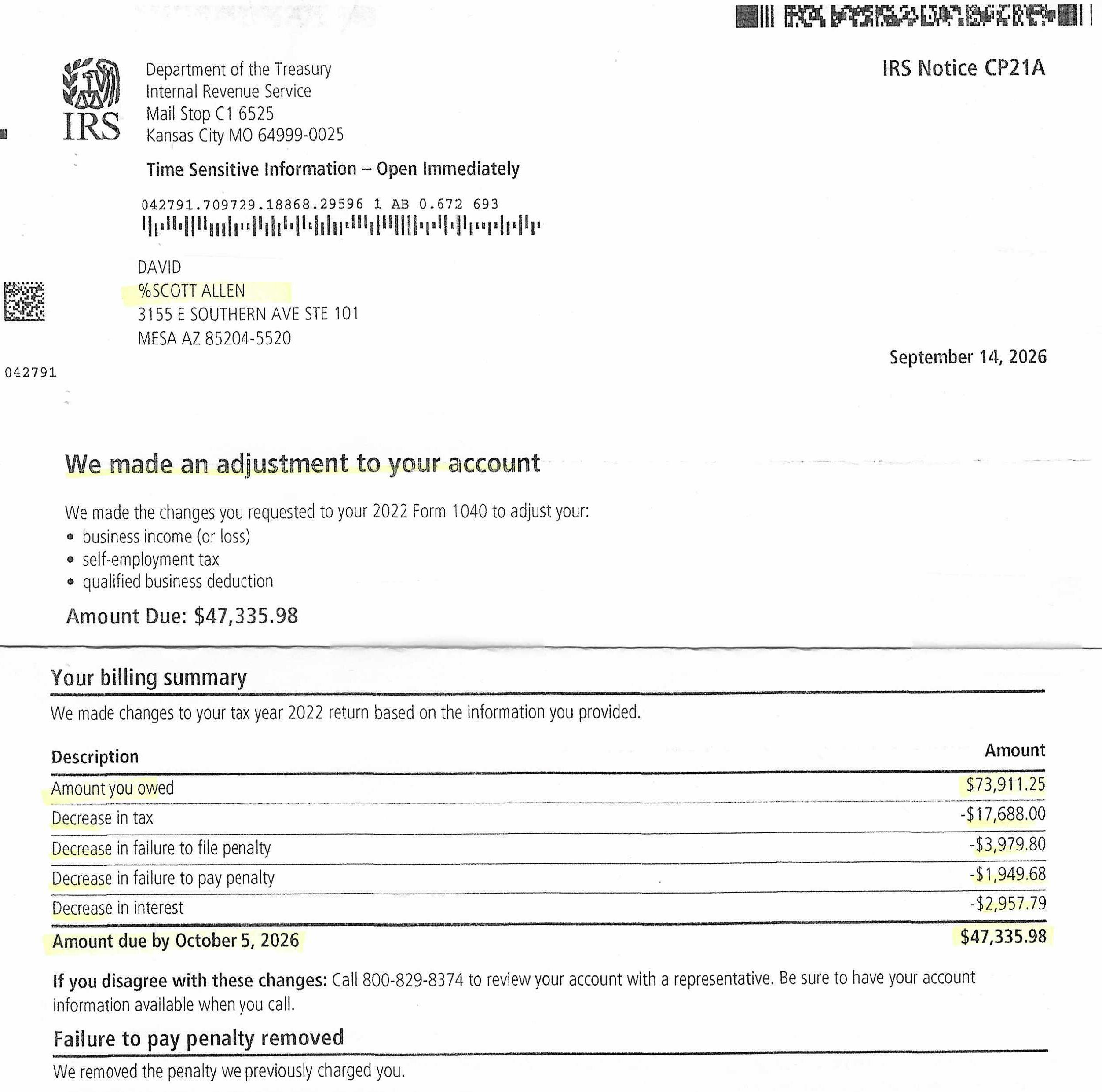
Scott Allen, EA reviewed David’s tax situation, examined the IRS adjustments, worked on correcting the underlying tax liability, and successfully obtained reductions in tax, penalties, and interest. The IRS subsequently issued Notice CP21A showing that the amount due had been reduced to $47,335.98.
Scott Allen, EA is now working with David to negotiate an appropriate IRS payment plan based on the reduced balance.
This case illustrates an important point for taxpayers in Gilbert and throughout the East Valley: an IRS notice is not necessarily the final word on what a taxpayer ultimately has to pay. Depending on the facts of the case, there may be opportunities to correct tax returns, challenge IRS adjustments, request penalty relief, address interest, and negotiate an appropriate collection resolution.
David’s Gilbert AZ IRS Tax Problem
David’s IRS problem involved his 2022 federal income tax return. According to the IRS Notice CP21A issued on September 14, 2026, the IRS made adjustments involving:
- Business income or loss
- Self-employment tax
- Qualified business income deduction
The initial amount shown as owed was $73,911.25.
After Scott Allen, EA reviewed and worked on the taxpayer’s account, the IRS notice showed the following reductions:
| IRS Adjustment | Amount Reduced |
|---|---|
| Decrease in tax | $17,688.00 |
| Decrease in failure-to-file penalty | $3,979.80 |
| Decrease in failure-to-pay penalty | $1,949.68 |
| Decrease in interest | $2,957.79 |
| Total reduction | $26,575.27 |
| Remaining amount due | $47,335.98 |
The IRS notice states that the changes were made to the taxpayer’s 2022 Form 1040 based on information provided to the IRS.
For David, this meant that the IRS balance went from $73,911.25 to $47,335.98.
That is a reduction of more than $26,000 before addressing how the remaining balance would be paid.
Gilbert AZ IRS Tax Abatement
Scott Allen, EA Represented David Before the IRS
One of the important components of David’s case was the Power of Attorney authorization.
The IRS permits taxpayers to authorize qualified professionals to represent them before the agency. Form 2848, Power of Attorney and Declaration of Representative, is used to authorize an eligible representative. The IRS specifically recognizes attorneys, CPAs, and Enrolled Agents as professionals with unlimited representation rights before the IRS.
An authorized representative can communicate with the IRS concerning the matters and tax periods covered by the Power of Attorney. This can allow the taxpayer’s representative to handle correspondence, discuss the account with IRS personnel, advocate for the taxpayer, and work through collection and tax issues without requiring the taxpayer to personally handle every IRS conversation.
In David’s situation, Scott Allen, EA was able to work directly on the IRS matter rather than simply telling David what he should do himself.
That distinction can be extremely important when an IRS account involves disputed tax, penalties, interest, business income, self-employment tax, or other complicated adjustments.
An IRS Balance Should Be Reviewed Before It Is Simply Paid
Many taxpayers receive an IRS notice and immediately assume that the amount shown is unquestionably correct.
That is not always the best approach.
When an IRS assessment is based on information that may be incomplete, misunderstood, or different from the taxpayer’s actual tax situation, the account may need to be reviewed carefully.
The IRS itself recognizes that taxpayers may need to amend previously filed returns when there are changes involving income, deductions, credits, dependents, filing status, or tax liability.
A qualified tax professional can review the underlying tax return and IRS adjustments to determine whether the assessment appears accurate and whether documentation or amended filings may be appropriate.
In David’s case, Scott Allen, EA was able to work through the tax issues and obtain reductions in the tax, penalties, and interest.
The result was not simply a new payment arrangement on the original $73,911.25 balance. The underlying amount was first reduced to $47,335.98.
That is an important distinction.
A payment plan on a lower legally supportable balance can be very different from simply agreeing to pay the original IRS assessment.
Penalty Abatement Can Be an Important Part of IRS Tax Resolution
Penalties can add thousands of dollars to an IRS balance.
The IRS has several forms of penalty relief. Depending on the circumstances, taxpayers may qualify for relief through programs such as First Time Abate, reasonable-cause relief, or other statutory or administrative provisions. The IRS states that reasonable-cause determinations are made based on the facts and circumstances of each individual case.
David’s IRS notice specifically shows reductions in both the failure-to-file and failure-to-pay penalties.
The notice also shows a reduction in interest.
Taxpayers should not assume that every penalty or adjustment can automatically be removed. Relief depends on the applicable rules and the taxpayer’s facts. However, when a taxpayer receives a large IRS balance, a review of penalties and interest should be part of the overall resolution process.
Why a Gilbert AZ Enrolled Agent Can Be an Alternative to a Tax Attorney
Taxpayers facing IRS problems frequently ask whether they need to hire a Gilbert AZ IRS tax attorney.
An attorney can certainly represent taxpayers before the IRS. However, the IRS makes clear that Enrolled Agents, CPAs, and attorneys all have unlimited representation rights before the IRS.
This means an Enrolled Agent can represent a taxpayer in matters involving IRS audits, collections, payment plans, and appeals.
The IRS describes an Enrolled Agent as a federally authorized tax practitioner who has earned the privilege of representing taxpayers before the IRS. The IRS also states that Enrolled Agents have unlimited practice rights and can represent taxpayers regarding any tax matter before any IRS office.
Scott Allen, EA is therefore able to represent taxpayers before the IRS without being an attorney.
Tax Knowledge Is Often the Central Issue
Many IRS problems are fundamentally tax problems.
They may involve:
- Business income
- Self-employment tax
- Deductions
- Qualified business income
- Amended returns
- Penalty abatement
- IRS notices
- Back tax returns
- IRS collection procedures
- Installment agreements
- Offers in Compromise
- Currently Not Collectible status
- IRS audits and protests
An Enrolled Agent’s practice is specifically focused on federal taxation and representation before the IRS.
The IRS explains that individuals who become Enrolled Agents generally must pass a comprehensive three-part Special Enrollment Examination covering individual and business tax returns and representation, or qualify through certain former IRS employment experience. Enrolled Agents are also required to complete continuing education.
That makes an EA a professional option for taxpayers whose primary problem is resolving an IRS tax matter.
Does a Taxpayer Always Need an Attorney?
There are situations where an attorney may be particularly appropriate.
For example, a taxpayer dealing with litigation, certain legal disputes, criminal tax matters, complex legal opinions, or other issues requiring specialized legal services may need an attorney.
But many ordinary IRS controversies do not require litigation.
A taxpayer dealing with an IRS balance, penalty problem, payment plan, tax adjustment, audit, collection issue, or amended return may be able to work with an Enrolled Agent who has the authority to represent the taxpayer before the IRS.
The important question is therefore not simply:
“Does this taxpayer need a lawyer?”
A more useful question can be:
“What type of professional has the appropriate credentials and experience to solve this particular IRS problem?”
For many taxpayers, an experienced Enrolled Agent can provide the tax expertise and IRS representation needed without the taxpayer automatically having to retain a tax attorney.
Taxpayers should also compare the experience, services, communication style, and fees of any professional they are considering.
Scott Allen, EA Provides Local IRS Representation for Gilbert Taxpayers
Tax Debt Advisors, Inc. is located in Mesa, Arizona, and Scott Allen, EA provides IRS representation to taxpayers throughout the East Valley, including Gilbert, Chandler, Mesa, Queen Creek, Tempe, Scottsdale, and surrounding communities.
The firm’s website identifies Scott Allen, EA as an Enrolled Agent and describes services including IRS Power of Attorney representation, IRS settlement options, back tax return preparation, IRS tax debt help, payment plans, and IRS audit assistance.
For Gilbert taxpayers, having a local professional can also make the process more personal. Instead of simply calling a national tax resolution call center, taxpayers can meet with the professional who will actually work on their IRS case.
Tax Debt Advisors’ website provides additional information about its local Mesa practice and Scott Allen’s background as an Enrolled Agent.
The Next Step for David: Negotiating an IRS Payment Plan
After the tax, penalties, and interest were reduced, David’s remaining balance was $47,335.98.
Scott Allen, EA is now working on the next phase of the case: negotiating an appropriate payment plan with the IRS.
The IRS offers several payment options for taxpayers who cannot immediately pay their entire balance. Depending on the circumstances, taxpayers may qualify for short-term or long-term payment arrangements.
The IRS currently states that qualifying individual taxpayers with $50,000 or less in combined assessed tax, penalties, and interest may generally qualify for its Simple Payment Plan if they have filed all required returns. Other taxpayers may qualify for different installment agreement options depending on their circumstances.
David’s reduced balance of $47,335.98 is therefore particularly significant as Scott works on the payment-plan phase of the case.
The ultimate payment arrangement, however, depends upon the taxpayer’s circumstances and the IRS requirements applicable to the account.
Gilbert AZ Taxpayers Do Not Have to Face the IRS Alone
David’s case demonstrates why an IRS problem should be evaluated rather than ignored.
His original IRS balance was $73,911.25.
After Scott Allen, EA represented him and worked through the tax matter, the IRS notice reflected:
$26,575.27 in combined reductions to tax, penalties, and interest.
The resulting balance was:
$47,335.98
The next step is working toward an appropriate payment arrangement for the remaining balance.
Every IRS case is different. Not every taxpayer will qualify for the same tax reduction, penalty abatement, or payment plan. However, taxpayers should understand that there can be multiple steps involved in resolving an IRS liability.
For Gilbert, Arizona taxpayers dealing with IRS back taxes, penalties, disputed tax assessments, business-income adjustments, or collection problems, working with an experienced Enrolled Agent can provide a way to have the tax matter professionally reviewed and, when appropriate, handled directly with the IRS.
Scott Allen, EA of Tax Debt Advisors, Inc. provides local IRS representation and can represent taxpayers before the IRS through Power of Attorney.
Gilbert taxpayers who have received an IRS notice or are struggling with an IRS balance can contact Tax Debt Advisors, Inc. to have their situation reviewed and determine what options may be available.
Tax Debt Advisors, Inc.
3155 E. Southern Avenue, Suite 101
Mesa, AZ 85204
Phone: (480) 926-9300
For official IRS information about representation, taxpayers can also review the IRS guidance on Enrolled Agents, Power of Attorney, penalty relief, amended returns, and payment plans.
IRS Enrolled Agent Information
IRS Form 2848 – Power of Attorney
IRS Payment Plans
This case study is based on the IRS notice provided for David. IRS outcomes vary based on the taxpayer’s individual facts, financial circumstances, tax history, documentation, and applicable IRS rules.