
Written by Scott Allen

Scott Allen EA with Back Tax Return Help in Chandler AZ

Back Tax Return Help in Chandler Arizona: Local IRS Representation and Affordable Tax Debt Solutions

Chandler AZ taxpayers with unfiled back tax returns or outstanding IRS debts have options for resolving their tax problems. Whether someone has fallen behind on filing income tax returns, received threatening IRS collection notices, or is struggling to afford an existing IRS payment plan, professional representation can make a significant difference.

For taxpayers searching for Back Tax Return Help in Chandler Arizona, Tax Debt Advisors, Inc. provides experienced, local IRS representation to help individuals and families get back into compliance with the Internal Revenue Service.

Founded in 1977, Tax Debt Advisors, Inc. is a family-owned tax resolution business located in Mesa, Arizona, serving taxpayers throughout Chandler, Gilbert, Mesa, Tempe, Phoenix, Scottsdale, and Queen Creek.

Scott Allen, EA, an Enrolled Agent authorized to represent taxpayers before the IRS, works directly with clients to prepare and file delinquent tax returns, review outstanding tax liabilities, negotiate affordable IRS installment agreements, and pursue available tax debt resolution options.

One recent client, Mike, discovered how valuable professional IRS representation can be when Scott Allen, EA, helped him obtain a manageable payment arrangement for his outstanding federal tax liabilities.

Chandler Arizona IRS Tax Help: How Scott Allen, EA, Helped Mike Resolve His IRS Payment Plan

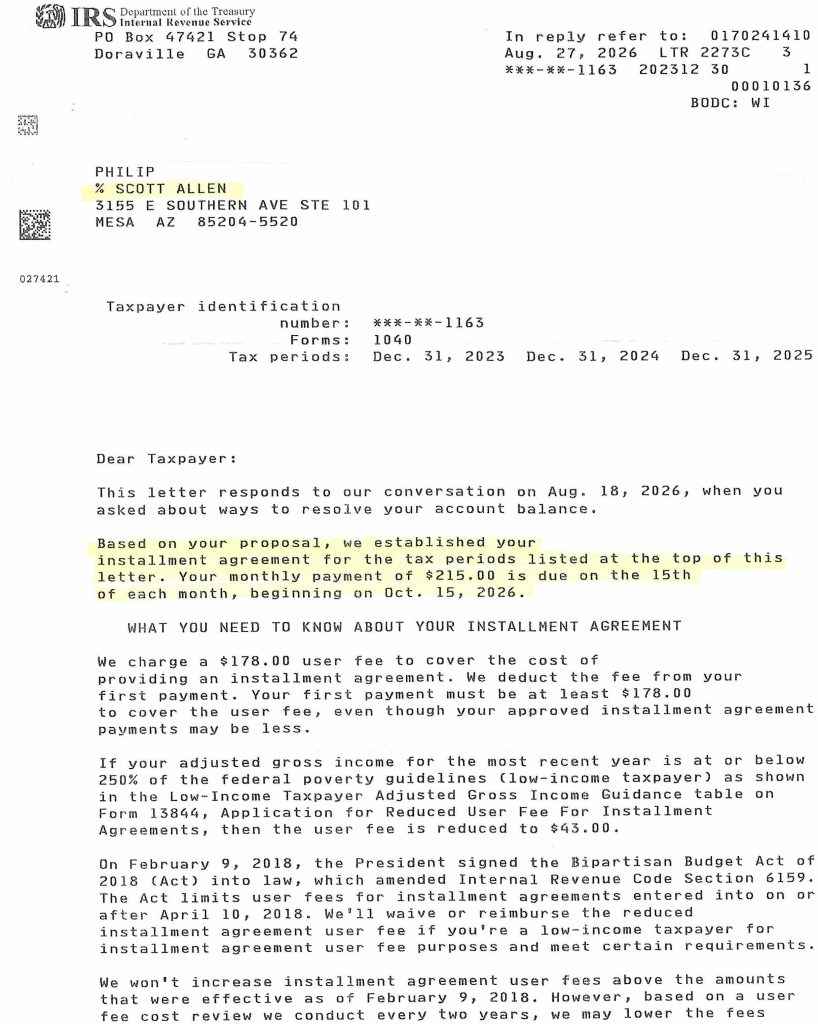
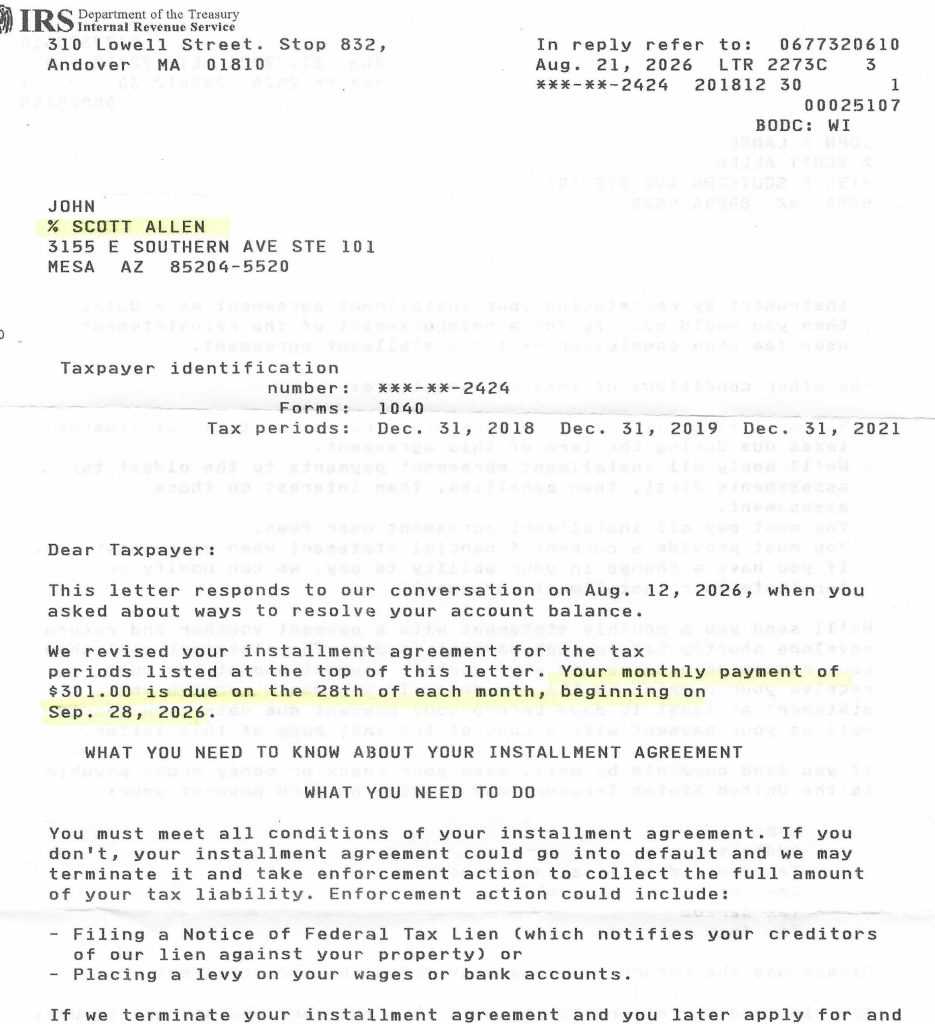
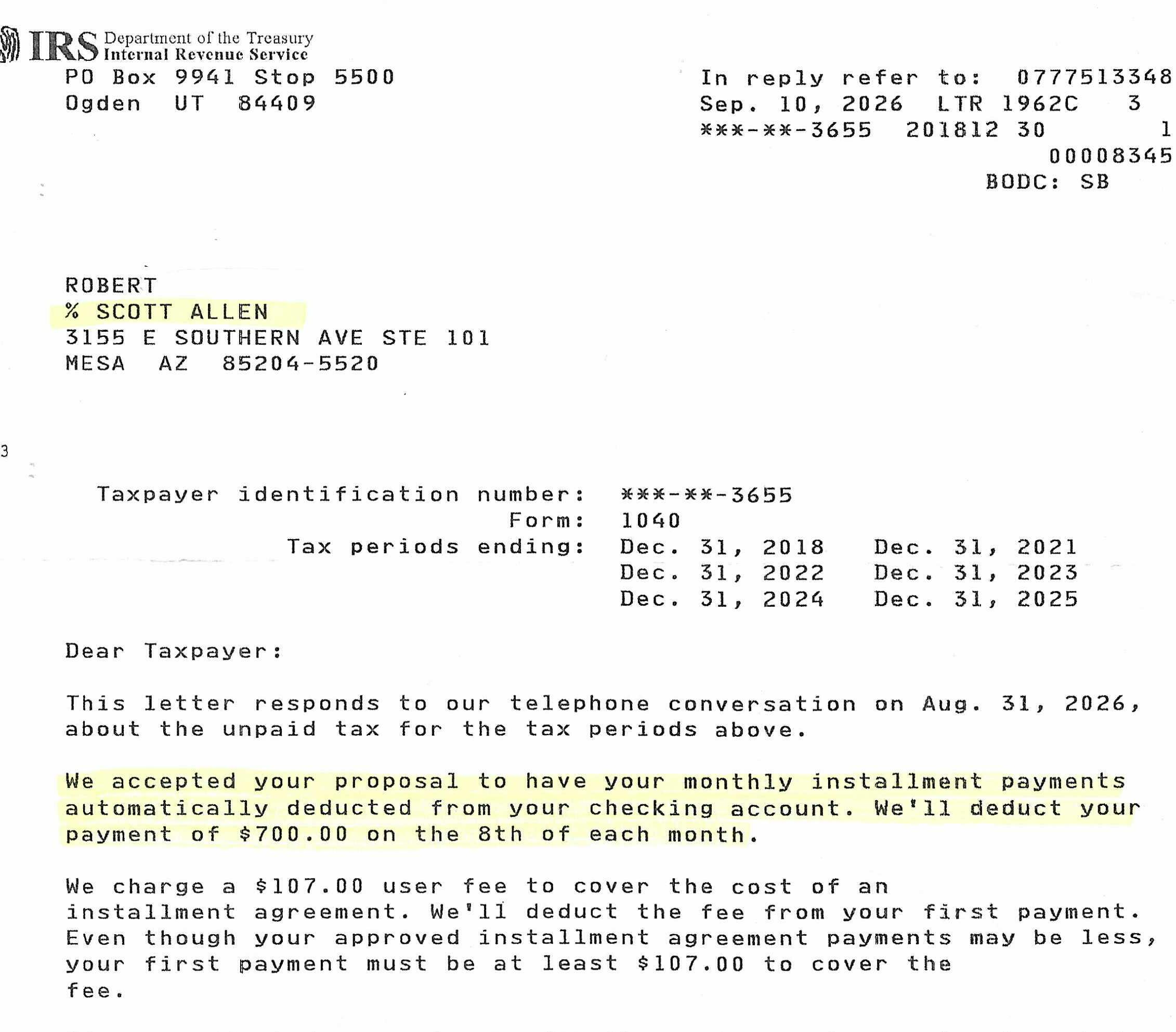
Mike was facing outstanding federal income tax liabilities for multiple tax years, including 2018, 2022, and 2023.

Like many taxpayers dealing with IRS back taxes, Mike needed a payment arrangement that would allow him to address his tax obligations without creating additional financial hardship.

After seeking assistance from Scott Allen, EA, of Tax Debt Advisors, Inc., Mike was able to obtain a revised IRS direct debit installment agreement.

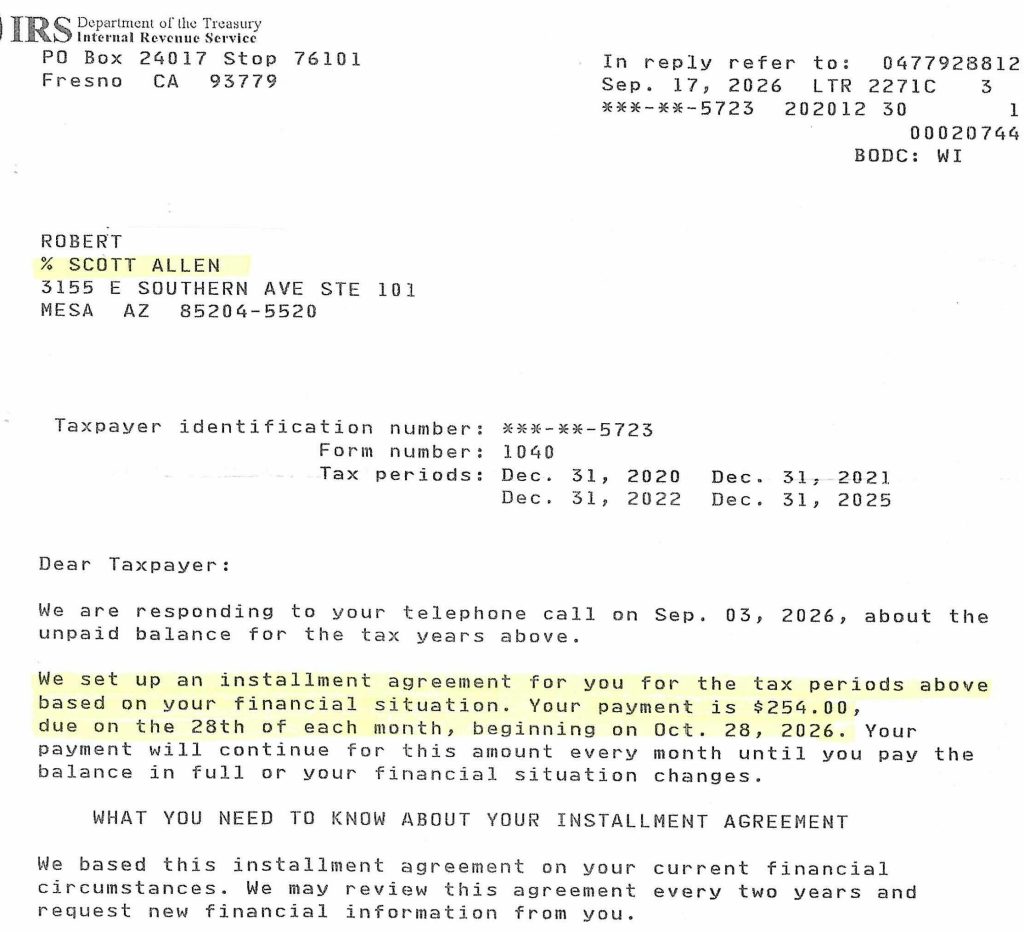
The IRS issued an official confirmation letter dated October 21, 2026, acknowledging the modification of Mike’s payment arrangement.

Under the revised agreement, Mike’s payments were structured as follows:

  • $100 per month beginning under the revised agreement.
  • $200 per month beginning November 12, 2027.
  • $300 per month beginning November 12, 2028, continuing until the balance is paid or his financial circumstances change.

This arrangement provided Mike with an opportunity to begin addressing his outstanding IRS tax liabilities through payments that gradually increase over time.

Rather than requiring Mike to immediately make larger monthly payments, the revised agreement established a structured payment schedule.

For individuals searching for Chandler AZ IRS payment plan help, Mike’s situation demonstrates that taxpayers may have options beyond simply accepting a payment amount they cannot afford.

Depending on their financial circumstances, taxpayers may qualify for modified installment agreements, including arrangements that account for anticipated changes in their ability to pay.

Scott Allen, EA, helps taxpayers evaluate these possibilities and negotiate directly with the IRS when appropriate.
Revised IRS Payment Plan for Back Taxes Owed

Revised IRS Payment Plan for Back Taxes Owed

Why Filing Back Tax Returns in Chandler Arizona Is So Important

One of the most common problems facing taxpayers with IRS debts is failing to file required federal income tax returns.

Some Chandler residents fall behind because they are self-employed and have difficulty calculating their income and expenses. Others may have experienced unemployment, divorce, business losses, medical expenses, or unexpected financial challenges.

Unfortunately, failing to file a required tax return does not make the obligation disappear.

When taxpayers neglect their filing responsibilities, the IRS may eventually take action, including preparing a Substitute for Return, commonly referred to as an SFR.

An IRS Substitute for Return is generally prepared using income information reported to the government by employers, financial institutions, and other third parties.

The problem is that an SFR may not include all the deductions, credits, business expenses, or other tax benefits that the taxpayer could potentially claim on a properly prepared return.

Consequently, taxpayers may receive tax assessments that are higher than the amounts they would otherwise owe.

Tax Debt Advisors, Inc. helps Chandler Arizona taxpayers prepare and file back tax returns, including returns for multiple years.

Scott Allen, EA, can review available tax records, identify missing income information, determine potential deductions, and prepare delinquent federal income tax returns.

In certain circumstances, properly filing missing tax returns can reduce an IRS assessment or correct an inaccurate tax liability.

Getting tax returns filed is also an important step toward qualifying for many IRS collection alternatives.

For taxpayers who have not filed income tax returns in several years, working with an experienced Enrolled Agent can help establish a clear path toward resolving their federal tax problems.

What Happens When Chandler AZ Taxpayers Ignore IRS Back Taxes?

Ignoring outstanding IRS tax debts can create serious financial consequences.

The IRS has several collection tools available when taxpayers fail to resolve unpaid federal income taxes.

Depending on the circumstances and required collection procedures, these may include:

  • Federal tax liens that can affect property and financial transactions.
  • Bank levies that seize funds from financial accounts.
  • Wage garnishments that redirect part of a taxpayer’s earnings to the IRS.
  • Additional penalties and interest that increase outstanding balances.
  • Collection notices demanding payment or warning of possible enforcement action.

For Chandler taxpayers already struggling financially, these collection actions can make an already difficult situation considerably worse.

The important thing to understand is that taxpayers often have opportunities to address their IRS debts before enforcement actions occur.

Scott Allen, EA, of Tax Debt Advisors, Inc., assists clients in communicating with the IRS, determining the status of their accounts, and identifying available collection alternatives.

In appropriate cases, obtaining an approved installment agreement can help prevent certain IRS enforcement actions while the taxpayer remains in compliance with the agreement.

However, taxpayers must continue satisfying the terms of their arrangements, including making required payments and meeting ongoing filing obligations.

How an Enrolled Agent Can Represent Chandler Arizona Taxpayers Before the IRS

Many people believe they must hire an IRS tax attorney to resolve federal income tax problems.

Although tax attorneys can be essential for certain legal matters, taxpayers should understand that an Enrolled Agent also has extensive federal tax representation authority.

Scott Allen, EA, is federally authorized to represent taxpayers before the Internal Revenue Service.

Enrolled Agents are tax professionals who have earned the privilege of representing taxpayers before the IRS by satisfying federal qualification requirements.

Unlike many tax preparers who focus primarily on preparing annual income tax returns, Enrolled Agents may represent taxpayers in IRS examinations, collection matters, and administrative appeals.

Scott Allen, EA, can assist Chandler taxpayers with matters such as:

  • Preparing and filing delinquent federal income tax returns.
  • Reviewing IRS account transcripts and outstanding balances.
  • Representing taxpayers through IRS Form 2848, Power of Attorney and Declaration of Representative.
  • Negotiating IRS installment agreements and payment plan modifications.
  • Evaluating Offers in Compromise.
  • Requesting Currently Not Collectible status when appropriate.
  • Responding to IRS notices and proposed tax adjustments.
  • Assisting with IRS audits and examination disputes.
  • Seeking eligible penalty relief.
  • Addressing federal tax liens, levies, and wage garnishments.

For many routine IRS collection and tax compliance matters, an experienced Enrolled Agent can provide the representation taxpayers need without requiring them to retain a tax attorney.

Taxpayers facing criminal tax allegations, litigation, or specialized legal disputes may require an attorney.

Can an IRS Payment Plan Be Reduced When Financial Circumstances Change?

Mike’s successful payment plan modification illustrates another important consideration for taxpayers with outstanding IRS debts.

An existing IRS installment agreement is not necessarily permanent in its original form.

Taxpayers sometimes experience changes in income, employment, household expenses, or financial responsibilities that make previously affordable payments difficult to maintain.

For example, a Chandler resident who originally agreed to pay $800 per month toward an IRS debt might later experience reduced income or increased necessary living expenses.

Depending on the circumstances, the taxpayer may be able to request a revised payment arrangement.

The IRS may require updated financial information, including documentation of income, assets, household expenses, and other relevant obligations.

Scott Allen, EA, assists taxpayers with reviewing their financial circumstances and presenting appropriate information to the IRS.

As demonstrated by Mike’s October 2026 IRS confirmation letter, a payment arrangement can sometimes be structured with lower initial payments and scheduled increases in later years.

For taxpayers seeking IRS debt settlement help in Chandler Arizona, this is an important reminder that resolving an IRS balance does not always require paying the entire amount immediately.

A properly negotiated payment plan can provide a practical method for addressing tax liabilities over time.

However, an installment agreement generally does not reduce the underlying tax debt itself, and applicable interest and penalties may continue to accrue.

Understanding the Different Ways to Settle IRS Debt in Chandler AZ

Not every taxpayer qualifies for the same IRS resolution program.

Some individuals have sufficient income to make monthly payments, while others may be unable to pay anything toward their outstanding balances after meeting necessary living expenses.

Tax Debt Advisors, Inc. reviews each taxpayer’s circumstances to help determine which available IRS collection alternative may be appropriate.

IRS Installment Agreements

An installment agreement allows an eligible taxpayer to make payments toward an outstanding federal tax balance over time.

Payment amounts and terms depend on factors such as the total amount owed, the taxpayer’s financial circumstances, and applicable IRS collection requirements.

Offer in Compromise

An Offer in Compromise may allow a qualifying taxpayer to resolve an IRS liability for less than the full amount owed.

The IRS considers factors such as income, expenses, assets, and future earning potential when evaluating offers based on doubt as to collectability.

Not every taxpayer qualifies for this program.

Currently Not Collectible Status

Taxpayers experiencing significant financial hardship may qualify for Currently Not Collectible status.

When the IRS determines that a taxpayer cannot currently pay without creating hardship, it may temporarily suspend certain collection efforts.

The liability generally remains outstanding, and interest and penalties may continue accruing. The IRS may review the taxpayer’s financial circumstances later.

Penalty Abatement

Some taxpayers may qualify for relief from certain IRS penalties.

Eligibility depends on factors such as prior compliance history, reasonable cause, and the specific penalties involved.

Scott Allen, EA, can review a taxpayer’s account to determine whether a penalty relief request may be appropriate.

Why Chandler Arizona Taxpayers Should Choose a Local IRS Tax Resolution Firm

Taxpayers searching online for help with IRS back taxes frequently encounter national tax resolution companies advertising dramatic tax debt reductions.

Some advertisements suggest that almost anyone can settle substantial IRS debts for pennies on the dollar.

Unfortunately, those claims do not reflect how IRS collection programs actually work.

The IRS evaluates taxpayers according to established eligibility requirements, financial information, and collection procedures.

A taxpayer who has sufficient income or assets may not qualify for a substantial reduction in the amount owed.

That is why working with a knowledgeable local tax professional can be valuable.

Tax Debt Advisors, Inc. has been a family-owned business in Mesa, Arizona, since 1977.

Unlike a distant call center, Tax Debt Advisors, Inc. offers Chandler taxpayers the opportunity to meet locally with Scott Allen, EA, and discuss their specific IRS problems.

Scott Allen personally assists clients with understanding their tax liabilities, reviewing their available options, and communicating with the IRS.

For taxpayers in Chandler, Mesa, Gilbert, Tempe, Queen Creek, Scottsdale, and Phoenix, having a local professional available for face-to-face consultations can provide greater convenience and continuity throughout the resolution process.

Tax Debt Advisors, Inc. understands that every taxpayer’s situation is different.

Someone who has failed to file six years of tax returns may require a very different approach from someone who has filed every return but owes $75,000 in federal income taxes.

A taxpayer facing an IRS bank levy may need immediate collection assistance, while another taxpayer may simply need an existing installment agreement reviewed.

Each situation deserves an individualized evaluation.

How Chandler AZ Taxpayers Can Begin Resolving Unfiled Tax Returns and IRS Debt

Taxpayers who have fallen behind with the IRS should not assume that their situation is beyond repair.

Taking action can often help prevent tax problems from becoming more complicated.

The first step is determining which tax returns are missing and how much the IRS believes is owed.

Next, taxpayers should evaluate whether their outstanding balances are accurate and whether any unfiled returns, amended returns, or disputed assessments need to be addressed.

Once the taxpayer’s filing requirements and account balances have been reviewed, available IRS resolution options can be evaluated.

Scott Allen, EA, assists clients through this process by obtaining appropriate authorization to communicate with the IRS, reviewing tax account information, preparing necessary returns, and negotiating collection alternatives when appropriate.

For Chandler taxpayers who have received IRS notices, are facing collection threats, or are simply overwhelmed by several years of unfiled income tax returns, obtaining professional guidance early can be an important decision.

Free Consultation for Back Tax Return Help in Chandler Arizona

Mike’s experience provides a useful example of how professional IRS representation can help a taxpayer obtain a more manageable arrangement for outstanding federal income taxes.

With the assistance of Scott Allen, EA, of Tax Debt Advisors, Inc., Mike received IRS confirmation of a modified payment agreement beginning at just $100 per month, with scheduled increases in subsequent years.

While every taxpayer’s financial circumstances are different, his case demonstrates that affordable IRS collection alternatives may be available.

For Chandler Arizona residents who need to prepare missing federal income tax returns, negotiate IRS payment plans, or address substantial IRS debts, Tax Debt Advisors, Inc. offers free initial consultations.

The firm has served Arizona taxpayers since 1977 and continues to provide local, personalized assistance with federal tax problems.

Taxpayers do not have to navigate complicated IRS procedures alone.

Whether someone owes $10,000, $50,000, $100,000, or more in federal income taxes, Scott Allen, EA, can review their circumstances and help identify appropriate options for resolving their IRS problems.

Chandler Arizona taxpayers searching for reliable back tax return help and IRS debt settlement assistance are encouraged to schedule a free consultation with Scott Allen, EA, of Tax Debt Advisors, Inc.

Visit https://www.taxdebtadvisors.com to learn more about preparing back tax returns, resolving IRS debts, and obtaining professional IRS representation.

Tax Debt Advisors, Inc. — Family-Owned IRS Tax Resolution Assistance Since 1977. Serving Chandler, Mesa, Gilbert, Phoenix, Tempe, Scottsdale, Queen Creek, and surrounding Arizona communities.
Written by Scott Allen

IRS Payment Help in Phoenix AZ

Phoenix AZ IRS Payment Plan Help: How Scott Allen, EA Reduced Anthony’s IRS Payments From $1,279 to $500 Per Month

As the Phoenix Suns begin the 2026–2027 NBA season, one Arizona taxpayer discovers that a successful financial comeback can begin with the right IRS representation.

When an IRS Payment Plan Becomes Too Expensive

As the Phoenix Suns take the court for another exciting NBA season, basketball fans throughout Phoenix, Mesa, Gilbert, Chandler, Scottsdale, and the surrounding Valley are looking forward to fresh opportunities, new strategies, and a successful season.

In professional basketball, a winning team must continually evaluate its strategy, make adjustments, and respond to changing circumstances. A game plan that worked in the first quarter may need to change by the fourth quarter.

The same principle applies to taxpayers struggling with IRS debt.

An IRS payment plan that was affordable when originally established may become financially overwhelming when a taxpayer’s income decreases, living expenses increase, or other financial circumstances change.

Fortunately, IRS installment agreements are not necessarily permanent arrangements that can never be adjusted.

With proper financial documentation and professional IRS representation, some taxpayers may qualify to have their monthly payments reduced.

That is exactly what happened when Scott Allen, EA, of Tax Debt Advisors, Inc., a family-owned Mesa, Arizona tax resolution business established in 1977, helped his client Anthony reduce his monthly IRS payment from $1,279 to just $500.

For Anthony, this successful negotiation meant an additional $779 every month that could remain available for household expenses and other financial obligations.

His experience demonstrates why Arizona taxpayers who are struggling with expensive IRS payment plans should consider having their financial circumstances professionally reviewed before assuming that their current payments cannot be changed.

Anthony’s IRS Payment Plan Was $1,279 Per Month

Anthony was already making payments toward his outstanding federal tax debt through an IRS installment agreement.

His original monthly payment was $1,279.

Although an installment agreement can provide taxpayers with a structured method of resolving unpaid federal taxes, the monthly payment must also be manageable within the taxpayer’s financial circumstances.

Over time, Anthony’s financial situation changed.

The payment arrangement that had previously been established no longer reflected his updated financial information.

Rather than continuing with a monthly obligation that was creating financial pressure, Anthony worked with Scott Allen, EA, of Tax Debt Advisors, Inc. to determine whether the IRS would consider revising the existing agreement.

Scott Allen reviewed Anthony’s updated financial information and worked with the IRS to request a more affordable monthly payment.

The objective was straightforward: establish a revised IRS installment agreement that would better reflect Anthony’s current ability to pay while keeping him on a path toward resolving his outstanding tax obligations.

The IRS Approved Anthony’s Revised Payment Plan

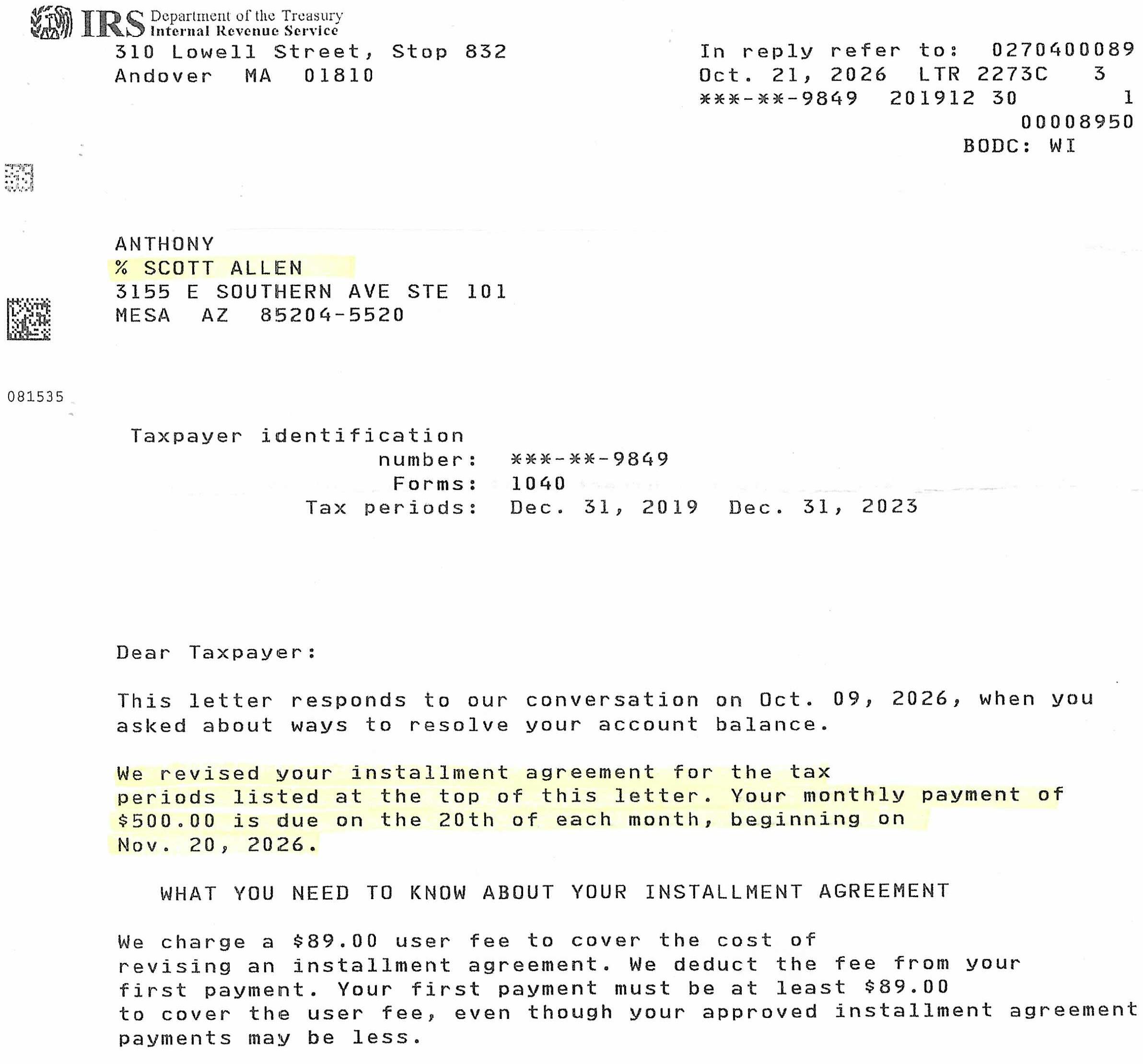
On October 21, 2026, the Internal Revenue Service issued Letter 2273C confirming that Anthony’s installment agreement had been revised.

The IRS letter specifically stated:

“We revised your installment agreement for the tax periods listed at the top of this letter.”

The correspondence confirmed that Anthony’s new monthly payment would be $500, beginning November 20, 2026, with payments due on the 20th of each month.

This was a significant financial improvement.

Anthony’s IRS Payment Plan Monthly Amount
Previous IRS payment $1,279
Revised IRS payment $500
Monthly payment reduction $779
Percentage reduction Approximately 61%
Annualized cash-flow improvement $9,348

By successfully revising Anthony’s installment agreement, Scott Allen, EA helped his client reduce the required monthly payment by approximately 61%.

That represents $9,348 in potential annual cash-flow relief, assuming the revised payment remains in effect for 12 months.

Importantly, a reduction in monthly payments does not automatically reduce the underlying IRS tax debt. Interest and applicable penalties may continue to accrue, and a longer repayment period may increase the total amount paid over time.

Nevertheless, a manageable monthly payment can make an enormous difference for taxpayers trying to maintain financial stability while addressing their IRS obligations.

Revised IRS Payment Plan for Back Taxes Owed

Revised IRS Payment Plan for Back Taxes Owed

Just Like the Phoenix Suns, Sometimes a New Game Plan Is Necessary

As the Phoenix Suns open their 2026–2027 basketball season, fans understand that successful teams cannot rely on the same strategy regardless of what happens on the court.

A coach may change defensive assignments, adjust player rotations, or call a timeout when the original approach is no longer producing the desired results.

Taxpayers dealing with the IRS may need to make similar adjustments.

Imagine a Phoenix homeowner who established an IRS payment plan several years ago while earning a higher income. Since that time, the taxpayer may have experienced reduced wages, increased housing costs, unexpected family expenses, or changes in employment.

Continuing to make an unaffordable payment simply because it was originally accepted by the IRS may not be the best financial strategy.

Just as a basketball coach reviews the scoreboard and changes the game plan, an experienced Enrolled Agent can review the taxpayer’s financial situation and determine whether a revised IRS installment agreement may be appropriate.

For Anthony, the successful adjustment was substantial.

His required monthly payment decreased by $779, providing greater flexibility to manage everyday expenses.

And while the Phoenix Suns are working toward victories on the basketball court, Anthony achieved an important financial victory by obtaining a more affordable IRS payment arrangement.

Can the IRS Reduce an Existing Monthly Payment Plan?

Yes. Depending on the taxpayer’s circumstances, the IRS may agree to revise an existing installment agreement.

Many Arizona taxpayers mistakenly believe that once an IRS monthly payment amount has been established, it cannot be changed.

That is not always the case.

The IRS has procedures for reviewing installment agreements when taxpayers experience changes in their financial circumstances.

A taxpayer who previously agreed to pay $1,000, $1,500, or even $2,500 per month may qualify for a lower payment if updated financial information supports the request.

However, a taxpayer cannot simply choose a lower payment amount and assume the IRS will accept it.

The IRS may require documentation establishing the taxpayer’s current financial condition.

Depending on the situation, this may involve reviewing:

  • Current household income and employment earnings.
  • Mortgage payments or rent.
  • Utilities, food, transportation, and other necessary living expenses.
  • Health insurance and qualifying medical expenses.
  • Bank account balances and other available assets.
  • Changes in family size or household financial obligations.
  • Other information relevant to the taxpayer’s ability to pay.

The IRS may also apply its collection financial standards when determining allowable living expenses.

An experienced tax representative can help organize this information and present an accurate financial picture to the IRS.

The goal is to determine an appropriate resolution based on the taxpayer’s circumstances and applicable IRS collection rules.

Why Hire Scott Allen, EA, for IRS Payment Plan Help in Phoenix AZ?

Taxpayers searching online for “Phoenix AZ IRS payment plan help” or “Mesa AZ IRS debt settlement” may encounter numerous national tax resolution companies advertising dramatic tax settlements.

However, not every taxpayer needs an Offer in Compromise, and not every IRS problem requires an attorney.

In many cases, an affordable IRS installment agreement may be a practical solution.

Scott Allen, EA, is an Enrolled Agent who is federally authorized to represent taxpayers before the Internal Revenue Service.

Enrolled Agents earn their authority to practice before the IRS through the United States Department of the Treasury.

Their representation authority includes assisting taxpayers with IRS collection matters, tax examinations, appeals, and other federal tax issues within the scope of their practice.

For taxpayers who need help negotiating an IRS installment agreement, an Enrolled Agent can communicate directly with the IRS after receiving the appropriate authorization, typically through IRS Form 2848, Power of Attorney and Declaration of Representative.

Scott Allen, EA provides professional representation to taxpayers who need assistance with:

  • Establishing new IRS installment agreements.
  • Revising existing IRS payment plans.
  • Preparing and filing delinquent federal income tax returns.
  • Addressing IRS collection notices.
  • Negotiating solutions for unpaid federal taxes.
  • Requesting penalty relief when appropriate.
  • Resolving IRS wage garnishments and bank levies.
  • Evaluating Currently Not Collectible status.
  • Reviewing eligibility for an Offer in Compromise.
  • Representing taxpayers during qualifying IRS examinations and disputes.

The appropriate strategy depends on each taxpayer’s financial information, filing compliance, and outstanding tax liabilities.

Tax Debt Advisors, Inc.: A Family-Owned Mesa Arizona Business Since 1977

For nearly five decades, Tax Debt Advisors, Inc. has served Arizona taxpayers seeking professional assistance with IRS tax problems.

Founded in 1977, the family-owned business is located in Mesa, Arizona, and serves taxpayers throughout the Phoenix metropolitan area.

Unlike taxpayers who contact national tax resolution companies and may be assigned to different representatives, clients of Tax Debt Advisors, Inc. have the opportunity to meet personally with Scott Allen, EA, to discuss their IRS problems.

Scott Allen can review the taxpayer’s situation, obtain authorization to communicate with the IRS, and work directly on an appropriate resolution.

This local approach is particularly valuable for taxpayers who prefer face-to-face communication and want to understand the process before making important financial decisions.

Tax Debt Advisors, Inc. assists taxpayers in Mesa, Phoenix, Gilbert, Chandler, Scottsdale, Tempe, Queen Creek, and surrounding Arizona communities.
Whether someone owes several thousand dollars or has accumulated a much larger federal tax liability, the first step is understanding the available IRS resolution options.

What Happens When Taxpayers Have Unfiled Back Tax Returns?

Another common problem facing Arizona taxpayers is the combination of unpaid IRS debt and multiple years of unfiled federal income tax returns.

Some taxpayers stop filing because they are concerned about how much they may owe.

Others may have experienced financial hardship, self-employment income complications, or difficulty gathering their tax records.

Unfortunately, ignoring unfiled tax returns can make an IRS collection problem more complicated.

The IRS generally requires taxpayers to satisfy applicable filing compliance requirements before approving many collection alternatives, including installment agreements.

Scott Allen, EA can professionally prepare and file delinquent federal income tax returns and represent taxpayers before the IRS to address their outstanding tax liabilities.

This can be especially helpful when the IRS has prepared a Substitute for Return based on information available to the government.

An IRS Substitute for Return may not reflect all deductions, expenses, credits, or other tax benefits for which the taxpayer is eligible.

Preparing accurate original returns can sometimes substantially change the amount assessed, depending on the facts and applicable IRS procedures.

Once the required returns are filed and the correct liabilities are determined, Scott Allen can evaluate appropriate collection alternatives.

For some taxpayers, the best solution may be a manageable monthly installment agreement.

For others, Currently Not Collectible status, penalty relief, or an Offer in Compromise may be worth considering.

Three Important Reasons to Review an Existing IRS Payment Plan

An IRS payment plan should be reviewed when circumstances suggest that the current agreement may no longer be appropriate.

1. Household Income Has Decreased

A taxpayer who previously earned $120,000 annually may now earn significantly less because of a job change, reduced hours, retirement, or business difficulties.

That reduction in income may justify reviewing the existing payment arrangement.

2. Necessary Living Expenses Have Increased

Arizona households may experience higher mortgage payments, insurance costs, medical expenses, transportation costs, or other necessary expenditures.

Depending on the taxpayer’s circumstances and IRS allowable expense rules, these changes may affect the ability-to-pay calculation.

3. The Existing Payment Is Becoming Unmanageable

Taxpayers who are struggling to maintain an existing installment agreement should consider requesting a review before missing payments.

A defaulted installment agreement may expose the taxpayer to renewed IRS collection activity, subject to applicable notice requirements and taxpayer protections.

Professional assistance can help identify available alternatives and communicate with the IRS before the situation becomes more serious.

Anthony’s IRS Payment Plan Revision Shows Why Professional Representation Matters

Anthony’s experience provides a practical example of how a revised IRS installment agreement can improve a taxpayer’s monthly finances.

His original IRS payment was $1,279 per month.

Following Scott Allen’s review and representation, the IRS approved a new payment of $500 per month.

The reduction was not based on an advertised promise that every taxpayer can settle tax debt for pennies on the dollar.

Instead, the revised agreement was based on Anthony’s updated financial information and the IRS’s review of his circumstances.

That distinction matters.

Successful IRS representation is not about making unrealistic guarantees. It is about understanding IRS collection procedures, reviewing the taxpayer’s financial condition, and pursuing a resolution that is supported by the facts.

Although Anthony’s outcome does not guarantee the same result for another taxpayer, it illustrates why an existing IRS payment plan may deserve a second look.

Phoenix AZ Taxpayers: Don’t Let an Unaffordable IRS Payment Plan Control Your Finances

The beginning of the Phoenix Suns’ 2026–2027 season brings renewed excitement throughout the Valley.

Every new season provides an opportunity to improve, adjust, and pursue better results.

For Arizona taxpayers struggling with IRS back taxes, a similar opportunity may exist.

A taxpayer who is currently paying $800, $1,200, $1,500, or more per month toward an IRS debt may have options worth reviewing.

A revised installment agreement could potentially reduce financial pressure while allowing the taxpayer to remain compliant with IRS payment requirements.

But the right solution requires a careful review of the taxpayer’s income, expenses, assets, filing history, and collection circumstances.

Tax Debt Advisors, Inc. provides that assistance through experienced, local IRS representation.

Schedule a Free Consultation With Scott Allen, EA

Arizona taxpayers who owe back taxes, have unfiled federal income tax returns, or are struggling with an expensive IRS installment agreement can contact Tax Debt Advisors, Inc. for a free initial consultation.

Scott Allen, EA can personally review the taxpayer’s IRS situation and explain which resolution options may be available.

Tax Debt Advisors, Inc.
Family-Owned in Mesa, Arizona Since 1977
Serving Phoenix, Mesa, Gilbert, Chandler, Scottsdale, Tempe, Queen Creek, and Surrounding Communities

Website: https://www.taxdebtadvisors.com

As the Phoenix Suns begin another season, Arizona taxpayers should remember that a financial comeback may start with a better strategy.

For Anthony, that strategy resulted in an IRS payment reduction from $1,279 to $500 per month.

For another taxpayer, the first step toward a more manageable IRS resolution could begin with a free consultation with Scott Allen, EA, of Tax Debt Advisors, Inc.


Written by Scott Allen

Settle IRS Debts in Phoenix Arizona

Phoenix AZ IRS Tax Debt Settlement: How Scott Allen, EA Helped a Taxpayer Resolve Back Taxes and Secure an Affordable IRS Payment Plan

For many taxpayers in Phoenix, Arizona, falling behind on filing federal income tax returns or owing a substantial amount of money to the Internal Revenue Service can become an overwhelming financial burden. Unfiled tax returns, accumulating penalties, interest charges, IRS collection notices, and the possibility of wage garnishments or bank levies can create significant financial stress.

Fortunately, taxpayers facing these challenges may have options for resolving their IRS problems without immediately paying their entire outstanding tax debt.

Scott Allen, EA, of Tax Debt Advisors, Inc., recently helped a taxpayer named Carmen address her outstanding federal income tax obligations and successfully negotiate an IRS installment agreement requiring monthly payments of just $515.

This real-life IRS tax resolution case demonstrates how professional representation, proper preparation of back tax returns, and negotiations with the IRS can help taxpayers work toward resolving their federal tax liabilities.

For Phoenix-area residents struggling with unfiled tax returns or significant IRS debt, Tax Debt Advisors, Inc. offers professional assistance and a free initial consultation to discuss available tax resolution options.

A Phoenix Arizona IRS Tax Debt Settlement Success Story

Carmen was facing federal income tax problems involving multiple tax years. Like many taxpayers who fall behind on their tax obligations, she needed professional assistance addressing outstanding tax returns and working with the IRS to resolve her unpaid balances.

Rather than attempting to navigate the complicated IRS collection process alone, Carmen obtained professional representation from Scott Allen, EA, of Tax Debt Advisors, Inc.

As an Enrolled Agent, Scott Allen is federally authorized to represent taxpayers before the Internal Revenue Service. His representation services include assisting clients with delinquent tax returns, IRS collection matters, installment agreements, and other federal tax resolution issues.

Scott Allen assisted Carmen with her back tax preparation needs and worked toward establishing a manageable arrangement for her outstanding federal tax liabilities.

The objective was to help Carmen become compliant with her federal tax filing obligations and negotiate a payment arrangement that would allow her to address her IRS debt over time.

The IRS Approved Carmen’s $515 Monthly Payment Plan

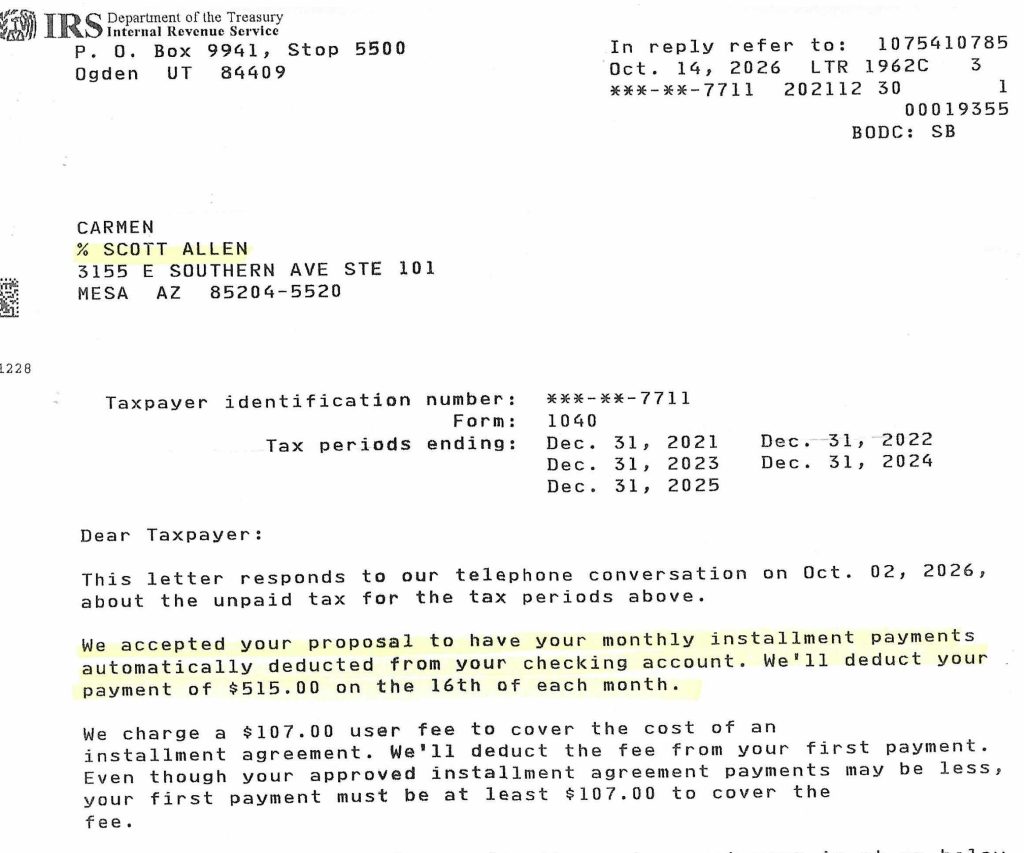
On October 14, 2026, the Internal Revenue Service issued an official letter confirming acceptance of Carmen’s proposed installment agreement.

The IRS correspondence identified federal individual income tax liabilities associated with the following tax years:

  • 2021
  • 2022
  • 2023
  • 2024
  • 2025

Most importantly, the IRS confirmed that Carmen’s proposed monthly installment payments had been accepted.

The IRS approval letter stated:

“We accepted your proposal to have your monthly installment payments automatically deducted from your checking account.”

The letter further confirmed that the IRS would deduct $515 on the 16th of each month.

This was a meaningful accomplishment for Carmen because it established a defined monthly payment arrangement for addressing her outstanding federal income tax obligations.

Instead of facing an uncertain collection situation, Carmen now had an approved payment plan with scheduled monthly withdrawals.

The IRS also assessed a $107 installment agreement user fee, which the agency indicated would be deducted from the first payment.

Although interest and applicable penalties generally continue to accrue while an installment agreement is in effect, an approved payment arrangement can provide taxpayers with greater financial predictability and may help prevent certain enforced collection actions while the agreement remains in good standing.

Carmen’s case illustrates why taxpayers with substantial IRS debts should investigate their available options before assuming they must immediately pay their entire tax balance.

Settle IRS Debts in Phoenix Arizona

Settle IRS Debts in Phoenix Arizona

Why Filing Back Tax Returns Is Often the First Step Toward IRS Tax Relief

One of the most common problems facing taxpayers in Phoenix, Arizona is failing to file federal income tax returns for several consecutive years.

Taxpayers may fall behind for numerous reasons, including financial hardship, business difficulties, missing tax documents, unexpected life events, or simply being unable to afford the taxes they believe they owe.

Unfortunately, failing to file required tax returns generally makes an IRS tax problem more difficult to resolve.

When taxpayers have unfiled federal income tax returns, the IRS may prepare a Substitute for Return using income information reported by employers, financial institutions, and other third parties.

These IRS-prepared returns may not include all the deductions, expenses, credits, or other tax benefits that a taxpayer could otherwise claim.

Consequently, an IRS Substitute for Return can sometimes produce a tax liability that is substantially higher than the amount the taxpayer would owe after filing an accurate original return.

How Tax Debt Advisors, Inc. Helps Phoenix Taxpayers File Back Taxes

Scott Allen, EA assists taxpayers who need to prepare and file delinquent federal income tax returns.

Depending on the circumstances, this process may include obtaining IRS wage and income transcripts, reviewing previously filed returns, identifying missing tax years, reconstructing income and deductible expenses, and preparing accurate federal tax returns.

Once the necessary returns have been prepared and filed, the taxpayer may be in a better position to pursue an IRS tax resolution program.

Taxpayers generally must satisfy applicable filing compliance requirements before the IRS will approve many types of collection alternatives.

For individuals who have not filed taxes in several years, obtaining professional assistance can be an important first step toward resolving their federal tax problems.

Phoenix AZ taxpayers with three, four, five, or more years of unfiled tax returns should not assume their situation is beyond repair. The appropriate solution depends on the taxpayer’s filing requirements, financial circumstances, and IRS account history.

Can Phoenix AZ Taxpayers Settle IRS Debt Through a Monthly Payment Plan?

Many taxpayers mistakenly believe that an IRS tax settlement always means convincing the government to accept pennies on the dollar.

Although the IRS does offer an Offer in Compromise program for qualifying taxpayers, that is only one possible method of resolving federal tax debt.

An IRS installment agreement is another commonly used tax resolution option.

An installment agreement allows an eligible taxpayer to pay outstanding federal tax liabilities through scheduled payments rather than paying the entire balance immediately.

The amount of the monthly payment can depend on several factors, including the total tax liability, applicable IRS collection rules, the taxpayer’s financial circumstances, and the type of installment agreement requested.

In Carmen’s case, Scott Allen, EA successfully helped obtain IRS approval for a $515 monthly direct debit installment agreement.

This type of arrangement can be especially valuable when a taxpayer does not have sufficient savings or available assets to immediately pay the outstanding federal tax debt.

Benefits of an IRS Installment Agreement

An approved IRS payment plan may provide several advantages:

  • A predictable monthly payment amount.
  • The ability to address tax debt over time.
  • Reduced risk of certain IRS enforced collection actions while the agreement remains in good standing.
  • Automatic monthly payments through a direct debit agreement.
  • An opportunity to regain compliance with federal tax obligations.
  • Greater financial stability compared with an unresolved IRS collection account.

However, an installment agreement does not automatically reduce the principal amount of tax owed. Interest and certain penalties may continue to accumulate until the balance is paid, and taxpayers must comply with the terms of their agreements.

An experienced tax representative can evaluate whether an installment agreement is appropriate or whether another resolution strategy may be more beneficial.

Other IRS Tax Debt Settlement Options Available to Phoenix Arizona Taxpayers

Every taxpayer’s financial situation is different. A resolution strategy that works for one individual may not be appropriate for another.

Tax Debt Advisors, Inc. assists taxpayers in evaluating available IRS tax relief options based on their particular circumstances.

1. IRS Offer in Compromise

An Offer in Compromise allows certain qualifying taxpayers to settle their federal tax debt for less than the full amount owed.

The IRS generally evaluates a taxpayer’s ability to pay, income, expenses, and asset equity when considering an offer based on doubt as to collectability.

Not every taxpayer qualifies, and submitting an offer does not guarantee approval.

For taxpayers experiencing significant financial hardship, however, an Offer in Compromise may be worth evaluating.

2. IRS Installment Agreements

An installment agreement allows taxpayers to make monthly payments toward outstanding tax balances.

Depending on eligibility and circumstances, taxpayers may qualify for different types of payment arrangements.

Carmen’s case demonstrates how an approved installment agreement can provide a structured path toward resolving outstanding IRS debt.

3. Currently Not Collectible Status

Some taxpayers simply do not have sufficient income or available assets to make payments toward their outstanding federal tax debt.

When an individual qualifies for Currently Not Collectible status, the IRS may temporarily suspend active collection efforts.

The underlying tax liability generally remains outstanding, and penalties and interest may continue to accrue.

The IRS can also periodically review the taxpayer’s financial situation to determine whether collection activity should resume.

4. IRS Penalty Abatement

IRS penalties can add thousands of dollars to an already substantial tax balance.

Depending on the taxpayer’s history and circumstances, certain penalties may qualify for administrative relief, First Time Abate relief, or reasonable cause penalty abatement.

Scott Allen, EA can review a taxpayer’s IRS account to determine whether penalty relief may be available.

Reducing eligible penalties can sometimes lower the total amount owed and improve the taxpayer’s overall financial position.

5. Filing or Amending Prior-Year Tax Returns

In some situations, taxpayers owe excessive amounts because an original return was prepared incorrectly or because the IRS assessed tax using incomplete information.

Reviewing prior-year returns and filing appropriate amended or original returns may reveal legitimate deductions, credits, or adjustments that reduce the assessed tax liability.

Before negotiating payment arrangements, it is often important to determine whether the IRS balance is accurate.

Why Hire Scott Allen, EA Instead of Handling IRS Debt Alone?

Taxpayers in Phoenix can contact the IRS directly and attempt to resolve their own tax problems.

However, understanding IRS collection procedures, interpreting account transcripts, evaluating financial information, and determining which resolution program is appropriate can be complicated.

Professional representation can be particularly valuable when a taxpayer has multiple years of unfiled returns, significant outstanding balances, or active IRS collection activity.

Scott Allen is an Enrolled Agent, commonly abbreviated as EA.

An Enrolled Agent is a federally authorized tax practitioner who has earned the privilege of representing taxpayers before the Internal Revenue Service.

Unlike professionals whose practices may focus primarily on general accounting or legal matters, Enrolled Agents can specialize in federal taxation and IRS representation.

Through an appropriate IRS power of attorney, typically Form 2848, Scott Allen can communicate directly with the IRS on a client’s behalf regarding authorized tax matters.

This representation may include reviewing IRS account information, communicating with IRS personnel, addressing collection notices, and negotiating eligible payment arrangements.

For many routine IRS collection and tax compliance matters, an experienced Enrolled Agent can provide the specialized representation a taxpayer needs.

Cases involving criminal tax allegations, complex tax litigation, or other legal issues may require an attorney.

The Importance of Hiring a Local Phoenix AZ IRS Tax Resolution Professional

Taxpayers searching online for “Phoenix AZ IRS tax debt settlement” or “Phoenix AZ back tax returns” may encounter numerous national tax relief companies advertising dramatic tax reductions.

However, taxpayers should carefully evaluate any company promising guaranteed settlements or unusually low payments before reviewing their financial circumstances.

Tax Debt Advisors, Inc. provides local taxpayers with the opportunity to meet with Scott Allen, EA, and discuss their individual IRS problems.

Having access to a local tax professional can be particularly helpful when a taxpayer needs assistance gathering financial records, preparing multiple years of delinquent returns, or reviewing IRS correspondence.

Tax Debt Advisors, Inc. serves taxpayers throughout the Phoenix metropolitan area, including Phoenix, Mesa, Gilbert, Chandler, Tempe, Scottsdale, Queen Creek, and surrounding Arizona communities.
Taxpayers do not necessarily need to travel to an IRS office or negotiate directly with an IRS revenue officer when they have properly authorized professional representation.

For individuals who have been avoiding IRS notices or delaying the preparation of delinquent tax returns, meeting with an experienced tax professional can provide a practical starting point.

What Happens When a Phoenix Taxpayer Ignores IRS Tax Debt?

Ignoring federal tax problems rarely makes them disappear.

When a taxpayer fails to address outstanding tax liabilities, the IRS may continue sending notices, assessing applicable penalties and interest, and pursuing collection actions when legally permitted.

Depending on the circumstances and required procedures, potential IRS collection actions can include federal tax liens, wage levies, bank levies, and other enforcement measures.

The IRS generally must follow statutory notice and collection requirements before taking certain enforcement actions.

Nevertheless, allowing tax problems to remain unresolved can significantly limit a taxpayer’s options.

Taxpayers who respond early may have more opportunities to address missing returns, correct inaccurate assessments, request available relief, or negotiate payment terms before collection activity escalates.

An IRS installment agreement or another approved resolution arrangement may help a qualifying taxpayer address the debt in a more organized manner.

How Scott Allen, EA Approaches IRS Tax Debt Resolution

Effective IRS representation generally begins with understanding the taxpayer’s complete federal tax situation.

For taxpayers who owe money to the IRS, Tax Debt Advisors, Inc. can assist with evaluating several important questions.

Are all required federal income tax returns filed?

Does the IRS balance accurately reflect the taxpayer’s actual liability?

Have penalties and interest been assessed correctly?

Does the taxpayer qualify for penalty relief?

Can the taxpayer afford to pay the balance in full?

Would an installment agreement, Offer in Compromise, or Currently Not Collectible status be appropriate?

Are there existing IRS liens, levies, or collection notices that require immediate attention?

By examining these issues, Scott Allen can help identify potential resolution strategies and explain the available options.

Carmen’s successful installment agreement illustrates the value of addressing tax compliance and IRS collection issues through a coordinated approach.

A $515 Monthly IRS Payment Plan Can Make a Meaningful Difference

For taxpayers facing a large IRS balance, the prospect of paying everything immediately may seem impossible.

Carmen’s experience demonstrates that the IRS may approve monthly installment payments instead of requiring immediate payment of the entire outstanding balance.

Her October 14, 2026 IRS approval letter provides written confirmation that the agency accepted her proposed direct debit installment agreement.

The approved payment was $515 per month, with payments scheduled for the 16th.

Although the IRS letter does not establish that Carmen’s underlying tax principal was forgiven or reduced, it confirms an important negotiated collection resolution: an accepted monthly payment arrangement covering the listed tax periods.

This distinction is important because legitimate IRS tax resolution involves understanding the actual terms of an agreement rather than promising that every taxpayer can eliminate most of their tax debt.

For Carmen, the approved arrangement provided a defined method of paying her outstanding obligations.

For other Phoenix taxpayers, the most appropriate solution could be entirely different.

Some may qualify for a lower monthly payment, others may be eligible for penalty relief or an Offer in Compromise, and some may need to focus first on preparing years of missing tax returns.

The key is evaluating the taxpayer’s individual circumstances before selecting a strategy.

Phoenix AZ Taxpayers With Unfiled Returns or IRS Debt Should Seek Help Before Problems Escalate

Many people delay addressing IRS problems because they are embarrassed about missing tax returns or afraid of discovering how much they owe.

Others believe that hiring a tax professional will be too expensive or that the IRS will refuse to work with them.

However, waiting can make an already difficult financial situation more complicated.

Taxpayers who have not filed their 2021, 2022, 2023, 2024, or 2025 federal income tax returns may need assistance determining their filing requirements and identifying which returns must be prepared.

Individuals who already owe substantial IRS balances may benefit from having an Enrolled Agent review their accounts and explain potential resolution options.

Whether a taxpayer owes $15,000, $50,000, $100,000, or more, the available IRS programs and appropriate strategy depend on the taxpayer’s specific facts.

The successful resolution of Carmen’s installment agreement shows that taking action can lead to a more manageable arrangement.

Schedule a Free IRS Tax Debt Consultation With Scott Allen, EA in the Phoenix Area

Taxpayers throughout Phoenix, Mesa, Gilbert, Chandler, Scottsdale, Tempe, and surrounding Arizona communities who are struggling with IRS tax debt or unfiled federal income tax returns can contact Tax Debt Advisors, Inc. for professional assistance.

Scott Allen, EA helps taxpayers understand their IRS obligations, prepare delinquent tax returns, evaluate available tax relief programs, and pursue appropriate IRS collection resolutions.

Carmen’s case is one example of how experienced representation can help a taxpayer obtain an approved IRS installment agreement.

While every IRS case is different and no particular outcome can be guaranteed, taxpayers may have more options than they realize.

Tax Debt Advisors, Inc. offers a free initial consultation for Phoenix-area taxpayers who need assistance with back tax returns, IRS payment plans, or federal tax debt resolution.

Taxpayers do not have to continue facing IRS notices, unfiled tax returns, or growing federal tax balances without understanding their available options.

Visit www.taxdebtadvisors.com to schedule a free consultation with Scott Allen, EA, and take the first step toward resolving IRS tax problems.

Written by Scott Allen

Kerry was represented: Phoenix AZ Back Tax Returns

Phoenix AZ Back Tax Returns: How Tax Debt Advisors, Inc. Helps Taxpayers File Missing Returns and Resolve IRS Debt

For Phoenix-area taxpayers who have fallen behind on filing federal income tax returns, the problem can become more stressful with every passing year. Missing returns can eventually lead to IRS notices, estimated assessments, growing penalties and interest, and collection activity. Some taxpayers avoid dealing with the problem because they believe they must have enough money to pay the entire tax debt before filing their missing returns.

That is not necessarily the case.

The IRS specifically advises taxpayers to file past-due returns even when they cannot immediately pay the resulting balance. Depending on the taxpayer’s circumstances, payment plans and other collection alternatives may be available after filing compliance has been addressed. IRS

For taxpayers searching for help with Phoenix AZ back tax returns, Tax Debt Advisors, Inc. assists individuals with both sides of the problem: preparing delinquent tax returns and representing taxpayers before the IRS to work toward an appropriate resolution of the resulting tax debt.

Phoenix AZ Back Tax Returns and IRS Representation

Falling behind on tax returns is more common than many taxpayers realize. A taxpayer might have missed one year because of a difficult financial period and then become overwhelmed as additional years went unfiled. Others may have been self-employed, operated a business, gone through a divorce, lost financial records, or simply been unsure how to reconstruct several years of income and expenses.

Whatever caused the problem, ignoring unfiled returns generally does not make the situation easier.

The IRS encourages taxpayers to file past-due returns and warns that failure to voluntarily file can lead to additional consequences. Unfiled returns can also create problems when a taxpayer applies for a mortgage, business loan, or other financing where copies of filed tax returns may be requested. IRS

Tax Debt Advisors, Inc. helps Phoenix taxpayers determine which returns need to be filed, obtain available IRS income information when appropriate, prepare the missing returns, and address the collection problem that may remain afterward.

For someone searching online for Phoenix AZ back tax returns, an important point is that filing the returns is often the beginning of the resolution process rather than the end of it.

A Phoenix-Area Taxpayer’s IRS Installment Agreement

The IRS letter shown with this article provides an example of how filing compliance and IRS representation can ultimately lead to a manageable resolution.

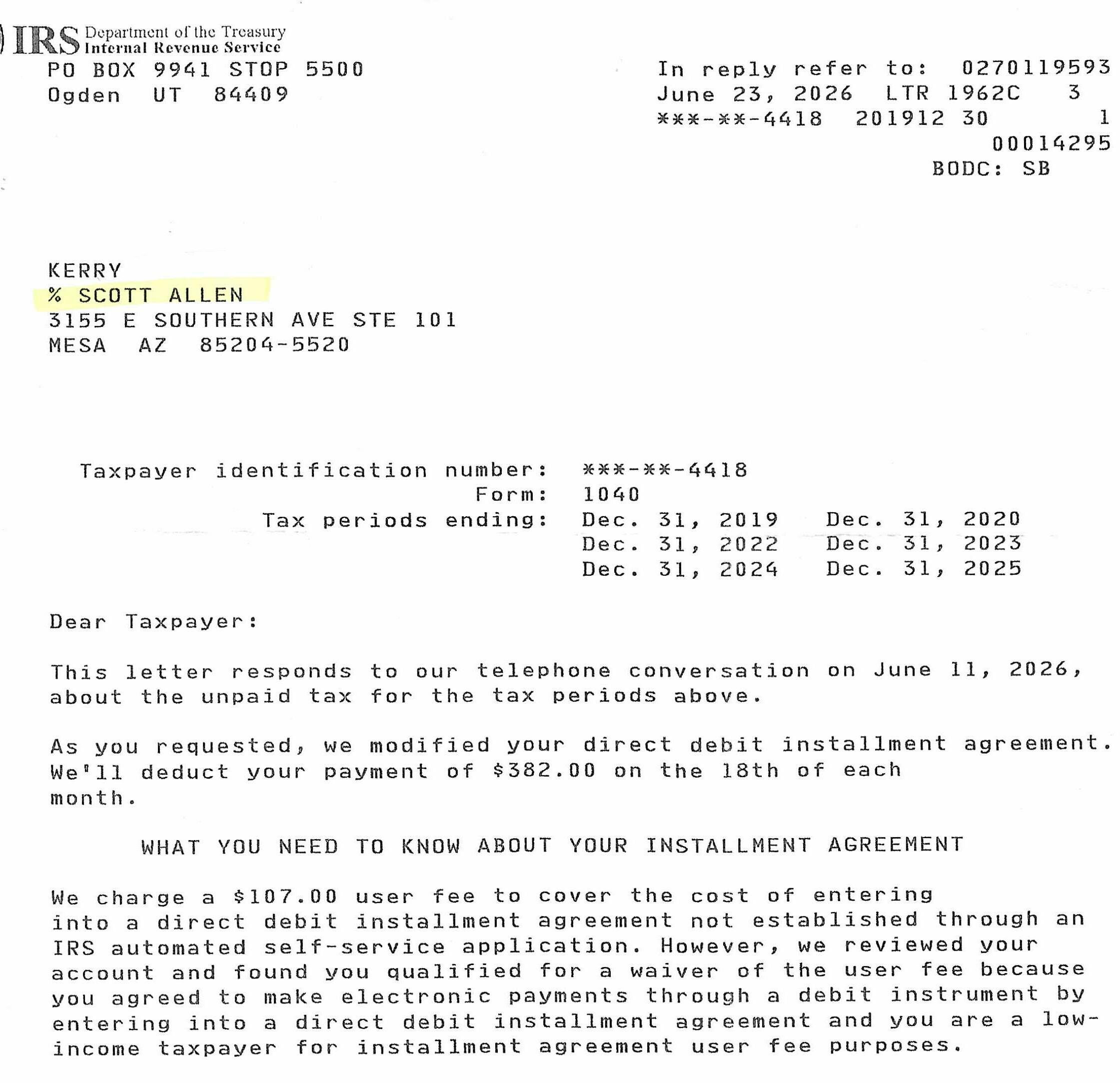
Tax Debt Advisors, Inc. represented a taxpayer who had multiple individual income tax periods involved with the IRS. The IRS correspondence dated June 23, 2026, identifies Form 1040 tax periods ending in 2019, 2020, 2022, 2023, 2024 and 2025.

After addressing the taxpayer’s IRS situation, the account was placed into a direct debit installment agreement requiring a monthly payment of $382.

The IRS letter confirms:

“As you requested, we modified your direct debit installment agreement. We’ll deduct your payment of $382.00 on the 18th of each month.”

This example demonstrates an important point for Phoenix taxpayers with several years of tax problems: owing the IRS does not automatically mean that the entire balance must be paid immediately.

An installment agreement is one of several IRS collection alternatives that may be available depending on the taxpayer’s circumstances.

Every tax situation is different, and the $382 payment obtained in this case should not be interpreted as a guarantee that another taxpayer will qualify for the same result. The appropriate resolution depends on factors including the amount owed, filing compliance, collection statute, income, expenses, assets and the particular IRS program involved.

Kerry's Phoenix AZ Back Tax Returns

Kerry’s Phoenix AZ Back Tax Returns

Filing Back Tax Returns Can Be Critical Before Negotiating With the IRS

Taxpayers sometimes want to negotiate their tax debt before dealing with their missing returns. In many situations, that reverses the order in which the problem needs to be addressed.

The IRS states that most payment plans and tax-debt relief options require taxpayers to have filed all required returns. Current IRS guidance also says that taxpayers generally must be current with filing requirements before a payment plan request can be considered.

That makes identifying and preparing Phoenix AZ back tax returns an important first step.

Tax Debt Advisors, Inc. can help a taxpayer determine the missing years and work toward bringing the taxpayer into filing compliance. Once the required returns have been prepared and filed, attention can turn toward determining how the resulting IRS balance should be resolved.

Taxpayers should also understand that they do not necessarily need to pay everything they owe simply to file their returns. The IRS expressly tells taxpayers who cannot pay in full to file anyway and then consider available payment alternatives.

What Happens When Someone Cannot Pay the IRS in Full?

There is no single IRS settlement program appropriate for everyone.

The IRS currently identifies several potential ways of dealing with federal tax debt, including payment plans, Offers in Compromise, temporary collection delays and penalty relief when the taxpayer qualifies.

One common solution is an installment agreement.

An IRS installment agreement permits an eligible taxpayer to make monthly payments rather than immediately paying the entire tax liability. Current IRS guidance provides several types of payment arrangements, and the requirements depend on the taxpayer’s balance and circumstances.

For qualifying individuals, the IRS’s Simple Payment Plan generally applies when assessed taxes, penalties and interest total $50,000 or less and filing and payment requirements are current. The IRS also states that taxpayers who do not qualify for a Simple Payment Plan may still qualify for another type of payment plan.

That distinction can be important. A taxpayer should not automatically assume that being outside the requirements for a particular IRS program means there are no other resolution possibilities.

Other IRS Tax Debt Resolution Options

An installment agreement is only one possible resolution.

Depending upon the taxpayer’s financial circumstances, an Offer in Compromise may allow a qualifying taxpayer to settle an IRS debt for less than the full amount owed. However, an Offer in Compromise is not automatically available merely because someone owes a large amount of tax. Qualification requirements apply.

Another possibility may be a temporary delay of collection when a taxpayer cannot currently pay because of financial circumstances. The IRS recognizes collection delay as one of its tax-debt resolution options.

There are also circumstances where a Partial Payment Installment Agreement may be considered. The IRS explains that this type of arrangement can apply when a taxpayer cannot afford to fully pay the liability before the applicable Collection Statute Expiration Date. These cases generally require detailed financial disclosure and can be subject to future financial reviews.

The appropriate strategy therefore requires more than simply asking, “How much does the taxpayer owe?”

It requires reviewing the taxpayer’s entire IRS situation.

Why Professional Representation Can Help With Phoenix AZ Back Tax Returns

A taxpayer dealing with several years of unfiled returns may actually be facing two separate problems.

The first is tax preparation: determining what returns are missing and preparing accurate delinquent returns.

The second is IRS collection resolution: determining what should happen with the balance after those returns have been processed.

Tax Debt Advisors, Inc. works with taxpayers on both issues.

Scott Allen, EA, of Tax Debt Advisors, Inc. is an Enrolled Agent who represents taxpayers before the IRS. With appropriate authorization, professional representation can allow the representative to communicate with the IRS regarding the taxpayer’s account and work through the filing and collection issues involved in the case.

That can be particularly valuable when a taxpayer has multiple unfiled years, IRS notices, missing tax records, or a substantial balance that cannot simply be paid in full.

Missing Tax Records Shouldn’t Automatically Stop a Taxpayer From Getting Started

One reason taxpayers continue postponing their Phoenix AZ back tax returns is that they no longer have all of their old tax documents.

Perhaps a W-2 was lost. Maybe the taxpayer cannot locate an old 1099. Someone who was self-employed may have incomplete business records. A taxpayer who moved several times may no longer have paperwork from years ago.

Missing documents can complicate tax preparation, but they do not necessarily mean the taxpayer should continue doing nothing.

IRS wage and income information may be available to help identify income documents reported under a taxpayer’s Social Security number or taxpayer identification number. The appropriate method of reconstructing a return depends on the taxpayer’s circumstances and the records available.

The objective is to determine what information is needed and begin resolving the missing-return problem instead of allowing another year to pass.

Why Staying Current Matters After an IRS Settlement

Getting an installment agreement approved is not the end of a taxpayer’s responsibilities.

The IRS requires taxpayers with payment plans to remain current with their tax obligations. Taxpayers generally need to file required future returns on time, make required payments and continue making their scheduled installment payments. A new unpaid tax liability can jeopardize an existing agreement.

Interest and applicable penalties can also continue to accrue while an unpaid balance remains.

This is why a good IRS resolution strategy should not focus exclusively on yesterday’s tax debt. It should also help prevent the taxpayer from creating another balance in the future.

For an employee, that might involve reviewing federal income tax withholding. For a self-employed taxpayer, it may mean making appropriate estimated tax payments.

Searching for Phoenix AZ Back Tax Returns Help?

Taxpayers with several years of unfiled tax returns can easily feel as though the situation has become too complicated to fix. In many cases, however, the most important action is simply beginning the process.

The taxpayer featured in this case had multiple tax years involved with the IRS. The June 2026 IRS correspondence ultimately confirmed a $382 monthly direct debit installment agreement.

That outcome illustrates why taxpayers should not assume that several years of tax problems automatically mean there is no manageable path forward.

Tax Debt Advisors, Inc. helps Phoenix-area taxpayers identify missing returns, prepare delinquent federal income tax returns, address IRS notices and negotiate tax debt resolution options based on the taxpayer’s individual circumstances.

For taxpayers searching for Phoenix AZ back tax returns, the process generally begins by determining exactly what is missing, getting the required returns prepared and filed, determining the actual IRS balance, and then evaluating the available collection alternatives.

The IRS itself recognizes multiple options for taxpayers who cannot pay their federal tax debt in full.

The key is addressing the problem rather than continuing to postpone it.

Tax Debt Advisors, Inc. serves taxpayers throughout Phoenix, Mesa, Gilbert, Chandler, Tempe, Scottsdale, Queen Creek and surrounding Arizona communities. Taxpayers who need to file back tax returns or resolve an existing IRS debt can contact Tax Debt Advisors, Inc. to discuss their circumstances and determine an appropriate next step.
Written by Scott Allen

IRS Tax Abatement in Gilbert Arizona

Gilbert AZ IRS Tax Abatement: How Scott Allen, EA Helped David Reduce His IRS Debt and Pursue a Payment Plan

Receiving an IRS notice showing a balance of tens of thousands of dollars can be overwhelming for any taxpayer. For a Gilbert, Arizona taxpayer named David, an IRS assessment on his 2022 tax return resulted in a balance of more than $73,000. Rather than attempting to resolve the matter alone, David authorized Scott Allen, EA of Tax Debt Advisors, Inc. to represent him before the Internal Revenue Service through Power of Attorney.

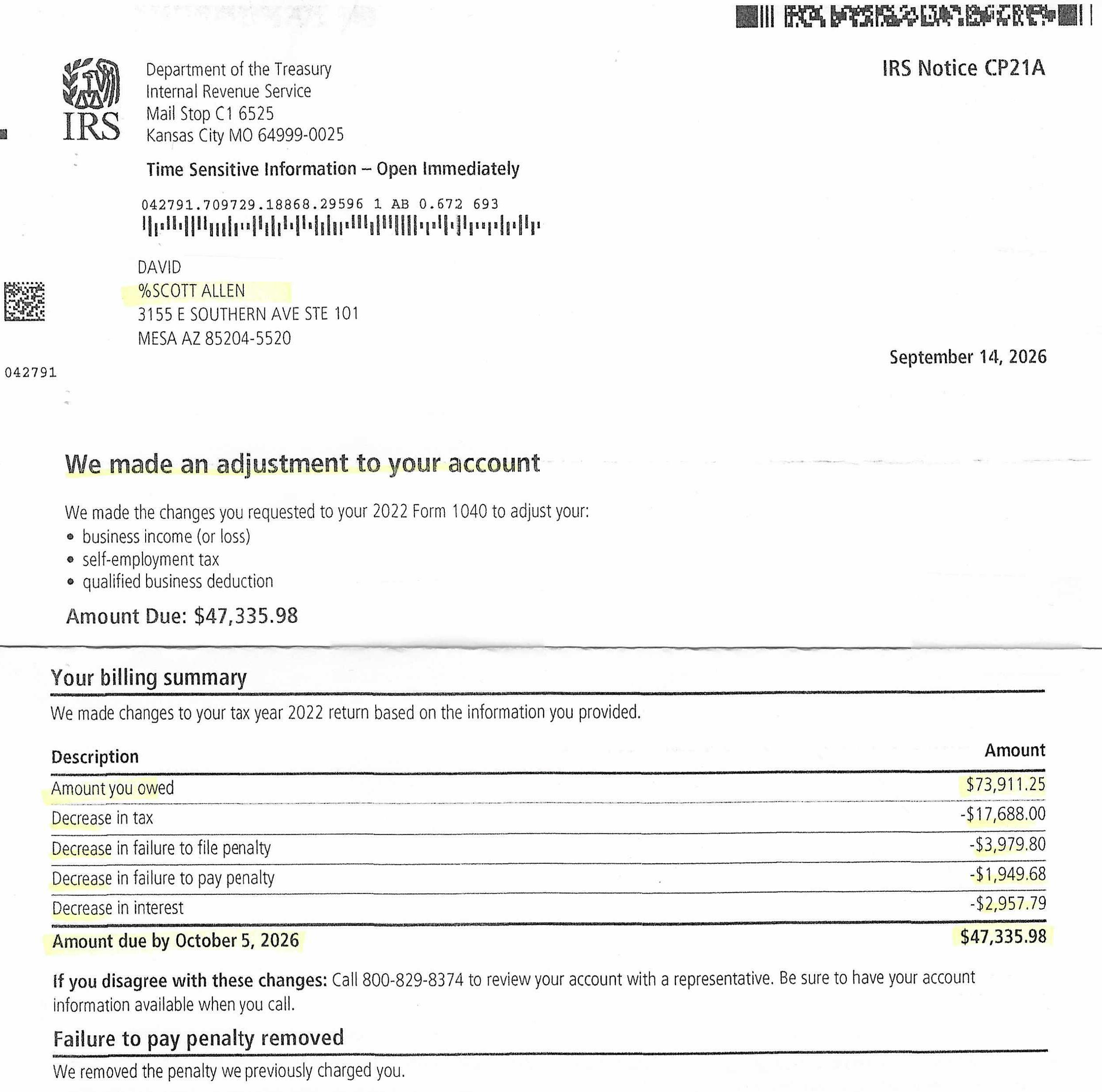
Scott Allen, EA reviewed David’s tax situation, examined the IRS adjustments, worked on correcting the underlying tax liability, and successfully obtained reductions in tax, penalties, and interest. The IRS subsequently issued Notice CP21A showing that the amount due had been reduced to $47,335.98.

Scott Allen, EA is now working with David to negotiate an appropriate IRS payment plan based on the reduced balance.

This case illustrates an important point for taxpayers in Gilbert and throughout the East Valley: an IRS notice is not necessarily the final word on what a taxpayer ultimately has to pay. Depending on the facts of the case, there may be opportunities to correct tax returns, challenge IRS adjustments, request penalty relief, address interest, and negotiate an appropriate collection resolution.


David’s Gilbert AZ IRS Tax Problem

David’s IRS problem involved his 2022 federal income tax return. According to the IRS Notice CP21A issued on September 14, 2026, the IRS made adjustments involving:

  • Business income or loss
  • Self-employment tax
  • Qualified business income deduction

The initial amount shown as owed was $73,911.25.

After Scott Allen, EA reviewed and worked on the taxpayer’s account, the IRS notice showed the following reductions:

IRS Adjustment Amount Reduced
Decrease in tax $17,688.00
Decrease in failure-to-file penalty $3,979.80
Decrease in failure-to-pay penalty $1,949.68
Decrease in interest $2,957.79
Total reduction $26,575.27
Remaining amount due $47,335.98

The IRS notice states that the changes were made to the taxpayer’s 2022 Form 1040 based on information provided to the IRS.

For David, this meant that the IRS balance went from $73,911.25 to $47,335.98.

That is a reduction of more than $26,000 before addressing how the remaining balance would be paid.

Gilbert AZ IRS Tax Abatement

Gilbert AZ IRS Tax Abatement


Scott Allen, EA Represented David Before the IRS

One of the important components of David’s case was the Power of Attorney authorization.

The IRS permits taxpayers to authorize qualified professionals to represent them before the agency. Form 2848, Power of Attorney and Declaration of Representative, is used to authorize an eligible representative. The IRS specifically recognizes attorneys, CPAs, and Enrolled Agents as professionals with unlimited representation rights before the IRS.

An authorized representative can communicate with the IRS concerning the matters and tax periods covered by the Power of Attorney. This can allow the taxpayer’s representative to handle correspondence, discuss the account with IRS personnel, advocate for the taxpayer, and work through collection and tax issues without requiring the taxpayer to personally handle every IRS conversation.

In David’s situation, Scott Allen, EA was able to work directly on the IRS matter rather than simply telling David what he should do himself.

That distinction can be extremely important when an IRS account involves disputed tax, penalties, interest, business income, self-employment tax, or other complicated adjustments.


An IRS Balance Should Be Reviewed Before It Is Simply Paid

Many taxpayers receive an IRS notice and immediately assume that the amount shown is unquestionably correct.

That is not always the best approach.

When an IRS assessment is based on information that may be incomplete, misunderstood, or different from the taxpayer’s actual tax situation, the account may need to be reviewed carefully.

The IRS itself recognizes that taxpayers may need to amend previously filed returns when there are changes involving income, deductions, credits, dependents, filing status, or tax liability.

A qualified tax professional can review the underlying tax return and IRS adjustments to determine whether the assessment appears accurate and whether documentation or amended filings may be appropriate.

In David’s case, Scott Allen, EA was able to work through the tax issues and obtain reductions in the tax, penalties, and interest.

The result was not simply a new payment arrangement on the original $73,911.25 balance. The underlying amount was first reduced to $47,335.98.

That is an important distinction.

A payment plan on a lower legally supportable balance can be very different from simply agreeing to pay the original IRS assessment.


Penalty Abatement Can Be an Important Part of IRS Tax Resolution

Penalties can add thousands of dollars to an IRS balance.

The IRS has several forms of penalty relief. Depending on the circumstances, taxpayers may qualify for relief through programs such as First Time Abate, reasonable-cause relief, or other statutory or administrative provisions. The IRS states that reasonable-cause determinations are made based on the facts and circumstances of each individual case.

David’s IRS notice specifically shows reductions in both the failure-to-file and failure-to-pay penalties.

The notice also shows a reduction in interest.

Taxpayers should not assume that every penalty or adjustment can automatically be removed. Relief depends on the applicable rules and the taxpayer’s facts. However, when a taxpayer receives a large IRS balance, a review of penalties and interest should be part of the overall resolution process.


Why a Gilbert AZ Enrolled Agent Can Be an Alternative to a Tax Attorney

Taxpayers facing IRS problems frequently ask whether they need to hire a Gilbert AZ IRS tax attorney.

An attorney can certainly represent taxpayers before the IRS. However, the IRS makes clear that Enrolled Agents, CPAs, and attorneys all have unlimited representation rights before the IRS.

This means an Enrolled Agent can represent a taxpayer in matters involving IRS audits, collections, payment plans, and appeals.

The IRS describes an Enrolled Agent as a federally authorized tax practitioner who has earned the privilege of representing taxpayers before the IRS. The IRS also states that Enrolled Agents have unlimited practice rights and can represent taxpayers regarding any tax matter before any IRS office.

Scott Allen, EA is therefore able to represent taxpayers before the IRS without being an attorney.

Tax Knowledge Is Often the Central Issue

Many IRS problems are fundamentally tax problems.

They may involve:

  • Business income
  • Self-employment tax
  • Deductions
  • Qualified business income
  • Amended returns
  • Penalty abatement
  • IRS notices
  • Back tax returns
  • IRS collection procedures
  • Installment agreements
  • Offers in Compromise
  • Currently Not Collectible status
  • IRS audits and protests

An Enrolled Agent’s practice is specifically focused on federal taxation and representation before the IRS.

The IRS explains that individuals who become Enrolled Agents generally must pass a comprehensive three-part Special Enrollment Examination covering individual and business tax returns and representation, or qualify through certain former IRS employment experience. Enrolled Agents are also required to complete continuing education.

That makes an EA a professional option for taxpayers whose primary problem is resolving an IRS tax matter.


Does a Taxpayer Always Need an Attorney?

There are situations where an attorney may be particularly appropriate.

For example, a taxpayer dealing with litigation, certain legal disputes, criminal tax matters, complex legal opinions, or other issues requiring specialized legal services may need an attorney.

But many ordinary IRS controversies do not require litigation.

A taxpayer dealing with an IRS balance, penalty problem, payment plan, tax adjustment, audit, collection issue, or amended return may be able to work with an Enrolled Agent who has the authority to represent the taxpayer before the IRS.

The important question is therefore not simply:

“Does this taxpayer need a lawyer?”

A more useful question can be:

“What type of professional has the appropriate credentials and experience to solve this particular IRS problem?”

For many taxpayers, an experienced Enrolled Agent can provide the tax expertise and IRS representation needed without the taxpayer automatically having to retain a tax attorney.

Taxpayers should also compare the experience, services, communication style, and fees of any professional they are considering.


Scott Allen, EA Provides Local IRS Representation for Gilbert Taxpayers

Tax Debt Advisors, Inc. is located in Mesa, Arizona, and Scott Allen, EA provides IRS representation to taxpayers throughout the East Valley, including Gilbert, Chandler, Mesa, Queen Creek, Tempe, Scottsdale, and surrounding communities.

The firm’s website identifies Scott Allen, EA as an Enrolled Agent and describes services including IRS Power of Attorney representation, IRS settlement options, back tax return preparation, IRS tax debt help, payment plans, and IRS audit assistance.

For Gilbert taxpayers, having a local professional can also make the process more personal. Instead of simply calling a national tax resolution call center, taxpayers can meet with the professional who will actually work on their IRS case.

Tax Debt Advisors’ website provides additional information about its local Mesa practice and Scott Allen’s background as an Enrolled Agent.


The Next Step for David: Negotiating an IRS Payment Plan

After the tax, penalties, and interest were reduced, David’s remaining balance was $47,335.98.

Scott Allen, EA is now working on the next phase of the case: negotiating an appropriate payment plan with the IRS.

The IRS offers several payment options for taxpayers who cannot immediately pay their entire balance. Depending on the circumstances, taxpayers may qualify for short-term or long-term payment arrangements.

The IRS currently states that qualifying individual taxpayers with $50,000 or less in combined assessed tax, penalties, and interest may generally qualify for its Simple Payment Plan if they have filed all required returns. Other taxpayers may qualify for different installment agreement options depending on their circumstances.

David’s reduced balance of $47,335.98 is therefore particularly significant as Scott works on the payment-plan phase of the case.

The ultimate payment arrangement, however, depends upon the taxpayer’s circumstances and the IRS requirements applicable to the account.


Gilbert AZ Taxpayers Do Not Have to Face the IRS Alone

David’s case demonstrates why an IRS problem should be evaluated rather than ignored.

His original IRS balance was $73,911.25.

After Scott Allen, EA represented him and worked through the tax matter, the IRS notice reflected:

$26,575.27 in combined reductions to tax, penalties, and interest.

The resulting balance was:

$47,335.98

The next step is working toward an appropriate payment arrangement for the remaining balance.

Every IRS case is different. Not every taxpayer will qualify for the same tax reduction, penalty abatement, or payment plan. However, taxpayers should understand that there can be multiple steps involved in resolving an IRS liability.

For Gilbert, Arizona taxpayers dealing with IRS back taxes, penalties, disputed tax assessments, business-income adjustments, or collection problems, working with an experienced Enrolled Agent can provide a way to have the tax matter professionally reviewed and, when appropriate, handled directly with the IRS.

Scott Allen, EA of Tax Debt Advisors, Inc. provides local IRS representation and can represent taxpayers before the IRS through Power of Attorney.

Gilbert taxpayers who have received an IRS notice or are struggling with an IRS balance can contact Tax Debt Advisors, Inc. to have their situation reviewed and determine what options may be available.

Tax Debt Advisors, Inc.

Tax Debt Advisors, Inc.
3155 E. Southern Avenue, Suite 101
Mesa, AZ 85204
Phone: (480) 926-9300

For official IRS information about representation, taxpayers can also review the IRS guidance on Enrolled Agents, Power of Attorney, penalty relief, amended returns, and payment plans.

IRS Enrolled Agent Information
IRS Form 2848 – Power of Attorney
IRS Payment Plans

This case study is based on the IRS notice provided for David. IRS outcomes vary based on the taxpayer’s individual facts, financial circumstances, tax history, documentation, and applicable IRS rules.

Written by Scott Allen

Robert’s Mesa AZ IRS Settlement

Mesa AZ IRS Settlement: How Scott Allen, EA Helped Robert Resolve $673,000 in IRS Tax Debt

For taxpayers facing a large IRS balance, the amount shown on an IRS notice can feel overwhelming. A tax debt of hundreds of thousands of dollars may seem impossible to resolve, especially when the taxpayer also has missing tax returns, incomplete records, or years of unresolved tax problems.

However, an IRS tax debt does not necessarily have to be paid all at once. The Internal Revenue Service has several resolution options available to qualified taxpayers, and an installment agreement can sometimes allow a taxpayer to resolve a substantial tax liability through affordable monthly payments based on the taxpayer’s financial circumstances.

A recent case involving Robert, a Mesa, Arizona taxpayer, illustrates how professional IRS representation can make a significant difference when dealing with a large federal tax liability.

Scott Allen, EA of Tax Debt Advisors, Inc., represented Robert before the IRS through a Power of Attorney, prepared and filed his back tax returns, and worked with the IRS to establish a payment arrangement of just $254 per month on an IRS debt of approximately $673,000.

The IRS subsequently issued correspondence confirming the installment agreement and stating that Robert’s payment would be $254 due on the 28th of each month beginning October 28, 2026.

A $673,000 IRS Tax Debt Can Be Overwhelming

When a taxpayer receives IRS correspondence showing a balance of hundreds of thousands of dollars, the first reaction is often fear and uncertainty.

Questions can quickly arise:

  • How can the IRS debt possibly be paid?
  • Will the IRS levy a bank account?
  • Could wages be garnished?
  • Can the IRS take property?
  • What happens if tax returns have not been filed?
  • Is an Offer in Compromise possible?
  • Can the taxpayer qualify for an installment agreement?
  • How much will the monthly payment be?
  • Does the taxpayer need an attorney?
  • Can someone communicate with the IRS on the taxpayer’s behalf?

These are serious questions, particularly when several tax years are involved.

For Mesa taxpayers dealing with these circumstances, professional IRS representation can provide a structured process for determining what returns need to be filed, establishing the correct tax liabilities, reviewing the taxpayer’s financial situation, and identifying the IRS resolution options that may be available.

That was the approach taken by Scott Allen, EA in Robert’s case.

Scott Allen, EA Represented Robert Before the IRS

Scott Allen, EA of Tax Debt Advisors, Inc. was able to represent Robert directly before the IRS after obtaining Power of Attorney authorization.

A Power of Attorney allows an authorized tax professional to communicate with the IRS regarding a taxpayer’s tax matters within the scope of the authorization.

This can be particularly valuable when a taxpayer has several unresolved tax issues. Instead of the taxpayer attempting to navigate IRS procedures alone, the tax professional can communicate with the IRS, submit documentation, address outstanding filing requirements, and work toward an appropriate resolution.

In Robert’s case, Scott Allen, EA handled the representation and worked through the process of getting Robert’s tax situation into compliance.

Filing Back Tax Returns Was an Important Part of the Process

One of the first problems many taxpayers with IRS debt face is that they have not filed all of their required tax returns.

A taxpayer may have several years of missing returns because of financial problems, personal circumstances, business difficulties, lost records, or simply because the taxpayer became overwhelmed by the situation.

Unfortunately, ignoring missing tax returns generally does not make the problem disappear.

The IRS can file substitute returns in certain circumstances, and those returns may not include all deductions, credits, or other information that the taxpayer could have claimed had the taxpayer filed an accurate return.

Scott Allen, EA was able to prepare and file Robert’s missing back tax returns as part of the overall IRS resolution process.

Getting the required returns filed can be an important step toward determining the taxpayer’s actual tax liability and establishing what resolution options may be available.

The IRS Debt Was Approximately $673,000

Robert’s situation involved an IRS liability of approximately $673,000.

A balance of that size could potentially create enormous financial pressure if the IRS demanded immediate payment.

Instead of simply accepting the large balance as an amount that had to be paid immediately, Scott Allen, EA evaluated Robert’s financial circumstances and worked with the IRS to establish an installment agreement.

The result was a monthly payment of only $254.

The IRS letter dated September 17, 2026, confirms that the IRS established an installment agreement based on Robert’s financial situation.

The letter states that the payment is $254 per month, due on the 28th of each month, beginning October 28, 2026. It also explains that the payment will continue until the balance is paid in full or Robert’s financial situation changes.

That distinction is important.

Robert's Mesa AZ IRS Settlement

Robert’s Mesa AZ IRS Settlement

An IRS Payment Plan Is One Type of Tax Debt Resolution

There are many different ways that IRS tax debt may potentially be resolved. An installment agreement is just one of those options.

Depending on the taxpayer’s circumstances, other IRS resolution strategies can include:

  • Installment agreements
  • Offer in Compromise
  • Currently Not Collectible status
  • Partial-pay installment agreements
  • Payment arrangements based on financial circumstances
  • Filing delinquent tax returns
  • Correcting IRS-filed substitute returns
  • Challenging certain IRS assessments
  • Addressing IRS liens and levies
  • Resolving specific notices or collection issues

Not every option is available to every taxpayer.

The appropriate strategy depends on factors such as income, expenses, assets, equity, filing compliance, the amount and type of tax debt, and the taxpayer’s overall financial circumstances.

That is why an experienced review of the taxpayer’s situation can be important before deciding how to approach the IRS.

A Low Monthly Payment Does Not Mean the IRS Debt Disappeared

Robert’s case is also an important example of the difference between reducing a tax debt and establishing an affordable payment arrangement.

The approximately $673,000 tax liability was not simply erased because the IRS established a $254 monthly installment agreement.

Instead, the IRS agreed to accept the specified monthly payment based on Robert’s financial circumstances.

The IRS letter specifically states that the payment will continue until the balance is paid in full or the taxpayer’s financial situation changes.

This is an important distinction for taxpayers researching “IRS settlement” options in Mesa, Arizona.

An IRS settlement can refer broadly to resolving a tax problem, but not every resolution results in the IRS accepting less than the full amount owed. An installment agreement can be a legitimate way to resolve an IRS collection problem while allowing the taxpayer to make manageable monthly payments.

Mesa Taxpayers Should Not Ignore Back Taxes

Robert’s experience also illustrates why Mesa taxpayers with unfiled tax returns should consider addressing the problem rather than continuing to ignore it.

Back taxes can become more complicated as additional years pass.

Penalties and interest can accumulate, IRS notices can escalate, and collection activity can potentially become more serious.

For someone who has multiple unfiled returns, trying to solve everything at once without professional assistance can also be overwhelming.

A Mesa taxpayer may have records scattered across multiple years, incomplete income documentation, old bank statements, missing business records, or other information that needs to be reconstructed.

Tax Debt Advisors, Inc. can help taxpayers work through these issues and determine what needs to be filed and what IRS resolution options may be appropriate.

Local Mesa IRS Representation

For taxpayers in Mesa and throughout the East Valley, working with a local tax professional can provide a different experience than dealing with a large national tax-relief company.

Tax Debt Advisors, Inc. is located in Mesa, Arizona, and Scott Allen, EA provides IRS representation for taxpayers dealing with federal tax problems.

The firm works with taxpayers dealing with issues such as:

  • Unfiled and delinquent tax returns
  • IRS back taxes
  • IRS payment plans
  • IRS installment agreements
  • IRS Offers in Compromise
  • Currently Not Collectible status
  • IRS levies
  • IRS wage garnishments
  • Federal tax liens
  • CP2000 notices
  • Substitute for Return issues
  • IRS audits and audit protests
  • IRS collection problems
  • Taxpayer representation through Power of Attorney

The objective is to determine what the taxpayer’s actual situation is and then work toward an IRS resolution based on the taxpayer’s circumstances.

The Importance of Addressing the Entire IRS Problem

Robert’s case demonstrates that an IRS problem is not necessarily solved simply by knowing how much the taxpayer owes.

The underlying issue may involve missing returns, IRS assessments, collection activity, financial hardship, or several of these problems at the same time.

Scott Allen, EA was able to address multiple components of Robert’s situation by representing him before the IRS, preparing and filing his back tax returns, and negotiating an installment agreement based on his financial situation.

The ultimate result was an IRS payment arrangement requiring $254 per month, despite an approximately $673,000 IRS tax liability.

For a taxpayer facing a balance of that size, establishing an affordable monthly payment can provide a structured path for dealing with the IRS rather than leaving the taxpayer unsure of what to do next.

Mesa AZ Taxpayers With Back Taxes Have Options

Robert’s case is a reminder that receiving a large IRS balance does not necessarily mean the taxpayer has no options.

There are multiple IRS tax resolution strategies, and an installment agreement is one potential solution. Other taxpayers may qualify for different forms of relief depending on their financial circumstances and tax history.

For Mesa, Gilbert, Chandler, Tempe, Queen Creek, and other East Valley taxpayers who have unfiled returns or significant IRS tax debt, the first step is often determining exactly what the IRS is claiming is owed and bringing the taxpayer’s filing history up to date.

Scott Allen, EA of Tax Debt Advisors, Inc. provides local IRS representation in Mesa, Arizona and can represent taxpayers before the IRS through Power of Attorney.

Mesa taxpayers who are behind on their tax returns or struggling with a large IRS balance can contact Tax Debt Advisors, Inc. to have their situation reviewed and determine what IRS tax resolution options may be available.

Tax results vary from taxpayer to taxpayer. An installment agreement, Offer in Compromise, Currently Not Collectible status, or other IRS resolution is subject to applicable IRS requirements and the taxpayer’s individual financial circumstances.

Written by Scott Allen

Mesa Arizona Back Tax Returns and Debt

Resolving Back Tax Debt in Mesa, Arizona: How Scott Allen, EA Helps Taxpayers Regain Control and Peace of Mind

Falling behind on tax filings or accumulating unmanageable IRS debt can feel overwhelming. For many individuals and business owners in Mesa, Arizona, dealing with back taxes creates constant anxiety, fear of wage garnishments, bank levies, or federal tax liens. When the Internal Revenue Service (IRS) starts sending collection notices or automated warning letters, taxpayers often feel paralyzed, unsure of where to turn or how to fix a complex tax situation.

Fortunately, resolving tax debt and back tax returns does not have to be an agonizing or solitary experience. Working with a dedicated, local tax professional who understands IRS procedures inside and out can make all the difference. Scott Allen, EA (Enrolled Agent) of Tax Debt Advisors, Inc. has spent decades helping struggling taxpayers navigate IRS complications, prepare unfiled back tax returns, and negotiate realistic, sustainable tax settlements.

The Reality of Unfiled Back Tax Returns and IRS Collection Efforts

When an individual misses a tax deadline—whether for a single year or several consecutive years—the IRS does not simply forget about the debt. Over time, unfiled returns trigger automated assessment routines, accrued failure-to-file and failure-to-pay penalties, and compound interest. In many instances, the IRS will construct a Substitute for Return (SFR) on behalf of the taxpayer.

An SFR is rarely advantageous to the taxpayer. When the IRS prepares a substitute return, it includes income reported via 1099s, W-2s, and other information returns, but it completely excludes legitimate deductions, dependents, credits, or business expenses that the taxpayer is rightfully entitled to claim. As a result, the tax balance calculated under an SFR is almost always drastically higher than what the actual tax liability should be.

Overcoming Missing Records and Documentation Gaps

One of the primary reasons taxpayers delay filing missing tax returns is the lack of organized financial records. Documents get misplaced during moves, lost in digital clutter, or destroyed over time. Many people assume that without original W-2s, 1099s, or receipts, filing back tax returns is impossible.

Scott Allen, EA specializes in solving this exact problem. As an Enrolled Agent with Power of Attorney representation rights, Scott can request official IRS wage and income transcripts directly from the Internal Revenue Service. These official records allow him to reconstruct accurate, fully compliant tax returns for all unfiled years—even if the client has zero personal records on hand. By replacing synthetic IRS estimates or SFR filings with true, accurate tax returns, Scott frequently reduces the client’s perceived tax liability substantially right from the start.

Why You Should Beware of Out-of-State “1-800” Pennies-on-the-Dollar Claims

Turn on late-night radio or television, or search the internet for tax assistance, and you will undoubtedly encounter aggressive advertising campaigns from giant national tax resolution firms. These out-of-state “1-800” tax companies often make extravagant promises, advertising that they can settle tax debts for “pennies on the dollar” through an Offer in Compromise (OIC).

The Truth About “Pennies on the Dollar” Settlements

While an Offer in Compromise is a valid legal remedy provided by the IRS, the qualification criteria are exceedingly strict. The IRS only approves an Offer in Compromise when a taxpayer can demonstrably prove that their net income, assets, and future earning potential make it mathematically impossible for the IRS to collect the full tax debt within the statutory timeline.

In reality, very few taxpayers actually qualify for an Offer in Compromise.

National tax mills frequently take large non-refundable retainers from clients, promise dramatic debt reductions without reviewing their detailed financial standing, and then deliver minimal results or file unqualified OIC applications that are quickly rejected by the IRS. Meanwhile, months pass, penalties continue to accrue, and the client remains in jeopardy.

The Local Advantage: Face-to-Face Accountability in Mesa, Arizona

Choosing to work with a local tax professional like Scott Allen, EA offers distinct advantages that national 1-800 entities cannot replicate:

  1. Direct Communication and Power of Attorney: When hiring Scott Allen, EA, clients work directly with an experienced Enrolled Agent who represents them directly before the IRS under an official Power of Attorney (Form 2848). Clients are never passed between anonymous call-center operators or automated ticket systems.

  2. Personalized, Honest Financial Evaluation: Scott conducts a thorough analysis of actual financial standing, verifying whether an Offer in Compromise, an Installment Agreement, or a Currently Not Collectible status is truly the best fit for unique circumstances.

  3. Local Reputation & Track Record: Serving Mesa and the surrounding East Valley community, Tax Debt Advisors, Inc. builds its practice on long-term trust, verified success stories, and transparent communication.

Real-World Case Study: How Scott Allen, EA Helped Robert Resolve His IRS Debt & Avoid Tax Liens

To understand how professional tax representation works in practice, consider the real-world case of Robert, a client who turned to Scott Allen, EA for help with multiple years of unfiled tax returns and mounting IRS debt.

The Challenge: Multiple Missing Years and Rising Enforcement Risk

Robert had accumulated unfiled tax returns spanning six tax periods (December 31 of 2018, 2021, 2022, 2023, 2024, and 2025). As the years compounded, so did his stress. With unpaid tax liabilities looming across multiple tax periods, Robert faced severe risks, including potential wage garnishment, bank levies, and the filing of a Notice of Federal Tax Lien.

A Notice of Federal Tax Lien is a formal public document filed by the government to secure its interest in a taxpayer’s real estate or personal assets. Beyond clouding asset titles, a tax lien can severely damage personal and business credit ratings, making financing, leasing, or refinancing virtually impossible.

The Strategic Solution: Preparation, Representation, and Strategic Debt Structuring

Upon being retained under Power of Attorney, Scott Allen, EA executed a step-by-step resolution plan:

  1. IRS Representation via Power of Attorney: Scott assumed full legal representation before the IRS, taking over all direct communications and halting aggressive collection demands against Robert.

  2. Filing All Back Tax Returns: Scott prepared and filed all missing Form 1040 tax returns for the tax periods ending December 31, 2018, 2021, 2022, 2023, 2024, and 2025. By preparing accurate returns with all rightful tax deductions and credits, Robert’s true liability was established.

  3. Lien Prevention Strategy: IRS collection rules allow streamlined installment agreements without mandatory federal tax lien filings if the total unpaid debt is successfully negotiated and structured below $50,000. Scott structured Robert’s filings and debt settlement to bring the total debt safely below this key threshold.

  4. Negotiating an Approved IRS Direct Debit Installment Agreement: Following direct negotiations with the IRS (concluded via telephone consultation), Scott successfully secured an official IRS Installment Agreement acceptance letter (LTR 1962C issued on September 10, 2026).

The Outcome: A Sustainable $700/Month Plan and Complete Lien Protection

The IRS officially accepted Robert’s proposal for an affordable Direct Debit Installment Agreement, deducting $700.00 per month directly from his checking account on the 8th of each month, along with the standard $107.00 agreement user fee.

Because the total debt was structured safely under the $50,000 mark and placed into an automatic direct-debit payment plan, the IRS was prevented from filing a Federal Tax Lien against Robert. Robert achieved full tax compliance, protected his personal credit and property, and gained a clear, predictable path toward complete financial freedom.

Back Tax Return Help In Mesa Arizona

Back Tax Return Help In Mesa Arizona

Key Benefits of Having IRS Power of Attorney Representation

Many taxpayers do not realize that they do not have to speak directly to the IRS themselves. When executing an IRS Power of Attorney with an Enrolled Agent like Scott Allen:

  • No Direct IRS Contact Required: Taxpayers no longer need to endure frustrating hours on hold with the IRS or handle intimidating collection calls. All communications, notices, and settlement negotiations are handled directly by their licensed representative.

  • Immediate Protection: Once Power of Attorney is on file with the IRS Centralized Authorization File (CAF) unit, the IRS is legally required to route collection contacts through the representative.

  • Expert Negotiation Skills: An Enrolled Agent understands the Internal Revenue Manual (IRM), legal rights of taxpayers, and administrative relief programs, ensuring clients receive the absolute best settlement allowable by law.

Steps to Take If You Owe Back Taxes or Have Missing Returns

If you are currently struggling with unfiled tax returns or back tax debt in Mesa, Arizona, taking prompt action is the single most effective way to protect your financial future. Follow these essential steps:

  1. Stop Ignoring IRS Letters: IRS notices operate on strict timelines. Ignoring statutory notices of intent to levy or lien only accelerates enforcement actions.

  2. Avoid Unrealistic Quick-Fix Schemes: Be skeptical of any tax relief company promising guaranteed $0 settlements before analyzing your actual income and asset financials.

  3. Consult a Verified, Local Enrolled Agent: Schedule a consultation with a local practitioner like Scott Allen, EA at Tax Debt Advisors, Inc.

  4. Gather What You Have (or Let Your EA Retrieve Transcripts): Even if you lack complete tax records, a professional Enrolled Agent can obtain official IRS transcripts to complete back returns accurately.

  5. Establish a Compliant Resolution Plan: Whether through a streamlined installment agreement, currently not collectible status, or an offer in compromise (if truly qualified), moving into full compliance stops levies, liens, and severe penalties.

Take Back Control of Your Financial Future Today

Tax debt does not resolve itself, but with the right professional representation, it can be handled efficiently, affordably, and permanently. Scott Allen, EA of Tax Debt Advisors, Inc. brings decades of local expertise, dedicated representation, and proven strategies to taxpayers in Mesa, Arizona and surrounding areas.

By taking control, filing missing back tax returns, and negotiating a manageable payment plan—just as Scott did for Robert—you can protect your assets, prevent tax liens, and enjoy true peace of mind.

Contact Information:

Written by Scott Allen

Negotiating IRS Debt in Mesa AZ

Navigating IRS Debt: How to Negotiate IRS Debt in Mesa, AZ

Receiving official mail from the Internal Revenue Service is a universal trigger for anxiety, particularly when an individual is already carrying the heavy burden of unpaid back taxes. For residents living in Mesa, Arizona, and the surrounding East Valley, a common document arriving in mailboxes is IRS Letter LTR 2273C.

Understanding what this letter signifies, knowing how to establish a formal agreement, and taking the correct steps to clear missing tax returns are critical components of achieving long-term financial stability. Working with a dedicated, licensed professional—such as Scott Allen, EA at Tax Debt Advisors, Inc.—allows taxpayers to efficiently negotiate IRS debt in Mesa, AZ, avoid harsh collection tactics, and secure a manageable pathway out of tax debt.

Understanding IRS Letter LTR 2273C

When the IRS issues Letter LTR 2273C, it serves as formal written confirmation that an installment agreement request has been accepted or modified.

Unlike aggressive demand notices or threat of levy letters, LTR 2273C reflects a working arrangement between the taxpayer and the federal government. For example, a standard LTR 2273C clearly outlines the foundational terms of an installment plan, detailing essential facts:

  • Taxpayer Identification and Periods Covered: The letter identifies the specific tax years included under the agreement (such as Form 1040 for tax years ending December 31, 2023, 2024, and 2025).

  • Monthly Payment Terms: It explicitly states the agreed-upon monthly payment amount and the precise day of the month the payment is due.

  • Establishment Fees: The notice breaks down the statutory user fees charged by the IRS to institute an installment agreement—typically $178 for standard setups, or reduced rates (such as $43) for taxpayers who qualify under low-income federal guidelines.

While receiving Letter LTR 2273C confirms that a payment plan is in place and immediate collections are paused, it is vital to remember that an installment agreement is a legally binding contract. Failing to make payments on time, failing to pay future tax liabilities, or failing to file subsequent tax returns will cause the agreement to default, immediately exposing the taxpayer to wage garnishments, bank levies, and tax liens.

Negotiate IRS Debt in Mesa AZ

Negotiate IRS Debt in Mesa AZ

The Challenge of Unfiled Back Tax Returns

Before the IRS will enter into a formal installment agreement or approve a resolution plan, every non-filed tax return must be completed and submitted. The IRS maintains a strict policy: a taxpayer cannot be considered “compliant” or eligible for relief until all back tax returns are filed.

For many individuals attempting to negotiate IRS debt in Mesa, AZ, the single greatest obstacle is a lack of financial documentation. Taxpayers often avoid filing back taxes because they have lost past W-2s, 1099s, bank statements, or business receipt logs. Years of unfiled taxes create immense stress, causing many people to delay taking action until levies or property liens are threatened.

However, missing records do not have to halt progress. Licensed tax professionals have administrative channels to reconstruct missing tax histories and bring non-compliant taxpayers into full standing with the IRS.

How Scott Allen, EA Reconstructs Missing Records and Resolves IRS Debt

Scott Allen, EA is an Enrolled Agent licensed by the United States Department of the Treasury to represent taxpayers in all 50 states before every administrative level of the Internal Revenue Service. Operating Tax Debt Advisors, Inc.—a trusted family-owned practice located in Mesa, Arizona—Scott Allen specializes exclusively in tax relief, back tax filings, and IRS debt negotiation.

1. Reconstructing Lost Tax Data

If a taxpayer has lost all past financial records, Scott Allen, EA can contact the IRS directly using a Power of Attorney (Form 2848). By retrieving official Wage and Income Transcripts directly from the IRS database, Scott Allen can gather third-party reported income, wage history, tax withholdings, and interest reports for all unfiled years. Even without personal paper records, back tax returns can be accurately prepared, signed, and filed to re-establish full compliance.

2. Stopping Aggressive IRS Enforcement

When taxpayers delay addressing back debt, the IRS utilizes automated collection efforts, including bank account freezes and wage garnishments. By establishing formal power of attorney, Scott Allen, EA intercepts IRS communications, stays levies, and negotiates settlements directly on behalf of the client, removing the fear and burden of dealing with federal agents directly.

3. Negotiating Favorable Settlement Terms

Not all taxpayers require a standard installment agreement. Depending on an individual’s income, living expenses, total debt, and asset profile, Scott Allen, EA evaluates every case to determine the optimal legal resolution:

  • Installment Agreements: Establishing structured monthly payments tailored to the taxpayer’s actual budget, formalizing agreements through notices like LTR 2273C.

  • Offer in Compromise (OIC): Negotiating a settlement for a lower dollar amount than the original balance owed when full repayment creates severe financial hardship.

  • Currently Not Collectible (CNC) Status: Pausing all collection activities if the taxpayer is currently undergoing financial hardship, ensuring the IRS cannot garnish wages or freeze accounts.

  • Penalty Abatement: Requesting the removal of administrative late-filing or late-payment penalties where reasonable cause exists.

Why Local Representation Matters in Mesa, AZ

Navigating federal tax law requires precision, transparency, and localized expertise. Out-of-state “tax relief mills” often promise unrealistic results, charging hefty upfront fees only to place clients into automated programs that do not solve the underlying problems.

Working with a local Mesa, Arizona family business like Tax Debt Advisors, Inc. offers clear advantages:

  • Direct Access to an Licensed Enrolled Agent: Clients work directly with Scott Allen, EA, ensuring personalized representation rather than being passed between call-center operators.

  • Proven Local Track Record: Decades of serving the East Valley community means deep experience with both IRS federal policies and Arizona Department of Revenue state tax resolutions.

  • End-to-End Resolution: From organizing missing books and filing delinquent returns to finalizing installment agreements like Letter LTR 2273C, every step of the resolution process is handled under one roof.

Take the First Step Toward Tax Relief

Receiving IRS notices like LTR 2273C is a clear sign that action must be taken. Tax debt rarely resolves itself, and interest and statutory penalties continue to compound daily on unpaid balances. Whether facing multiple years of unfiled back taxes, missing receipts, or complex IRS debt negotiations, professional assistance is readily available.

Scott Allen, EA at Tax Debt Advisors, Inc. provides the expertise required to represent taxpayers before the IRS, reconstruct missing income documentation, prepare accurate back tax returns, and negotiate IRS debt in Mesa, AZ.

To put an end to IRS collection notices and secure peace of mind, contact Tax Debt Advisors, Inc. today to schedule a confidential consultation.

Tax Debt Advisors, Inc.

3155 E Southern Ave Ste 101

Mesa, AZ 85204

Phone: (480) 926-9300

Website: www.taxdebtadvisors.com

Written by Scott Allen

Queen Creek AZ Local IRS Representation

Local IRS Representation in Queen Creek AZ Helps Taxpayer Resolve IRS Balance Through Revised Installment Agreement

When a taxpayer receives an IRS notice stating that a tax balance is due, the situation can quickly become overwhelming. IRS collection notices can involve significant amounts of money, strict deadlines, and the possibility of liens or levies if the taxpayer does not comply with the terms of the agreement.

For taxpayers in Queen Creek, Arizona, having access to experienced local IRS representation in Queen Creek AZ can make a significant difference. A local tax professional can communicate directly with the IRS, review the taxpayer’s financial circumstances, determine which resolution options may be available, and help establish a payment arrangement that the taxpayer can realistically maintain.

A recent case handled by Scott Allen EA of Tax Debt Advisors, Inc. demonstrates how professional IRS representation can help a taxpayer obtain a manageable resolution to an outstanding federal tax liability.

Queen Creek Taxpayer Receives Help With IRS Tax Debt

Tax Debt Advisors, Inc., a family-owned tax resolution firm serving the Phoenix metropolitan area, recently represented a client named John in connection with his IRS account.

John had outstanding federal income tax issues involving multiple tax years. The IRS correspondence identified tax periods ending December 31, 2018, December 31, 2019, and December 31, 2021.

Rather than attempting to navigate the IRS collection process on his own, John worked with Scott Allen EA, an Enrolled Agent and owner of Tax Debt Advisors, Inc.

Scott Allen EA was able to communicate with the IRS on John’s behalf and work toward a resolution of the outstanding account.

The result was a revised IRS installment agreement.

According to the IRS letter dated August 21, 2026, the installment agreement was revised for the tax periods involved. Under the revised agreement, John’s monthly payment was established at $301 per month, with payments due on the 28th of each month beginning September 28, 2026.

For a taxpayer dealing with IRS collection activity, establishing an affordable monthly payment can provide an important path toward resolving federal tax debt while avoiding more aggressive collection consequences.

Queen Creek AZ IRS Representation

Queen Creek AZ IRS Representation

What Is IRS Representation?

IRS representation allows an authorized tax professional to communicate with the Internal Revenue Service on behalf of a taxpayer.

An Enrolled Agent, such as Scott Allen EA, is federally authorized to represent taxpayers before the IRS. This can be particularly valuable when a taxpayer is dealing with:

  • Unpaid federal tax balances
  • Unfiled tax returns
  • IRS collection notices
  • IRS payment plans
  • Federal tax liens
  • Bank levies
  • Wage garnishments
  • IRS audits
  • CP2000 notices
  • Offers in Compromise
  • Currently Not Collectible status
  • IRS installment agreements

Instead of the taxpayer attempting to handle every IRS communication personally, professional representation can allow the tax professional to communicate with the IRS, review the account, and work toward an appropriate resolution.

For residents and business owners in the Queen Creek area, choosing local IRS representation in Queen Creek AZ can also provide the advantage of working with a firm that understands the local community and is accessible to taxpayers throughout the East Valley.

Why an IRS Installment Agreement Can Be Important

An IRS installment agreement is an arrangement that allows an eligible taxpayer to pay an outstanding federal tax liability over time rather than paying the entire balance immediately.

For someone who cannot afford to pay the full IRS balance at once, an installment agreement can be an important collection-resolution tool.

In John’s case, the IRS confirmed the revised payment arrangement in writing. The letter specifically stated that the monthly payment would be $301 and that payments would begin September 28, 2026.

The IRS also explained that the taxpayer must comply with the conditions of the installment agreement. Failure to make required payments or otherwise comply with the agreement can result in the IRS terminating the arrangement and pursuing additional collection activity.

That is why establishing the payment agreement is only part of the process. The taxpayer must also understand the requirements and maintain compliance going forward.

IRS Collection Actions Can Become Serious

One of the most important reasons taxpayers should address IRS problems promptly is that the IRS has substantial collection authority.

An unresolved federal tax liability can potentially lead to collection actions including a Notice of Federal Tax Lien or a levy against wages, bank accounts, or other property, depending on the circumstances.

The IRS letter received by John specifically warned that if the installment agreement went into default, the IRS could terminate the agreement and take enforcement action to collect the full amount of the tax liability.

For taxpayers already dealing with financial pressure, an IRS levy can create an additional hardship.

A bank levy, for example, can interfere with a taxpayer’s ability to pay ordinary household expenses. A wage levy can reduce take-home income and make it more difficult to maintain a household budget.

Obtaining professional help before collection activity escalates can therefore be an important step.

The Importance of Reviewing the Entire IRS Account

One of the challenges with IRS tax debt is that taxpayers may not always have a complete understanding of what the IRS believes is owed.

An IRS account can contain balances from multiple tax years, penalties, interest, notices, previous payment arrangements, filed or unfiled returns, and other account activity.

John’s case involved multiple tax periods, including 2018, 2019, and 2021. Reviewing the entire account is therefore an important part of determining an appropriate resolution.

A tax professional can help determine:

  1. Which tax years are involved.
  2. Whether all required returns have been filed.
  3. How much tax, penalties, and interest are currently owed.
  4. Whether the IRS has filed a tax lien.
  5. Whether the taxpayer is facing levy action.
  6. Whether an installment agreement may be appropriate.
  7. Whether another IRS collection alternative should be considered.
  8. What the taxpayer needs to do to remain in compliance.

This comprehensive approach can be much more effective than simply responding to one IRS notice without understanding the taxpayer’s entire account.

Local IRS Representation in Queen Creek AZ

Taxpayers searching for local IRS representation in Queen Creek AZ often want more than a company located somewhere across the country.

They want to know that the professional they hire understands IRS collection procedures and is available to discuss their specific situation.

Tax Debt Advisors, Inc. is located in the East Valley and serves taxpayers throughout Queen Creek and surrounding communities, including Gilbert, Mesa, Chandler, Tempe, Scottsdale, and the greater Phoenix area.

The firm’s local presence gives Arizona taxpayers an opportunity to work with a tax resolution professional who is familiar with the community while also providing representation before the federal government.

Scott Allen EA works directly with taxpayers who are dealing with IRS problems and helps them understand the options that may be available based on their individual circumstances.

Not Every Taxpayer Needs the Same IRS Solution

One of the biggest misconceptions about IRS tax debt is that every taxpayer should pursue the same type of resolution.

That is not the case.

An installment agreement may be appropriate for one taxpayer, while another taxpayer may qualify for Currently Not Collectible status. In other circumstances, an Offer in Compromise may be worth investigating.

Some taxpayers may first need to file delinquent returns before the IRS will consider certain collection alternatives.

Others may need professional assistance responding to an IRS notice, correcting an account, or addressing a proposed collection action.

The appropriate strategy depends on the taxpayer’s financial circumstances, income, expenses, assets, liabilities, filing history, and the details of the IRS account.

That is why experienced local IRS representation in Queen Creek AZ can be valuable. Rather than automatically recommending one solution, a qualified tax professional can review the taxpayer’s circumstances and determine which options should be considered.

John’s $301 Monthly IRS Payment

John’s case illustrates the importance of negotiating an IRS resolution that is structured around the taxpayer’s circumstances.

Following communication with the IRS, the installment agreement was revised to require a monthly payment of $301.

The IRS letter stated that the payment was due on the 28th of each month, beginning September 28, 2026.

The revised agreement provided John with a defined path for addressing his federal tax obligations rather than leaving the account unresolved.

It is important to understand that an installment agreement does not necessarily eliminate the underlying tax debt. Interest and certain penalties can continue to accrue until the balance is paid, depending on the circumstances.

However, for a taxpayer who cannot immediately pay the full balance, an approved installment agreement can provide a structured method for addressing the liability while maintaining compliance with the IRS.

Why Taxpayers Should Not Ignore IRS Notices

Ignoring IRS correspondence rarely makes a tax problem disappear.

In many cases, collection activity can become progressively more serious when taxpayers fail to respond.

A taxpayer who receives an IRS notice should carefully review:

  • The tax years involved
  • The amount the IRS says is owed
  • The deadline for responding
  • Any proposed collection action
  • Payment instructions
  • Requirements for maintaining an existing agreement

Taxpayers should also keep copies of all IRS correspondence and records of payments.

If the taxpayer does not understand the notice or cannot afford to pay the amount demanded, professional assistance may be appropriate.

An Enrolled Agent Can Represent Taxpayers Before the IRS

Scott Allen EA is an Enrolled Agent and owner of Tax Debt Advisors, Inc.

Enrolled Agents are federally authorized tax practitioners who can represent taxpayers before the IRS. This representation can be especially helpful when taxpayers are facing collection issues and need someone who understands IRS procedures.

Professional representation can also reduce the burden on taxpayers who are uncomfortable communicating with the IRS themselves.

Instead of repeatedly calling the IRS, waiting on hold, trying to understand collection terminology, and attempting to determine which resolution option may be appropriate, taxpayers can have an experienced representative evaluate the situation and communicate with the IRS on their behalf.

Tax Debt Problems Do Not Have to Be Handled Alone

John’s case is an example of how professional representation can help a taxpayer move from an unresolved IRS balance toward a formal payment arrangement.

The IRS confirmed that John’s installment agreement had been revised and established a monthly payment of $301 beginning September 28, 2026.

For taxpayers in Queen Creek who are dealing with federal tax debt, the case also demonstrates why it can be beneficial to address an IRS problem before collection activity becomes more severe.

A taxpayer does not necessarily have to pay the entire IRS balance immediately simply because an IRS notice states that a balance is due. Depending on the taxpayer’s circumstances, there may be several possible avenues for resolving the account.

The first step is understanding exactly what the IRS is requesting and then determining what resolution options may be available.

Get Local IRS Help in Queen Creek

Taxpayers looking for local IRS representation in Queen Creek AZ can contact Tax Debt Advisors, Inc. to discuss their IRS tax problems.

Scott Allen EA and his team assist taxpayers with IRS payment plans, unfiled tax returns, IRS collections, tax liens, levies, wage garnishments, Offers in Compromise, Currently Not Collectible status, and other federal tax resolution matters.

Tax Debt Advisors, Inc. focuses on representing taxpayers and helping them navigate the IRS collection process.

For someone like John, obtaining professional representation resulted in a revised installment agreement with a manageable $301 monthly payment and a defined path toward addressing his federal tax obligations.

For taxpayers facing an IRS balance, the sooner the problem is reviewed, the more opportunities there may be to determine an appropriate resolution.

Tax Debt Advisors, Inc.
Scott Allen EA
Local IRS Representation in Queen Creek, AZ

Written by Scott Allen

Chandler AZ IRS Tax Help

IRS Tax Help in Chandler AZ: How Tax Debt Advisors Helped a Local Taxpayer Resolve an IRS Installment Agreement Issue

When taxpayers fall behind with the Internal Revenue Service, the problem can quickly become overwhelming. Unpaid taxes can accumulate over multiple years, interest and penalties can increase the balance, and IRS collection notices can create significant financial stress. For taxpayers in Chandler, Arizona, having a local tax professional who understands IRS collection procedures can make the process much easier to manage.

Scott Allen EA of Tax Debt Advisors, Inc., a locally owned Arizona tax resolution firm, recently represented a taxpayer named James in dealing with his IRS tax debt. The case demonstrates how professional IRS tax help in Chandler AZ can assist taxpayers who need to establish or modify an IRS payment arrangement and communicate with the IRS on their behalf.

In James’s situation, Tax Debt Advisors worked directly with the IRS regarding unpaid individual income taxes covering multiple tax years. The IRS subsequently issued correspondence confirming that the taxpayer’s direct-debit installment agreement had been modified. Under the revised agreement, the IRS agreed to withdraw $360 per month on the 28th of each month.

For taxpayers struggling with IRS debt, an installment agreement can provide an important alternative to more aggressive collection actions.


IRS Tax Problems Can Become More Complicated Over Time

Many taxpayers initially believe that an unpaid tax balance is something they can resolve later. Unfortunately, waiting too long can make an IRS problem substantially more difficult.

Federal tax debt may continue to grow because of penalties and interest. At the same time, the IRS has significant collection authority. Depending on the circumstances, the IRS may pursue collection through methods such as:

  • Federal tax liens
  • Bank levies
  • Wage garnishments
  • Seizure of certain assets
  • Collection notices
  • Required payment arrangements
  • Other IRS enforcement actions

The IRS letter involved in James’s case specifically explained that failure to comply with an installment agreement could result in the agreement going into default or being terminated. The IRS also warned that enforcement action could potentially include filing a Notice of Federal Tax Lien or placing a levy on wages or bank accounts.

This is one reason obtaining IRS tax help in Chandler AZ can be valuable before a taxpayer’s situation reaches the enforcement stage.

A tax professional can review the taxpayer’s circumstances, communicate with the IRS and help determine what resolution strategy makes the most sense.


A Real-World IRS Installment Agreement Case

James had unpaid federal income tax obligations involving numerous tax periods. Rather than attempting to handle the IRS matter entirely on his own, James worked with Scott Allen EA of Tax Debt Advisors, Inc.

The IRS correspondence dated September 2026 confirms that Tax Debt Advisors had communicated with the IRS regarding the taxpayer’s installment agreement.

The letter states that the IRS responded to a telephone conversation concerning the unpaid tax for the applicable tax periods. Following that communication, the IRS modified the taxpayer’s direct-debit installment agreement.

The new payment amount was established at:

$360 per month

The IRS stated that the payment would be automatically deducted on the 28th of each month.

For a taxpayer dealing with years of unpaid tax obligations, having a predictable monthly payment can provide considerably more financial stability than facing unpredictable collection activity.

This case also illustrates an important point about IRS representation: sometimes the goal is not necessarily to eliminate the entire tax debt immediately. Instead, the appropriate solution may involve negotiating an affordable payment arrangement that allows the taxpayer to remain compliant while addressing the outstanding liability.

IRS Tax Help in Chandler AZ

IRS Tax Help in Chandler AZ


What Is an IRS Installment Agreement?

An IRS installment agreement is an arrangement that allows an eligible taxpayer to pay federal tax debt over time rather than paying the entire balance immediately.

For someone who cannot afford to pay the IRS in full, an installment agreement can be an important collection alternative.

However, getting an installment agreement is only part of the process.

The payment generally needs to be affordable and manageable for the taxpayer’s financial situation. The taxpayer also needs to remain in compliance with the terms of the agreement.

The IRS letter sent to James made this clear. The IRS explained that the taxpayer must meet all of the conditions of the installment agreement.

If the taxpayer fails to comply, the IRS may default or terminate the agreement and potentially resume collection activity.

That is why taxpayers should not simply assume that once an agreement has been established, the IRS problem is permanently over.


Why IRS Representation Can Make a Difference

One of the biggest advantages of working with an experienced tax resolution professional is having someone communicate directly with the IRS.

For many taxpayers, calling the IRS can be frustrating and time-consuming. Taxpayers may be placed on hold, transferred between departments, asked for financial information or told that additional documentation is required.

An enrolled agent can communicate with the IRS on behalf of a taxpayer when properly authorized.

Scott Allen EA of Tax Debt Advisors, Inc. specializes in helping taxpayers deal with IRS collection problems and federal tax debt. The firm can represent taxpayers before the IRS and help evaluate potential solutions based on the taxpayer’s circumstances.

For individuals searching online for IRS tax help in Chandler AZ, working with a local professional can provide the benefit of having someone familiar with IRS procedures available to help navigate the process.


The IRS Can Take Collection Action When Tax Debt Goes Unresolved

The IRS letter in James’s case provides a reminder that installment agreements come with responsibilities.

The correspondence warned that if the installment agreement were not maintained, the IRS could take enforcement action to collect the full amount of the tax liability.

Potential collection actions mentioned by the IRS include a Notice of Federal Tax Lien and a levy on wages or bank accounts.

A federal tax lien is different from a levy.

A lien is essentially the government’s legal claim against a taxpayer’s property as security for unpaid tax debt. A levy is an actual collection action in which the IRS can take property or rights to property, such as funds in a bank account or portions of wages, when legal requirements are met.

Because these collection tools can have serious financial consequences, taxpayers with unresolved IRS debt should take IRS correspondence seriously.


What Should a Taxpayer Do After Receiving an IRS Notice?

The first step is to carefully review the notice and determine exactly what the IRS is requesting.

Taxpayers should pay particular attention to:

  1. The tax years involved
  2. The amount of tax allegedly owed
  3. Any deadlines contained in the notice
  4. Whether the IRS is requesting payment
  5. Whether a payment arrangement already exists
  6. Whether additional financial information is required
  7. Whether collection enforcement is being threatened

If a taxpayer cannot afford to pay the IRS in full, ignoring the notice generally does not make the tax debt disappear.

Instead, the taxpayer may want to explore available IRS resolution options.

Depending on the facts, potential solutions can include an installment agreement, Currently Not Collectible status, an Offer in Compromise, penalty abatement or other tax resolution strategies.

Not every taxpayer qualifies for every option, which is why an individual financial review is important.


Tax Debt Advisors Provides Local IRS Tax Help

Tax Debt Advisors, Inc. is a local Arizona tax resolution firm represented by Scott Allen EA.

The firm helps taxpayers dealing with a variety of federal tax problems, including unfiled tax returns, IRS payment plans, tax liens, levies, wage garnishments and significant IRS balances.

For taxpayers searching for IRS tax help in Chandler AZ, Tax Debt Advisors provides representation for individuals who need professional assistance dealing with the IRS.

Rather than simply telling a taxpayer to call the IRS, professional representation can involve reviewing the taxpayer’s account, determining what the IRS is seeking, communicating with IRS personnel and helping pursue an appropriate resolution.

The firm’s local presence can also be particularly helpful for Arizona taxpayers who prefer to work with a tax professional familiar with the area rather than an anonymous national tax-resolution company.


James’s Case Shows the Importance of Taking Action

James’s situation is a good example of why taxpayers with IRS debt should not assume that there are no options.

The IRS had unpaid tax obligations involving multiple years. Instead of allowing the situation to continue without a plan, James obtained professional representation from Scott Allen EA of Tax Debt Advisors.

Tax Debt Advisors communicated with the IRS and helped modify the taxpayer’s direct-debit installment agreement.

The resulting IRS correspondence confirmed the new payment arrangement of $360 per month, with the payment scheduled for the 28th of each month.

While every taxpayer’s situation is different, the case demonstrates that an IRS problem can sometimes be addressed through negotiation and an appropriate payment arrangement.

Most importantly, taxpayers should understand that an IRS collection problem does not necessarily mean that the IRS will demand immediate payment of the entire balance if the taxpayer qualifies for an alternative resolution.


Finding IRS Tax Help in Chandler AZ

Taxpayers in Chandler and throughout the East Valley who are dealing with IRS debt should consider getting professional advice before ignoring IRS notices or allowing a payment arrangement to default.

The IRS has numerous collection tools available, but taxpayers may also have options for resolving their tax liabilities.

The appropriate solution depends on factors such as income, expenses, assets, tax balance, filing history and the taxpayer’s ability to pay.

For some taxpayers, an installment agreement may be the appropriate solution. For others, a different IRS resolution strategy may provide a better long-term outcome.

The important first step is understanding the taxpayer’s actual IRS situation.

Scott Allen EA and Tax Debt Advisors, Inc. help Arizona taxpayers evaluate their IRS problems and work toward practical solutions.


Contact Tax Debt Advisors for IRS Tax Help in Chandler AZ

James’s experience demonstrates why professional IRS representation can be valuable when dealing with long-standing federal tax debt.

After working with Scott Allen EA of Tax Debt Advisors, Inc., James’s direct-debit installment agreement was modified, resulting in a structured $360 monthly payment to the IRS.

For taxpayers dealing with unpaid federal taxes, IRS collection notices, payment problems, liens or levies, getting professional assistance may help prevent the situation from becoming even more serious.

Taxpayers searching for IRS tax help in Chandler AZ can contact Tax Debt Advisors, Inc. to discuss their IRS tax situation and learn what options may be available.

Tax Debt Advisors, Inc.
Scott Allen EA
Local Arizona IRS Tax Resolution Representation

1 2 3 … 77