

Are your W2 wages under IRS levy in Arizona ?
How Scott Allen, EA Stopped an IRS Wage Levy for an Arizona Healthcare Worker at HonorHealth
When a taxpayer falls behind on filing federal income tax returns, the Internal Revenue Service does not simply wait indefinitely for those forms to arrive. Over time, unfiled tax returns trigger escalating enforcement measures that can culminate in one of the most financially devastating collection tools available to the federal government: a continuous wage levy. For John, a resident of Payson, Arizona, employed by HonorHealth, a couple of unfiled back tax returns spiraled into aggressive IRS collection action that threatened his paycheck, his household stability, and his peace of mind.
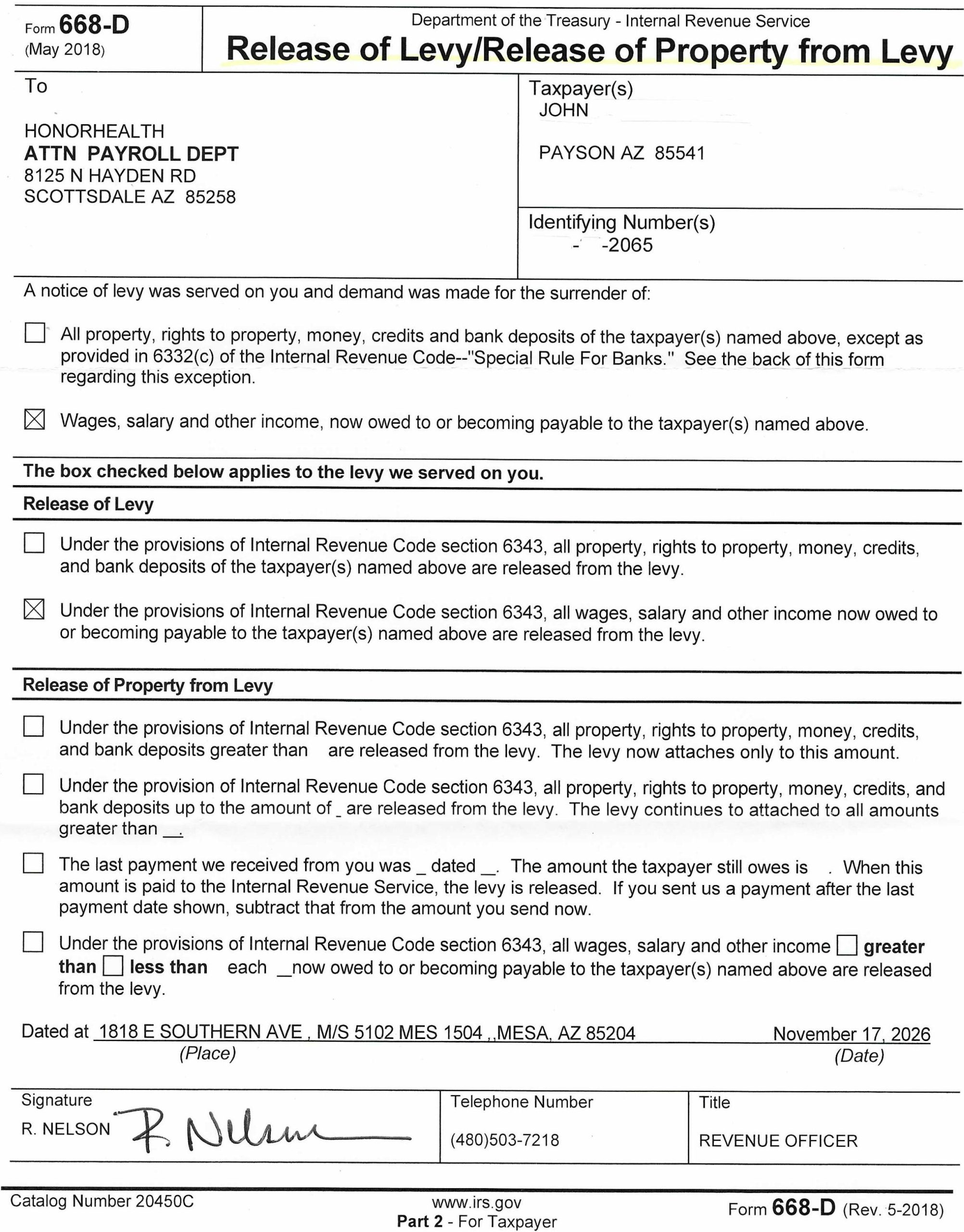
Facing an active IRS garnishment on his W-2 wages, John turned to Scott Allen, EA, owner of Tax Debt Advisors, Inc. in Mesa, Arizona. Stepping in immediately under federal Power of Attorney, Scott Allen took over all communications with the IRS, brought John back into full tax compliance, negotiated a structured installment agreement, and secured a formal IRS Form 668-D (Release of Levy/Release of Property from Levy) directed straight to HonorHealth’s payroll department in Scottsdale.
Release IRS Levy Help in Arizona
Understanding the Reality of an IRS Wage Levy
Many taxpayers confuse an IRS wage levy with a standard creditor garnishment, only to discover that federal tax levies operate under much harsher rules. Unlike private creditors, who generally must sue a debtor in civil court and obtain a money judgment before garnishing wages, the IRS has statutory authority under the Internal Revenue Code to seize wages after issuing a series of required notices, culminating in a Final Notice of Intent to Levy and Notice of Your Right to a Hearing.
Once an IRS wage levy is served on an employer—often via Form 668-W (Notice of Levy on Wages, Salary, and Other Income)—it is continuous. That means it does not just take a single deduction from one paycheck; it attaches to every subsequent paycheck until the tax debt is paid in full, the statute of limitations expires, or the IRS formally issues a release. Worse still, the IRS leaves the taxpayer with only a minimal exempt amount based on filing status and number of dependents, sweeping the vast majority of a worker’s net pay directly to the U.S. Treasury. For an employee in Arizona supporting a household and managing everyday living expenses, losing most of a W-2 paycheck can cause an immediate financial crisis.
How John’s Back Tax Returns Triggered Aggressive IRS Enforcement
John’s situation began in a way that is far more common than most people realize. Life events, shifting schedules, and mounting stress caused him to fall behind on a couple of years of federal tax returns. At first, the consequences seemed quiet. However, behind the scenes, the IRS computer systems flagged his account for non-compliance.
When a taxpayer has unfiled returns—especially when W-2s or 1099s have already been reported to the IRS by employers or financial institutions—the IRS refuses to negotiate standard resolution options. In many cases, the agency eventually prepares a Substitute for Return (SFR) using only the income reported to them, without giving the taxpayer credit for standard or itemized deductions, exemptions, or legitimate tax credits. That inflates the assessed tax balance, adds failure-to-file and failure-to-pay penalties, and compounds daily interest.
Because John had unfiled back tax returns on his record, the IRS treated his account as an active compliance problem rather than a simple balance-due case. The file was assigned to an IRS Revenue Officer operating out of the Mesa, Arizona office. Unlike automated call centers, local Revenue Officers have the authority to conduct field investigations, issue summonses, levy bank accounts, and serve continuous wage levies directly on employers. That aggressive enforcement resulted in a wage levy served on HonorHealth’s payroll department, putting John’s W-2 income directly in the IRS’s crosshairs.
Stepping In Under Power of Attorney: Why Enrolled Agent Representation Matters
When John contacted Tax Debt Advisors, Inc., his top priority was stopping the financial bleeding before his upcoming paychecks were gutted. As an Enrolled Agent (EA) licensed directly by the U.S. Department of the Treasury since 2007, Scott Allen holds unlimited practice rights before the Internal Revenue Service. That federal credential allows him to represent taxpayers in all 50 states and handle every level of IRS collections, audits, and appeals.
The very first step in protecting John was filing IRS Form 2848 (Power of Attorney and Declaration of Representative). Once Form 2848 is recorded, the IRS is legally required to deal directly with the taxpayer’s representative rather than pressuring the taxpayer over the phone or at their doorstep. For John, this meant an immediate end to the stress of trying to navigate complex tax procedures alone while dealing with a Revenue Officer.
Scott Allen immediately contacted the assigned IRS Revenue Officer in Mesa to establish representation, pull John’s complete IRS account and wage-and-income transcripts, and map out the exact requirements needed to lift the HonorHealth wage levy.
Solving the Root Cause: Bringing John Into Full Tax Compliance
A critical rule of IRS resolution is that the agency will almost never release a wage levy or approve a formal payment plan while a taxpayer remains out of compliance with unfiled returns. Even if a taxpayer is ready to pay, an IRS Revenue Officer will demand that all required delinquent tax returns be prepared and filed first so the true liability can be established.
Drawing on nearly two decades of specialized experience resolving delinquent tax filings across Mesa, Gilbert, Chandler, Tempe, Phoenix, and surrounding Arizona communities, Scott Allen moved quickly to address John’s missing tax years. Even when taxpayers have misplaced older W-2s or tax records, an Enrolled Agent can retrieve official IRS wage and income transcripts to reconstruct accurate returns and ensure the taxpayer receives every lawful deduction and credit they are entitled to claim.
By preparing and submitting John’s delinquent returns promptly and accurately, Scott Allen eliminated the IRS’s primary objection. John transitioned from being categorized as a “non-compliant taxpayer” to a compliant taxpayer actively working in good faith to resolve his federal tax obligations.
Negotiating a Sustainable Payment Plan and Securing Form 668-D
Once John’s back tax returns were filed and his compliance status was restored, Scott Allen shifted focus to resolving the total balance owed in a way that protected John’s ability to pay his living expenses in Payson.
Working directly with the Mesa Revenue Officer, Scott presented a complete financial picture and negotiated an IRS Installment Agreement tailored to John’s actual budget. Rather than having an arbitrary percentage of his W-2 paycheck seized every pay period, John gained a predictable, manageable monthly payment structure that satisfied federal collection standards while preserving his take-home pay.
With compliance verified and the payment arrangement established, the IRS Revenue Officer executed Form 668-D (Release of Levy/Release of Property from Levy) under the provisions of Internal Revenue Code Section 6343. Dated November 17, 2026, out of the IRS office at 1818 E. Southern Ave. in Mesa, Arizona, the official release was addressed directly to HonorHealth’s Payroll Department on N. Hayden Rd. in Scottsdale.
The Form 668-D specifically checked the box releasing “all wages, salary and other income now owed to or becoming payable to the taxpayer(s) named above” from the levy. As soon as HonorHealth’s payroll team processed that official release, the wage garnishment ended, restoring John’s full W-2 earnings.
Key Lessons for Arizona Taxpayers Facing IRS Wage Levies
John’s case highlights several vital truths for anyone in Arizona dealing with unfiled tax returns or active IRS collection notices:
-
Unfiled tax returns are the #1 trigger for aggressive enforcement: Ignoring missing tax years does not make the problem go away. It prevents you from qualifying for installment agreements, penalty abatements, or hardship programs, and it invites Substitute for Return assessments and Revenue Officer involvement.
-
An IRS wage levy can be released—even after it hits payroll: Receiving a notice that your employer has been served with an IRS levy is terrifying, but it is not permanent. With rapid intervention, compliance cleanup, and proper negotiation under IRC Section 6343, an Enrolled Agent can secure a Form 668-D levy release.
-
Local representation makes a real difference: Because Tax Debt Advisors, Inc. is based right in Mesa, Arizona, Scott Allen regularly works with local IRS Revenue Officers and understands the exact documentation and compliance standards required to get levies lifted fast.
Get Experienced IRS Levy Help in Mesa and Across Arizona
Founded in 1977 and backed by over 116,000 resolved tax debts, Tax Debt Advisors, Inc. helps individuals and business owners across Mesa, Gilbert, Chandler, Tempe, Scottsdale, Phoenix, and Payson resolve complex IRS problems directly with a licensed Enrolled Agent. Whether you have unfiled back tax returns, an active W-2 wage levy, a bank levy, or mounting IRS penalties, you do not have to face the IRS alone.
To speak directly with Scott Allen, EA about stopping an IRS wage levy and resolving your back taxes, visit www.taxdebtadvisors.com or contact the Mesa office today for a confidential consultation.