

Stop IRS Levy in Phoenix Arizona 2026
Phoenix, Arizona IRS Levy Help: How Scott Allen EA Helped Matthew Stop IRS Collection Action and Regain Financial Peace of Mind
Receiving an IRS levy notice or learning that the IRS intends to garnish wages can be one of the most stressful experiences a taxpayer will ever face. Many Arizona residents lose sleep worrying about frozen bank accounts, wage garnishments, mounting penalties, and whether they will ever be able to get back on track financially.
Fortunately, taxpayers have rights, and there are experienced professionals who can step in immediately to protect them.
One recent example involved Matthew, an Arizona taxpayer who had accumulated several years of unpaid federal income taxes. Facing increasing IRS collection pressure, Matthew turned to Scott Allen, EA, of Tax Debt Advisors, Inc. for professional representation. Through experienced IRS negotiation, filing compliance, and direct communication with the IRS as Matthew’s authorized representative, Scott was able to negotiate a manageable monthly payment plan and help prevent further aggressive IRS collection action.
Matthew’s story is one that many Arizona taxpayers can relate to.
When IRS Tax Debt Begins to Snowball
Very few taxpayers intentionally fall behind with the IRS.
Life events such as:
- Loss of employment
- Divorce
- Medical expenses
- Business setbacks
- Unexpected financial hardships
- Failure to file tax returns
can quickly create tax problems that continue growing year after year.
Once tax returns remain unfiled or balances remain unpaid, the IRS begins assessing:
- Failure-to-file penalties
- Failure-to-pay penalties
- Daily compounded interest
Eventually the IRS collection division becomes involved.
Many taxpayers ignore the IRS because they simply cannot afford to pay the balance in full. Unfortunately, ignoring IRS notices almost always makes the situation worse.
What Happens Before an IRS Levy?
The IRS generally follows a series of collection steps before levying wages or bank accounts.
These often include:
- Multiple balance due notices
- Demand for payment
- Assignment to IRS Collections
- Notice of Intent to Levy
- Collection Due Process rights
If no action is taken, the IRS may begin collecting by:
- Garnishing wages
- Levying bank accounts
- Seizing tax refunds
- Filing a Notice of Federal Tax Lien
- Levying retirement income
- Taking other collection actions permitted under federal law
The earlier taxpayers seek professional representation, the more options are typically available.
Matthew’s Situation
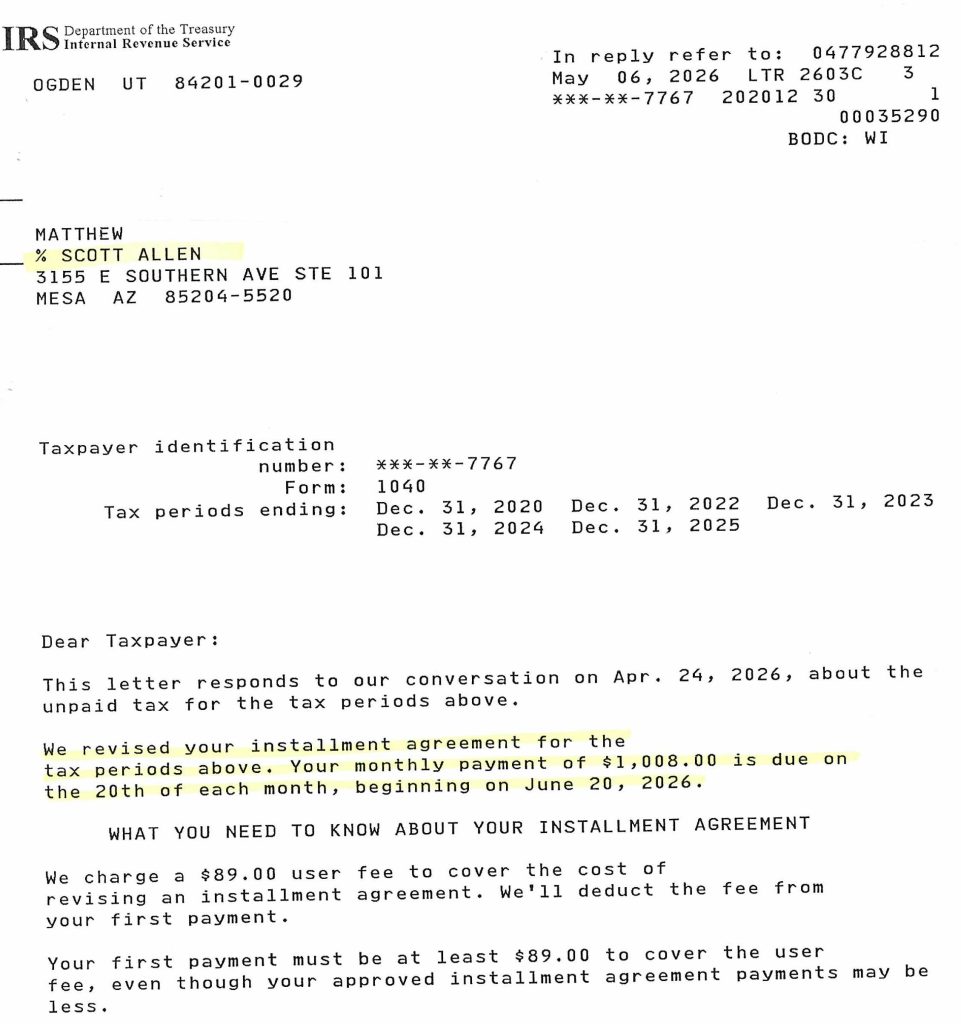
Matthew had accumulated unpaid federal income taxes for multiple years, including:
- 2020
- 2022
- 2023
- 2024
- 2025
As the balances continued increasing through penalties and interest, he became overwhelmed.
Like many taxpayers, Matthew worried that hiring professional representation would be extremely expensive.
He also believed he would probably need to hire a tax attorney.
Instead, Matthew met with Scott Allen, EA, of Tax Debt Advisors, Inc., to review his IRS situation.
Scott carefully evaluated Matthew’s IRS account transcripts, determined which tax years required attention, discussed available collection alternatives, and developed a strategy to bring Matthew back into IRS compliance.
Filing Back Tax Returns Is Often the First Step
Many taxpayers assume they can negotiate with the IRS immediately.
However, the IRS generally requires taxpayers to become filing compliant before approving most collection alternatives.
That means any missing tax returns usually need to be prepared and filed first.
Tax Debt Advisors, Inc. regularly assists Arizona taxpayers by:
- Preparing delinquent tax returns
- Reviewing IRS wage and income transcripts
- Correcting IRS substitute-for-return assessments
- Determining accurate balances owed
- Minimizing additional penalties whenever possible
Once Matthew became compliant with his filing requirements, Scott was able to move forward with negotiating directly with the IRS.
Negotiating an Affordable IRS Payment Plan
Every taxpayer’s financial situation is different.
The IRS offers several collection alternatives depending upon:
- Income
- Necessary living expenses
- Assets
- Equity
- Total tax liability
- Compliance history
After reviewing Matthew’s financial information, Scott negotiated a revised IRS installment agreement that fit Matthew’s financial circumstances.
The IRS approved a monthly payment plan of $1,008 per month, allowing Matthew to resolve multiple years of federal tax debt while avoiding more aggressive IRS collection action.
Instead of living with constant fear of IRS levies or wage garnishments, Matthew now had:
- A formal IRS agreement
- Predictable monthly payments
- Protection from additional collection activity while remaining compliant
- Peace of mind knowing a professional was handling communications with the IRS
Phoenix Arizona Stop IRS Levy
Can an Enrolled Agent Represent Taxpayers Before the IRS?
One of the biggest misconceptions taxpayers have is believing they must hire an expensive tax attorney whenever they owe the IRS money.
That simply is not true.
An Enrolled Agent (EA) is a federally licensed tax professional who receives unlimited practice rights before the Internal Revenue Service.
That means an Enrolled Agent can represent taxpayers before the IRS for matters including:
- IRS audits
- Collection cases
- Installment agreements
- Offers in Compromise
- Penalty abatement requests
- IRS appeals
- Wage garnishment cases
- Bank levy cases
- Back tax return preparation
- Tax lien issues
Unlike CPAs whose licensing authority is at the state level, Enrolled Agents are licensed directly by the U.S. Department of the Treasury to represent taxpayers before the IRS nationwide.
For taxpayers whose issues involve IRS collections rather than litigation in Tax Court, an experienced Enrolled Agent is often an excellent choice for knowledgeable and cost-effective representation.
How Tax Debt Advisors, Inc. Helps Arizona Taxpayers
Scott Allen EA understands that every IRS case is unique.
Rather than offering a one-size-fits-all solution, Tax Debt Advisors, Inc. carefully evaluates each client’s financial situation before recommending the most appropriate resolution strategy.
Services include:
Preparing Back Tax Returns
Many taxpayers have several years of missing returns.
Preparing accurate returns often reduces IRS balances significantly compared to IRS Substitute for Return assessments.
Stopping IRS Levies
If the IRS has begun collection action, immediate representation can often stop or prevent levy action while negotiations are underway.
Releasing Wage Garnishments
IRS wage garnishments can create enormous financial hardship.
Depending on the taxpayer’s circumstances, Tax Debt Advisors, Inc. may negotiate to have garnishments released after appropriate collection alternatives are established.
Bank Levy Assistance
Frozen bank accounts create immediate financial emergencies.
Prompt representation may help negotiate levy releases when taxpayers qualify.
IRS Installment Agreements
Affordable monthly payment plans frequently provide taxpayers with a practical long-term solution while protecting them from additional collection enforcement.
Penalty Abatement
Many taxpayers qualify for relief from certain IRS penalties.
Reducing penalties can significantly lower the total balance owed.
Why Acting Quickly Matters
Many taxpayers wait until their wages are already being garnished before seeking help.
Unfortunately, waiting often limits available options.
Early representation allows professionals to:
- Contact the IRS immediately
- Request collection holds
- Review IRS records
- Verify balances
- File missing tax returns
- Explore available resolution programs
- Prevent additional enforcement action
The sooner taxpayers act, the greater the opportunity to resolve their tax issues before collections escalate.
The Emotional Relief Is Often the Biggest Benefit
When Matthew first met with Scott Allen EA, he was overwhelmed.
Years of unpaid taxes had created tremendous stress.
Every IRS letter increased his anxiety.
Like many taxpayers, he simply did not know where to begin.
After professional representation was established, the burden shifted.
Instead of communicating directly with the IRS himself, Matthew had an experienced representative handling the process, explaining each step, and negotiating on his behalf.
That peace of mind is often one of the most valuable benefits professional IRS representation provides.
Arizona Taxpayers Do Not Have to Face the IRS Alone
If you have received IRS notices, owe back taxes, have unfiled tax returns, or are worried about an IRS levy or wage garnishment, you do not have to navigate the process by yourself.
Whether you need assistance filing delinquent tax returns, negotiating an affordable IRS payment plan, requesting penalty relief, or stopping IRS collection activity, experienced representation can make a significant difference.
Scott Allen, EA, of Tax Debt Advisors, Inc. has helped many Arizona taxpayers resolve complex IRS tax debt issues through knowledgeable representation, careful planning, and direct negotiation with the Internal Revenue Service.
As Matthew’s experience demonstrates, professional representation can transform an overwhelming tax problem into a manageable resolution. Rather than allowing fear of the IRS to continue growing, taxpayers can take proactive steps toward financial stability by working with a federally licensed Enrolled Agent who is authorized to represent them before the IRS.
If you are facing an IRS levy, wage garnishment, or years of unpaid taxes in Arizona, contact Tax Debt Advisors, Inc. to discuss your options. With timely action, accurate tax return preparation, and experienced IRS negotiation, it may be possible to stop collection activity, establish an affordable payment plan, and move forward with confidence.