

Kerry was represented: Phoenix AZ Back Tax Returns
Phoenix AZ Back Tax Returns: How Tax Debt Advisors, Inc. Helps Taxpayers File Missing Returns and Resolve IRS Debt
For Phoenix-area taxpayers who have fallen behind on filing federal income tax returns, the problem can become more stressful with every passing year. Missing returns can eventually lead to IRS notices, estimated assessments, growing penalties and interest, and collection activity. Some taxpayers avoid dealing with the problem because they believe they must have enough money to pay the entire tax debt before filing their missing returns.
That is not necessarily the case.
The IRS specifically advises taxpayers to file past-due returns even when they cannot immediately pay the resulting balance. Depending on the taxpayer’s circumstances, payment plans and other collection alternatives may be available after filing compliance has been addressed. IRS
For taxpayers searching for help with Phoenix AZ back tax returns, Tax Debt Advisors, Inc. assists individuals with both sides of the problem: preparing delinquent tax returns and representing taxpayers before the IRS to work toward an appropriate resolution of the resulting tax debt.
Phoenix AZ Back Tax Returns and IRS Representation
Falling behind on tax returns is more common than many taxpayers realize. A taxpayer might have missed one year because of a difficult financial period and then become overwhelmed as additional years went unfiled. Others may have been self-employed, operated a business, gone through a divorce, lost financial records, or simply been unsure how to reconstruct several years of income and expenses.
Whatever caused the problem, ignoring unfiled returns generally does not make the situation easier.
The IRS encourages taxpayers to file past-due returns and warns that failure to voluntarily file can lead to additional consequences. Unfiled returns can also create problems when a taxpayer applies for a mortgage, business loan, or other financing where copies of filed tax returns may be requested. IRS
Tax Debt Advisors, Inc. helps Phoenix taxpayers determine which returns need to be filed, obtain available IRS income information when appropriate, prepare the missing returns, and address the collection problem that may remain afterward.
For someone searching online for Phoenix AZ back tax returns, an important point is that filing the returns is often the beginning of the resolution process rather than the end of it.
A Phoenix-Area Taxpayer’s IRS Installment Agreement
The IRS letter shown with this article provides an example of how filing compliance and IRS representation can ultimately lead to a manageable resolution.
Tax Debt Advisors, Inc. represented a taxpayer who had multiple individual income tax periods involved with the IRS. The IRS correspondence dated June 23, 2026, identifies Form 1040 tax periods ending in 2019, 2020, 2022, 2023, 2024 and 2025.
After addressing the taxpayer’s IRS situation, the account was placed into a direct debit installment agreement requiring a monthly payment of $382.
The IRS letter confirms:
“As you requested, we modified your direct debit installment agreement. We’ll deduct your payment of $382.00 on the 18th of each month.”
This example demonstrates an important point for Phoenix taxpayers with several years of tax problems: owing the IRS does not automatically mean that the entire balance must be paid immediately.
An installment agreement is one of several IRS collection alternatives that may be available depending on the taxpayer’s circumstances.
Every tax situation is different, and the $382 payment obtained in this case should not be interpreted as a guarantee that another taxpayer will qualify for the same result. The appropriate resolution depends on factors including the amount owed, filing compliance, collection statute, income, expenses, assets and the particular IRS program involved.
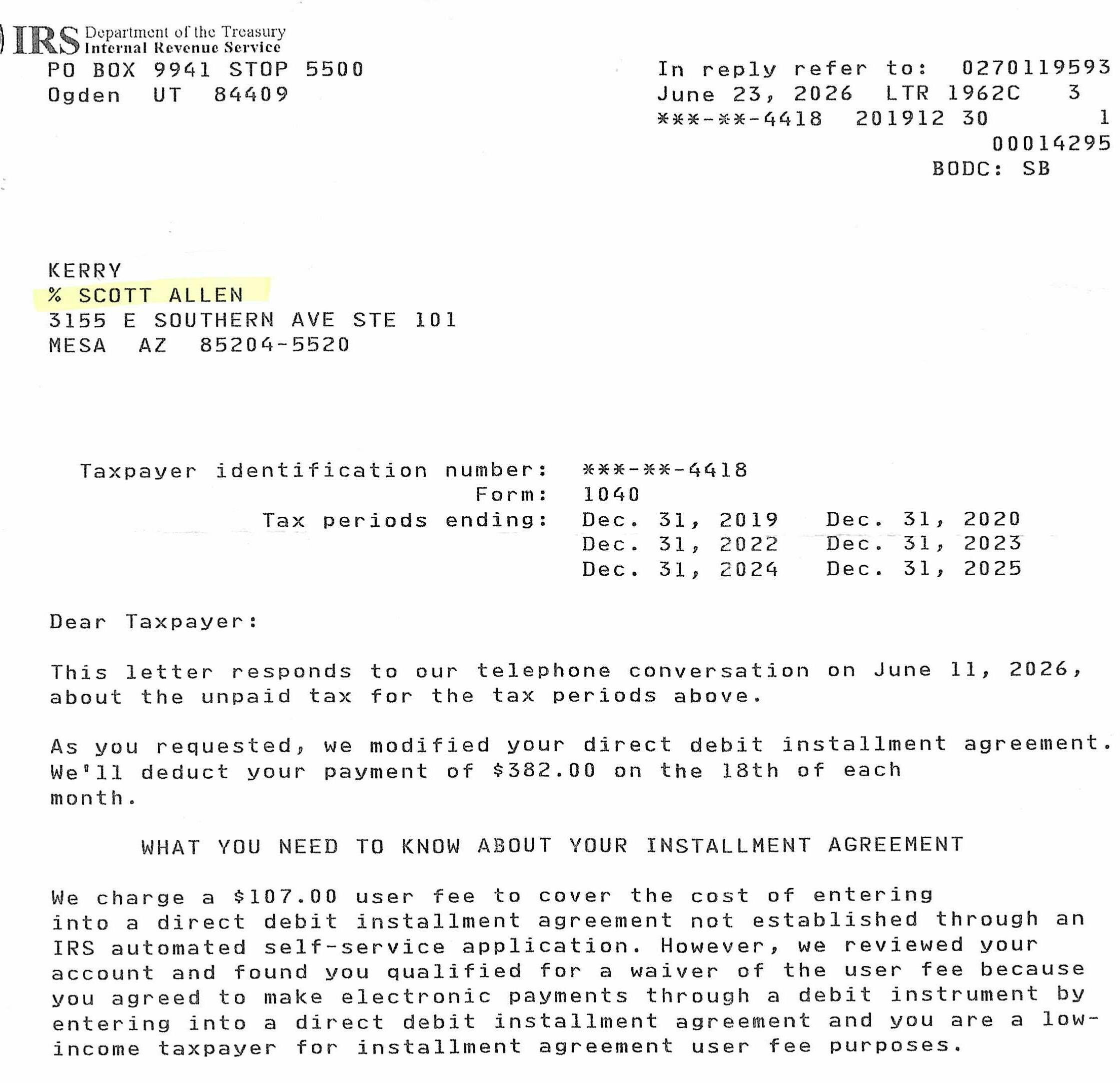
Kerry’s Phoenix AZ Back Tax Returns
Filing Back Tax Returns Can Be Critical Before Negotiating With the IRS
Taxpayers sometimes want to negotiate their tax debt before dealing with their missing returns. In many situations, that reverses the order in which the problem needs to be addressed.
The IRS states that most payment plans and tax-debt relief options require taxpayers to have filed all required returns. Current IRS guidance also says that taxpayers generally must be current with filing requirements before a payment plan request can be considered.
That makes identifying and preparing Phoenix AZ back tax returns an important first step.
Tax Debt Advisors, Inc. can help a taxpayer determine the missing years and work toward bringing the taxpayer into filing compliance. Once the required returns have been prepared and filed, attention can turn toward determining how the resulting IRS balance should be resolved.
Taxpayers should also understand that they do not necessarily need to pay everything they owe simply to file their returns. The IRS expressly tells taxpayers who cannot pay in full to file anyway and then consider available payment alternatives.
What Happens When Someone Cannot Pay the IRS in Full?
There is no single IRS settlement program appropriate for everyone.
The IRS currently identifies several potential ways of dealing with federal tax debt, including payment plans, Offers in Compromise, temporary collection delays and penalty relief when the taxpayer qualifies.
One common solution is an installment agreement.
An IRS installment agreement permits an eligible taxpayer to make monthly payments rather than immediately paying the entire tax liability. Current IRS guidance provides several types of payment arrangements, and the requirements depend on the taxpayer’s balance and circumstances.
For qualifying individuals, the IRS’s Simple Payment Plan generally applies when assessed taxes, penalties and interest total $50,000 or less and filing and payment requirements are current. The IRS also states that taxpayers who do not qualify for a Simple Payment Plan may still qualify for another type of payment plan.
That distinction can be important. A taxpayer should not automatically assume that being outside the requirements for a particular IRS program means there are no other resolution possibilities.
Other IRS Tax Debt Resolution Options
An installment agreement is only one possible resolution.
Depending upon the taxpayer’s financial circumstances, an Offer in Compromise may allow a qualifying taxpayer to settle an IRS debt for less than the full amount owed. However, an Offer in Compromise is not automatically available merely because someone owes a large amount of tax. Qualification requirements apply.
Another possibility may be a temporary delay of collection when a taxpayer cannot currently pay because of financial circumstances. The IRS recognizes collection delay as one of its tax-debt resolution options.
There are also circumstances where a Partial Payment Installment Agreement may be considered. The IRS explains that this type of arrangement can apply when a taxpayer cannot afford to fully pay the liability before the applicable Collection Statute Expiration Date. These cases generally require detailed financial disclosure and can be subject to future financial reviews.
The appropriate strategy therefore requires more than simply asking, “How much does the taxpayer owe?”
It requires reviewing the taxpayer’s entire IRS situation.
Why Professional Representation Can Help With Phoenix AZ Back Tax Returns
A taxpayer dealing with several years of unfiled returns may actually be facing two separate problems.
The first is tax preparation: determining what returns are missing and preparing accurate delinquent returns.
The second is IRS collection resolution: determining what should happen with the balance after those returns have been processed.
Tax Debt Advisors, Inc. works with taxpayers on both issues.
Scott Allen, EA, of Tax Debt Advisors, Inc. is an Enrolled Agent who represents taxpayers before the IRS. With appropriate authorization, professional representation can allow the representative to communicate with the IRS regarding the taxpayer’s account and work through the filing and collection issues involved in the case.
That can be particularly valuable when a taxpayer has multiple unfiled years, IRS notices, missing tax records, or a substantial balance that cannot simply be paid in full.
Missing Tax Records Shouldn’t Automatically Stop a Taxpayer From Getting Started
One reason taxpayers continue postponing their Phoenix AZ back tax returns is that they no longer have all of their old tax documents.
Perhaps a W-2 was lost. Maybe the taxpayer cannot locate an old 1099. Someone who was self-employed may have incomplete business records. A taxpayer who moved several times may no longer have paperwork from years ago.
Missing documents can complicate tax preparation, but they do not necessarily mean the taxpayer should continue doing nothing.
IRS wage and income information may be available to help identify income documents reported under a taxpayer’s Social Security number or taxpayer identification number. The appropriate method of reconstructing a return depends on the taxpayer’s circumstances and the records available.
The objective is to determine what information is needed and begin resolving the missing-return problem instead of allowing another year to pass.
Why Staying Current Matters After an IRS Settlement
Getting an installment agreement approved is not the end of a taxpayer’s responsibilities.
The IRS requires taxpayers with payment plans to remain current with their tax obligations. Taxpayers generally need to file required future returns on time, make required payments and continue making their scheduled installment payments. A new unpaid tax liability can jeopardize an existing agreement.
Interest and applicable penalties can also continue to accrue while an unpaid balance remains.
This is why a good IRS resolution strategy should not focus exclusively on yesterday’s tax debt. It should also help prevent the taxpayer from creating another balance in the future.
For an employee, that might involve reviewing federal income tax withholding. For a self-employed taxpayer, it may mean making appropriate estimated tax payments.
Searching for Phoenix AZ Back Tax Returns Help?
Taxpayers with several years of unfiled tax returns can easily feel as though the situation has become too complicated to fix. In many cases, however, the most important action is simply beginning the process.
The taxpayer featured in this case had multiple tax years involved with the IRS. The June 2026 IRS correspondence ultimately confirmed a $382 monthly direct debit installment agreement.
That outcome illustrates why taxpayers should not assume that several years of tax problems automatically mean there is no manageable path forward.
Tax Debt Advisors, Inc. helps Phoenix-area taxpayers identify missing returns, prepare delinquent federal income tax returns, address IRS notices and negotiate tax debt resolution options based on the taxpayer’s individual circumstances.
For taxpayers searching for Phoenix AZ back tax returns, the process generally begins by determining exactly what is missing, getting the required returns prepared and filed, determining the actual IRS balance, and then evaluating the available collection alternatives.
The IRS itself recognizes multiple options for taxpayers who cannot pay their federal tax debt in full.
The key is addressing the problem rather than continuing to postpone it.
Tax Debt Advisors, Inc. serves taxpayers throughout Phoenix, Mesa, Gilbert, Chandler, Tempe, Scottsdale, Queen Creek and surrounding Arizona communities. Taxpayers who need to file back tax returns or resolve an existing IRS debt can contact Tax Debt Advisors, Inc. to discuss their circumstances and determine an appropriate next step.