

Stop IRS Garnishment locally in Mesa AZ
How to Stop IRS Garnishment in Mesa AZ: How Scott Allen EA Secured a $375 Monthly Payment Plan for a Local Client
Facing an aggressive Internal Revenue Service collection action is one of the most stressful financial experiences an individual or family can endure. When unpaid taxes go unresolved, the federal government possesses broad statutory authority to seize wages, freeze bank accounts, and place liens on personal property. For taxpayers looking to stop IRS garnishment in Mesa AZ, navigating the complex bureaucracy of the IRS alone often leads to frustration, missed deadlines, and unfavorable financial terms.
Fortunately, local residents in the East Valley do not have to face the IRS by themselves. By partnering with an experienced, federally licensed tax professional, taxpayers can halt enforced collection actions and negotiate manageable resolutions. A recent victory achieved by Scott Allen, Enrolled Agent (EA), of Tax Debt Advisors Inc., demonstrates how strategic representation can transform a looming financial crisis into a predictable, affordable monthly payment plan.
Understanding the Threat of IRS Wage Garnishments and Bank Levies
Before examining how Tax Debt Advisors Inc. resolved this recent case, it is important to understand how IRS collections escalate. The IRS does not garnish wages or levy bank accounts without prior notice; rather, enforced collection is the culmination of a series of automated billing notices.
When a taxpayer files a return with a balance due—or fails to file a return altogether—the IRS sends an initial balance due notice, followed by increasingly urgent reminders. If the taxpayer ignores these notices or fails to establish a formal resolution, the IRS issues a Final Notice of Intent to Levy and Notice of Your Right to a Hearing (commonly Letter 1058 or Notice LT11). Once the 30-day window on that final notice expires, the IRS can legally execute:
-
Continuous Wage Garnishments: Unlike standard commercial creditors, who are generally capped at garnishing 25% of disposable earnings, the IRS can seize a massive portion of a taxpayer’s paycheck, leaving the individual with only a minimal exempt amount based on filing status and dependents.
-
Bank Account Levies: The IRS can instruct a taxpayer’s bank to freeze all funds available in checking and savings accounts on the day the levy is received, holding the money for 21 days before remitting it to the U.S. Treasury.
-
Federal Tax Liens: A Notice of Federal Tax Lien attaches to a taxpayer’s current and future assets, severely damaging borrowing power and complicating real estate or business transactions.
For working families in Mesa, Gilbert, and throughout Maricopa County, a sudden wage garnishment can make it impossible to pay rent, cover mortgage obligations, or afford basic groceries. Taking proactive steps to stop IRS garnishment in Mesa AZ before or immediately after a levy notice arrives is essential to protecting household cash flow.
Case Study: Resolving 2024 and 2025 Form 1040 Tax Debts in Mesa, AZ
Recently, a local taxpayer named Craig found himself facing unpaid federal income tax liabilities spanning two consecutive tax years: the tax periods ending December 31, 2024, and December 31, 2025 (Form 1040). Like many hardworking individuals, Craig faced the compounding pressure of back taxes alongside the looming threat of enforced IRS collection measures. Attempting to negotiate directly with the IRS Automated Collection System (ACS) can be overwhelming, as revenue officers and collection representatives demand strict financial disclosures and often push for aggressive monthly payments that exceed what a household can realistically afford.
Recognizing the need for professional advocacy, Craig turned to Scott Allen, EA, at Tax Debt Advisors Inc., located right in Mesa at 3155 E Southern Ave, Suite 101.
Step 1: Establishing Representation and Halting Collection Escalation
Upon taking the case, Scott Allen EA immediately filed a Power of Attorney (Form 2848) with the IRS. This crucial step officially placed Tax Debt Advisors Inc. on record as Craig’s authorized representative—a status reflected directly on official IRS correspondence addressed to Craig in care of Scott Allen. Once a Power of Attorney is processed, the IRS is required to communicate directly with the Enrolled Agent rather than harassing the taxpayer at home or work. Simultaneously, securing representation allows the practitioner to request a temporary collection hold while preparing the taxpayer’s financial package, effectively shielding the client’s wages and bank accounts from sudden levies.
Step 2: Financial Analysis and Direct IRS Negotiation
To secure a sustainable resolution, Scott Allen conducted a thorough review of Craig’s income, allowable living expenses, and overall financial standing under IRS Collection Financial Standards. Rather than allowing the IRS to dictate an unmanageable monthly figure, Scott prepared a precise, defensible installment proposal tailored to Craig’s actual budget.
On November 2, 2026, Scott Allen conducted a direct telephone negotiation with the IRS regarding Craig’s unpaid 2024 and 2025 Form 1040 liabilities. Armed with complete documentation and decades of procedural expertise, Scott advocated for a Direct Debit Installment Agreement (DDIA) that satisfied IRS compliance rules while protecting Craig’s financial stability.
Step 3: Official IRS Approval of a $375 Monthly Settlement
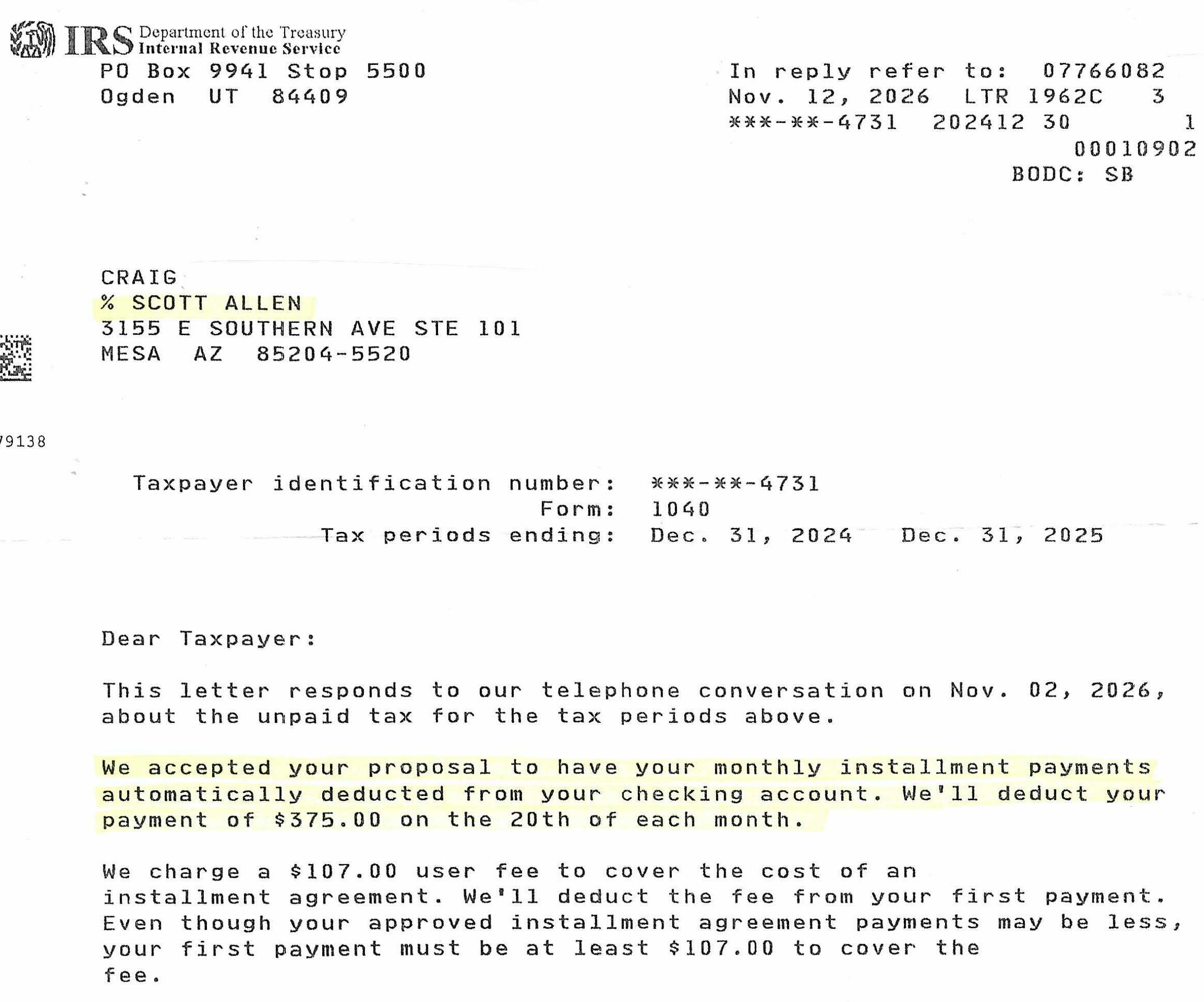
The negotiation proved to be a complete success. Just ten days later, on November 12, 2026, the IRS issued official confirmation via Letter 1962C. In the notice, the Internal Revenue Service formally confirmed:
“This letter responds to our telephone conversation on Nov. 02, 2026, about the unpaid tax for the tax periods above. We accepted your proposal to have your monthly installment payments automatically deducted from your checking account. We’ll deduct your payment of $375.00 on the 20th of each month.”
With a nominal one-time IRS user fee of $107.00 deducted from the initial payment, Craig’s tax matter was officially resolved. By locking in a predictable $375.00 monthly Direct Debit Installment Agreement, Craig completely eliminated the threat of wage garnishments and bank levies, allowing him to move forward with peace of mind.
Stop IRS Garnishment in Mesa AZ with Payment Plan
Why Direct Debit Installment Agreements Are a Powerful Tool
In Craig’s case, utilizing a Direct Debit Installment Agreement offered several distinct advantages over standard payment arrangements:
-
Immediate Protection from Levies: While an installment agreement is pending and once it is approved, the IRS is legally prohibited from issuing wage garnishments or bank levies, provided the taxpayer remains compliant with future tax filings and payments.
-
Reduced User Fees and Penalty Relief: Setting up an automated checking account deduction significantly lowers the IRS setup fee compared to non-automated agreements, and the Failure-to-Pay penalty rate is cut in half once an approved installment plan is in place on a timely filed tax return.
-
Zero Risk of Missed Payments: Because the $375.00 payment is automatically drafted on the 20th of each month, the taxpayer does not have to worry about lost checks or accidental defaults that could void the settlement.
The Advantage of Choosing a Local, Family-Owned Mesa Tax Practice
Taxpayers searching online for ways to stop IRS garnishment in Mesa AZ are frequently bombarded by advertisements from massive, out-of-state “tax relief” call centers. Those national corporations often rely on aggressive salespeople rather than licensed tax professionals, charging thousands of dollars in upfront retainers before passing files off to junior staffers who rarely speak directly to the client.
Tax Debt Advisors Inc. operates on the exact opposite philosophy. As a local, family-owned tax practice serving Mesa, Gilbert, Chandler, Tempe, and the broader Phoenix metro area, Tax Debt Advisors Inc. provides direct, face-to-face accountability.
When clients work with Tax Debt Advisors Inc., they work directly with Scott Allen, EA. An Enrolled Agent is the highest credential awarded by the Internal Revenue Service. Unlike unlicensed preparers, Enrolled Agents hold unrestricted practice rights before the IRS—meaning Scott Allen is federally authorized to represent taxpayers in all 50 states across audits, collections, appeals, and delinquent return filings.
Whether a taxpayer has fallen behind on a single year of Form 1040 filings or has multiple years of unfiled back tax returns, Scott Allen handles every phase of the resolution process:
-
Filing Delinquent Back Tax Returns: Preparing accurate, compliant federal and state returns to replace inflated IRS Substitute for Return (SFR) assessments.
-
Stopping Active Levies and Garnishments: Intervening rapidly with IRS Revenue Officers and the Automated Collection System to release wage garnishments and bank freezes.
-
Negotiating Tailored Settlements: Structuring affordable Installment Agreements, Partial Pay Installment Agreements (PPIA), Currently Not Collectible (CNC) hardship status, or Offers in Compromise (OIC) based on each client’s unique financial reality.
Take Action Today to Protect Your Paycheck and Bank Account
IRS tax debt does not disappear on its own—penalties and interest compound daily, and waiting until a paycheck is garnished only makes the situation more urgent. However, as Craig’s $375.00 monthly settlement demonstrates, an IRS balance does not have to ruin your financial future.
If you or someone you know needs to stop IRS garnishment in Mesa AZ, file delinquent back tax returns, or negotiate an affordable payment plan with the IRS, contact Scott Allen, EA, at Tax Debt Advisors Inc. today. Visit the local office at 3155 E Southern Ave, Suite 101, Mesa, AZ 85204, or visit www.taxdebtadvisors.com to schedule a confidential consultation and take the first step toward lasting tax relief.