
Written by Scott Allen

IRS Past Due Taxes Owed in Mesa AZ

Mesa AZ IRS Past Due Taxes Owed: How Scott Allen EA Helped Donna Resolve Years of IRS Debt with an Affordable Monthly Payment

For many taxpayers, receiving multiple IRS notices over several years can feel overwhelming. Interest and penalties continue to grow, collection letters become more aggressive, and many people worry that wage garnishments, bank levies, or federal tax liens are just around the corner. Fortunately, there are legitimate IRS resolution options available for taxpayers who seek experienced representation before collection actions escalate.

Donna, a Mesa, Arizona taxpayer, found herself in exactly that situation. After falling behind on several years of federal income taxes, she turned to Scott Allen, EA, of Tax Debt Advisors, Inc. for professional representation. Instead of facing the IRS alone, Donna authorized Scott to represent her before the IRS, evaluate every available resolution option, and negotiate a payment solution that fit her financial circumstances.

The result was a successful IRS installment agreement covering multiple tax years with an affordable monthly payment of $564 per month, allowing Donna to move forward without the uncertainty of escalating IRS collection efforts.

Donna’s IRS Tax Problem

Like many hardworking Americans, Donna accumulated unpaid federal income tax liabilities over multiple tax years. Her IRS account included balances from several different tax periods, creating a significant overall tax debt.

When taxpayers owe back taxes for several years, the IRS generally adds:

  • Failure-to-pay penalties
  • Accrued interest
  • Additional collection notices
  • Potential enforcement actions if ignored

As balances continue growing, many taxpayers mistakenly believe there is no way out. Some stop opening IRS mail entirely because the situation feels impossible.

Donna decided to take a different approach.

Rather than waiting for additional IRS collection action, she contacted Scott Allen EA at Tax Debt Advisors, Inc. in Mesa, Arizona, to discuss her options before matters became even more serious.

Why Professional Representation Matters

Many taxpayers believe the only solution is calling the IRS themselves. While that works in some situations, IRS collection cases involving multiple tax years often require a much more strategic approach.

As an Enrolled Agent (EA) authorized to represent taxpayers before the Internal Revenue Service, Scott Allen works directly with IRS collections personnel to determine the most appropriate resolution based upon each client’s financial situation.

Professional representation helps ensure:

  • All IRS transcripts are reviewed
  • Every tax year is analyzed
  • Collection statutes are verified
  • Resolution options are compared
  • Financial information is presented properly
  • Negotiations are handled professionally

Instead of guessing which IRS program might work, Donna had an experienced representative guiding every step of the process.

Donna’s Successful IRS Installment Agreement

After reviewing Donna’s financial information and IRS account, Scott negotiated an installment agreement covering all of her outstanding tax years.

According to the IRS confirmation letter, Donna’s total balance exceeded $21,000, yet Scott successfully negotiated a manageable payment arrangement requiring monthly payments of only $564.

This type of resolution offers several important benefits:

  • Stops further aggressive collection action while the agreement remains in good standing.
  • Provides predictable monthly payments.
  • Allows taxpayers to budget more effectively.
  • Keeps taxpayers working toward full compliance.
  • Eliminates much of the uncertainty surrounding IRS collections.

Although interest and certain penalties may continue until the balance is paid, establishing an approved installment agreement often provides immediate peace of mind while preventing more severe enforcement actions. IRS guidance explains that taxpayers who cannot pay in full may qualify for payment plans or other collection alternatives once all filing requirements have been met.
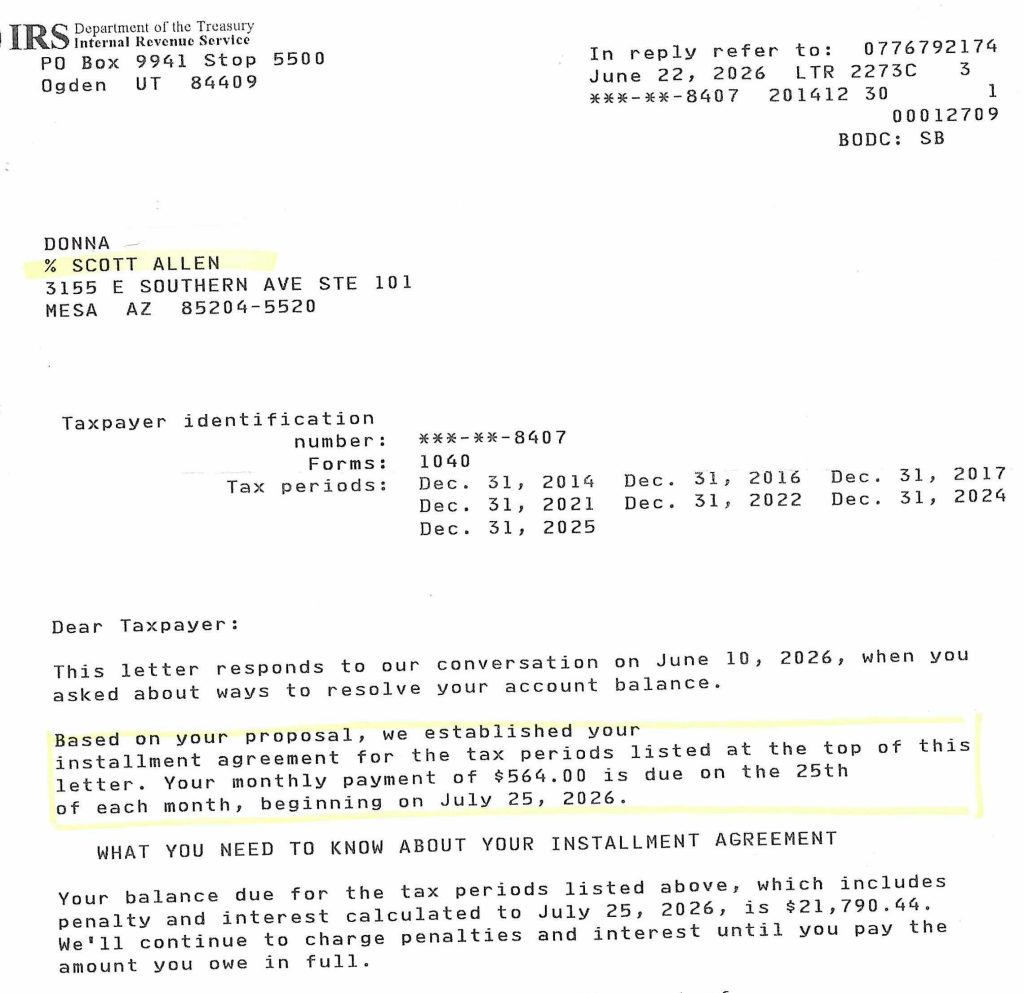
Donna's Mesa AZ Past Due IRS Taxes Owed

Donna’s Mesa AZ Past Due IRS Taxes Owed

The Three-Step IRS Settlement Process at Tax Debt Advisors, Inc.

One reason many Arizona taxpayers choose Scott Allen is the straightforward process used by Tax Debt Advisors, Inc. Rather than making unrealistic promises, the firm focuses on understanding the taxpayer’s complete financial picture before recommending an IRS resolution strategy.

Step 1: Review and Analyze the IRS Case

The process begins with gathering IRS records, reviewing tax transcripts, verifying balances owed, and identifying every outstanding tax year.

This initial evaluation answers critical questions such as:

  • Which years remain unpaid?
  • Are all tax returns filed?
  • How much is actually owed?
  • Has the IRS begun collection activity?
  • What resolution programs may apply?

Without accurate IRS records, taxpayers often make decisions based on incomplete information.

Step 2: Determine the Best Resolution Strategy

Every taxpayer’s financial situation is unique.

Some qualify for:

Rather than assuming everyone qualifies for an Offer in Compromise, Scott carefully evaluates the taxpayer’s income, expenses, assets, and overall financial condition before recommending the best available option. In reality, many taxpayers are better served through affordable installment agreements than through settlement programs that have strict eligibility requirements.

Step 3: Negotiate with the IRS

Once the appropriate strategy has been selected, Scott communicates directly with the IRS on behalf of the client.

This includes:

  • Preparing required financial documentation
  • Responding to IRS requests
  • Negotiating payment terms
  • Monitoring the case until a resolution is reached
  • Helping clients remain compliant going forward

Donna’s successful installment agreement is an excellent example of how this structured process can produce practical, long-term results.

Why Ignoring IRS Notices Is Risky

Many taxpayers postpone contacting the IRS because they fear the outcome.

Unfortunately, delaying action usually allows the problem to become more expensive.

The IRS collection process may eventually include:

  • Federal tax liens
  • Wage garnishments
  • Bank levies
  • Seizure of certain assets
  • Continued interest and penalties

Taking action early generally provides more available resolution options than waiting until enforcement begins.

Mesa AZ IRS Past Due Taxes Owed: Local Help Makes a Difference

Taxpayers searching online for Mesa AZ IRS past due taxes owed are often looking for someone local who understands both IRS procedures and Arizona taxpayers’ concerns.

Working with a local Enrolled Agent provides several advantages:

  • Personalized communication
  • Direct access to an experienced representative
  • Individual financial analysis
  • Customized IRS resolution strategies
  • Ongoing assistance throughout the process

Scott Allen has spent decades helping taxpayers resolve IRS collection matters through ethical representation and realistic expectations.

Lessons from the 2026 FIFA World Cup

As millions of soccer fans follow the excitement of the 2026 FIFA World Cup, one theme has stood out throughout the tournament: successful teams don’t win every match by relying on individual effort alone. They prepare, follow a game plan, adapt to changing circumstances, and trust experienced leadership. With the tournament now deep into the knockout stages, every decision carries greater importance, and disciplined execution often determines which teams advance.

Resolving IRS tax debt works much the same way.

Trying to solve years of unpaid taxes without understanding IRS procedures can feel like stepping onto the field against world-class competition without a coach. Success usually comes from preparation, strategy, and making the right adjustments based on the facts of each case.

Donna’s experience reflects that principle. Instead of reacting emotionally to IRS notices, she sought experienced representation, developed a realistic plan, and followed it through to a successful outcome.

Every IRS Case Is Different

One important misconception is that every taxpayer qualifies for the same IRS program.

That simply isn’t true.

Some taxpayers:

  • Qualify for installment agreements.
  • May qualify for penalty relief.
  • Could be eligible for Currently Not Collectible status.
  • May qualify for an Offer in Compromise.
  • Need additional tax returns prepared before negotiations can begin.

An experienced tax professional evaluates each possibility rather than forcing every client into a single solution.

Donna’s affordable installment agreement demonstrates that sometimes the best solution is not reducing the tax owed but creating a payment plan that allows the taxpayer to regain financial stability while satisfying IRS requirements.

If you are searching for Mesa AZ IRS past due taxes owed, Donna’s story shows that even multiple years of unpaid federal taxes do not necessarily mean financial disaster.

With experienced representation from Scott Allen, EA, of Tax Debt Advisors, Inc., taxpayers can often negotiate practical IRS solutions that fit their financial circumstances and help prevent more serious collection actions.

Donna went from facing years of unpaid IRS balances to obtaining a structured monthly payment agreement that allowed her to move forward with confidence. Her case illustrates that the earlier taxpayers seek professional assistance, the more opportunities may be available to resolve their IRS debt before collection activity becomes more aggressive.

For Arizona taxpayers struggling with past due IRS taxes, the first step is simply learning what options are available. A careful review of the facts, a realistic strategy, and experienced representation can often make all the difference in achieving a manageable resolution.

Written by Scott Allen

Mesa AZ IRS Tax Relief Advocate

How a Mesa AZ IRS Tax Relief Advocate Secured Currently Not Collectible Status for an Arizona Taxpayer

Navigating the complex rules, automated collection cycles, and dense bureaucracies of the Internal Revenue Service (IRS) is a notoriously daunting task for individual taxpayers. When a resident falls behind on federal tax liabilities, the financial burden is quickly exacerbated by compounding penalties and interest accruals. For individuals trapped under the weight of historic tax debt, finding an authoritative, experienced voice to intercede on their behalf is paramount. In Maricopa County, struggling taxpayers regularly seek the counsel of a dedicated Mesa AZ IRS tax relief advocate to serve as a legal barrier and strategic negotiator between themselves and aggressive federal collectors.

Through the diligent application of internal revenue tax codes and proper local representation, qualified professionals can secure formal resolutions that provide immediate, life-altering financial relief. A prominent example of this operational framework is demonstrated by the recent successful resolution achieved by Scott Allen, EA, of Tax Debt Advisors, Inc. By stepping into the arena as a true taxpayer advocate, Scott Allen, EA, successfully represented his client, John, managing to halt active collections and place an outstanding liability of over twenty-one thousand dollars into a legally recognized hardship classification known as Currently Not Collectible (CNC) status.

The Reality of Back Tax Debt and the Need for Immediate Intervention

When an individual taxpayer receives successive notifications from the Department of the Treasury, the instinctive reaction is frequently avoidance or intense anxiety. The IRS possesses unparalleled statutory powers to collect outstanding federal funds. These enforcement mechanisms include, but are not limited to, the direct levying of bank accounts, the continuous garnishment of weekly wages, and the filing of Federal Tax Liens that permanently damage personal and commercial credit ratings. For many taxpayers, these financial penalties begin to outpace their base income, creating a systemic deficit from which it feels impossible to escape.

In the case of John, an Arizona taxpayer faced with outstanding liabilities stemming across multiple tax periods—specifically the calendar years ending December 31, 2015, December 31, 2018, and December 31, 2019—the total accumulated balance had reached an intimidating sum. The IRS calculated John’s aggregate debt, inclusive of statutory base tax, failure-to-file penalties, failure-to-pay penalties, and compound interest, at precisely $21,693.00. Facing a debt of this magnitude while managing ordinary living expenses in today’s economic climate creates a severe hardship that requires expert analysis.

To safely resolve a multi-year tax imbalance, an unrepresented taxpayer cannot merely call a general customer service line and hope for an equitable outcome. The IRS operates via strict algorithmic procedures; collections are automated unless an enrolled professional formally establishes a legal defense or alternative resolution framework. This is where retaining a premier Mesa AZ IRS tax relief advocate becomes an essential structural strategy rather than a luxury. An Enrolled Agent (EA) possesses federally authorized credentials to sit directly across from IRS revenue officers, handle all correspondence, review internal transcripts, and build a defense that aligns perfectly with the taxpayer’s real financial capacity.

Filing Back Tax Returns: The Mandatory First Step toward IRS Relief

A fundamental rule of IRS tax resolution that Scott Allen, EA, emphasizes to every prospective client is the concept of “tax compliance.” The Internal Revenue Service will completely refuse to entertain any settlement offer, payment installment agreement, or hardship petition if the taxpayer has unfiled tax returns outstanding. Before any formal negotiation can begin, the IRS profile for the individual must be brought into absolute administrative compliance. This means all missing historical tax forms must be accurately prepared, verified, and officially processed into the IRS master file system.

Scott Allen, EA, specializes in the comprehensive reconstruction and filing of back tax returns for his clients. In many cases, taxpayers who have fallen out of compliance have lost their original W-2 forms, 1099 statements, bank records, or business ledgers. Attempting to file these historical documents without professional cross-referencing often results in errors that trigger immediate audits or unfavorable “Substitute for Return” (SFR) assessments by the IRS, where the government files on behalf of the taxpayer without applying any legal deductions or exemptions.

As a seasoned tax resolution expert, Scott Allen, EA, uses specialized protocol channels to pull official IRS wage and income transcripts. This allows his firm to see exactly what income reporting data the government possesses, enabling the flawless reconstruction of back tax returns. By ensuring that every single eligible deduction, tax credit, and cost-basis adjustment is properly claimed, Scott Allen, EA, minimizes the baseline liability before the negotiation process even commences. For John, establishing an unassailable baseline compliance record was the vital catalyst that allowed for advanced settlement discussions.

Official Case Summary: Exhibit Reference LTR 4624C

  • Taxpayer: John

  • Represented By: Scott Allen, EA • Tax Debt Advisors, Inc. (Mesa, AZ)

  • IRS Notice Type: Letter 4624C (Case Closed – Currently Not Collectible)

  • Tax Periods Settled: Dec. 31, 2015 | Dec. 31, 2018 | Dec. 31, 2019

  • Form Type: Form 1040 (Individual Income Tax Liability)

  • Total Enforced Balance Placed into Abeyance: $21,693.00

  • Outcome Overview: Through formal administrative representation, Scott Allen, EA, established that the client lacked the disposable income or asset liquidity to service the debt without severe financial deprivation. The IRS approved the request, officially closing the active collection case and shielding the client from ongoing levies and garnishments.

Scott Allen EA - Your Mesa AZ IRS Tax Relief Advocate

Scott Allen EA – Your Mesa AZ IRS Tax Relief Advocate

Understanding Currently Not Collectible (CNC) Status

Once tax compliance is achieved, a skilled Mesa AZ IRS tax relief advocate analyzes the taxpayer’s financial landscape to determine the optimal resolution mechanism. While many corporate “tax relief mills” universally promise an pennies-on-the-dollar Offer in Compromise (OIC) regardless of eligibility, a true advocate looks at the realistic options that serve the client’s immediate safety. For John, the ideal strategic path was securing Currently Not Collectible (CNC) status.

Currently Not Collectible status is an official IRS administrative designation reserved for taxpayers whose necessary living expenses consume their entire net income, leaving zero residual capacity to pay down back taxes. When a taxpayer is placed into CNC status, the IRS formally agrees to halt all active collection enforcement actions. This means that the threat of wage garnishments, bank seizures, and asset levies is completely frozen. The IRS explicitly recognizes that forcing the taxpayer to pay would result in an economic hardship rendering them unable to afford basic shelter, utilities, food, and medical care.

To successfully argue for CNC status, a representative must complete a rigorous financial evaluation, utilizing IRS Collection Information Statements (such as Form 433-F or Form 433-A). This process requires documenting all monthly income sources alongside highly structured local national standards for living expenses. The IRS enforces strict caps on what they allow a taxpayer to spend on housing or transportation; therefore, a representative must carefully present the financial narrative to ensure every dollar of essential expenditure is fully accounted for and accepted by the agent reviewing the file. Scott Allen, EA, meticulously organized John’s economic profile, demonstrating undeniably that John possessed no discretionary funds to allocate toward the $21,693.00 debt.

The Structural Benefits and Nuances of a CNC Settlement

The successful negotiation executed by Scott Allen, EA, culminated in an official administrative determination from the IRS Department of the Treasury (Ogden, UT campus), finalized on June 29, 2026. The official correspondence explicitly confirmed that the IRS has temporarily closed the collection case against John because it was determined he cannot afford to pay the outstanding balance at this time.

While CNC status brings an immediate end to the stress of aggressive collection tactics, a professional IRS tax relief advocate in Mesa AZ always ensures the taxpayer fully understands the operational mechanics of this status:

  1. Suspension of Active Enforcement: The IRS is legally barred from executing automated levies or garnishments against John’s income or assets for the duration of the CNC period.

  2. Continuous Running of the Statute of Limitations: The IRS has a strict 10-year statutory period (the Collection Statute Expiration Date, or CSED) to legally collect a tax liability. Crucially, while a taxpayer is in Currently Not Collectible status, the 10-year clock continues to run down. If the financial hardship persists until the expiration dates pass, the remaining portion of the $21,693.00 debt will permanently dissolve by law.

  3. Annual Compliance Requirements: The taxpayer must maintain immaculate future compliance. John is required to file all future federal income tax returns on time and avoid incurring any new unmanageable liabilities.

  4. Refund Offsets and Variable Reviews: While active collection is closed, the IRS will automatically apply future federal refunds to the pre-existing debt balance. Furthermore, if John’s financial position significantly improves in future tax years, the IRS can review the profile to determine if the collection file should be re-opened.

Why Local Representation Matters: The Tax Debt Advisors Inc. Advantage

In the tax resolution industry, there is a substantial difference between distant, national telemarketing operations and a deeply rooted local firm. Tax Debt Advisors, Inc. has been operating as a family-owned asset since 1977. For several decades, they have specialized exclusively in helping taxpayers in Mesa, Gilbert, Chandler, and the greater Phoenix metro area find real solutions to severe IRS dilemmas.

When taxpayers work with Scott Allen, EA, they are not assigned to an anonymous account executive or shifted through a rotating call center. They receive direct, customized attention from a federally licensed professional who understands local market conditions, local cost-of-living variables, and the exact procedural preferences of regional IRS offices. Scott Allen’s ability to act as a direct liaison ensures that every document submitted is optimized for swift approval, preventing the multi-month processing delays that often plague unrepresented applications.

Reclaim Your Financial Peace of Mind • Schedule Your Free Consultation

If you are currently facing unfiled back tax returns, mounting penalties, or an aggressive IRS tax debt that you cannot afford to pay, do not wait for a bank levy or wage garnishment to disrupt your life. Follow the exact framework that protected John from his $21,693.00 liability.

Contact Scott Allen, EA, the leading Mesa AZ IRS tax relief advocate at Tax Debt Advisors, Inc. right now to schedule a completely free initial consultation. Let an expert review your case, deal with the IRS on your behalf, and chart a direct course to total administrative resolution.

  • Call Today: (480) 926-9300

  • Office Location: 3155 E Southern Ave Ste 101, Mesa, AZ 85204

  • Website: www.taxdebtadvisors.com

Written by Scott Allen

Jessica’s IRS Settlement in Phoenix Arizona

Navigating Financial Relief: How Scott Allen, EA Secured a Currently Not Collectible Status for a Phoenix, AZ Taxpayer

For taxpayers buried under the crushing weight of old back taxes, the internal pressure from the IRS can feel absolute and inescapable. When tax liabilities compound year over year with accrued interest and compounding penalties, the final balance frequently climbs into tens of thousands of dollars, far outstripping an individual’s practical capacity to pay. In these high-stakes financial scenarios, securing an effective resolution demands more than just basic math—it requires an exhaustive understanding of the Internal Revenue Manual, tactical negotiating skill, and a proven strategy tailored to the specific collection landscape of the Southwest.

Recently, Scott Allen, EA, of Tax Debt Advisors Inc., achieved a monumental victory for his client, Jessica, by successfully negotiating a formal Currently Not Collectible (CNC) status with the IRS. This administrative determination effectively halted all active collection actions on a massive tax liability totaling $51,067.32 spanning multiple old tax periods. By establishing that compliance with immediate collection demands would induce severe economic hardship, Scott Allen, EA provided Jessica with complete relief from the severe financial stress that had disrupted her life for over a decade.

This case serves as an educational blueprint for individuals seeking a permanent, legal Phoenix Az IRS settlement to resolve back tax liabilities without being forced into predatory or unsustainable payment plans.

The Anatomy of Jessica’s Tax Dilemma: Delinquencies from 2012, 2013, and 2014

Jessica’s journey toward tax relief began with a problem common to many hardworking citizens: a series of unmanaged tax debts that snowballed over time. According to the official IRS documentation—specifically Letter 4624C issued from the Ogden, Utah IRS Service Center on June 22, 2026—Jessica faced substantial outstanding liabilities on IRS Form 1040 for three distinct tax periods:

  • December 31, 2012

  • December 31, 2013

  • December 31, 2014

Over the course of twelve to fourteen years, statutory interest rates and compounding failure-to-pay penalties inflated the core debt to an intimidating aggregate balance of $51,067.32 (calculated through June 27, 2026).

When a taxpayer owes this volume of money to the federal government, the IRS standard collection machine deploys aggressive enforcement tools. These routinely include automated computer-generated notices, telephonic collection outreach from IRS Revenue Officers, and the looming threat of bank levies, wage garnishments, and asset seizures. For Jessica, living with the constant threat of an aggressive levy program created an environment of perpetual anxiety. She realized that trying to resolve the matter directly with the IRS without expert representation could result in an aggressive payment agreement that she could not afford, further endangering her household’s basic survival.

The Strategic Intervention of Scott Allen, EA and Tax Debt Advisors Inc.

Recognizing the necessity of professional intervention, Jessica retained Scott Allen, EA, a highly sought-after Enrolled Agent based out of the family-owned firm Tax Debt Advisors Inc. in Mesa, Arizona. Enrolled Agents are federally authorized tax practitioners who possess technical expertise in tax administration and are empowered to represent taxpayers directly before all administrative levels of the Internal Revenue Service.

Upon taking the case, Scott Allen, EA immediately stepped between Jessica and the federal government, asserting formal power of attorney. This tactical move halted direct IRS communication with the client, routing all negotiations through his professional office at 3155 E Southern Ave Ste 101, Mesa, AZ 85204.

Scott’s initial priority was a thorough forensic analysis of Jessica’s comprehensive financial profile, contrasting her actual monthly income against the IRS’s strictly defined Local Standards for Housing, Utilities, Transportation, and Out-of-Pocket Healthcare. The primary goal was clear: prove to the IRS that Jessica lacked the discretionary income required to service a standard installment agreement, and that forcing payments would strip her of the ability to pay for necessary living expenses.

Through meticulous preparation of an IRS Collection Information Statement (such as Form 433-A), backed by complete documentation of living expenses, Scott Allen, EA presented an undeniable, legally binding case to the IRS Collection Division on June 10, 2026.

Understanding the ‘Currently Not Collectible’ Status: A Strategic Shield

On June 22, 2026, the IRS formally accepted the financial disclosures compiled by Scott Allen, EA, issuing an official determination: Case Closed – Currently Not Collectible.

What Does Currently Not Collectible Mean?

Currently Not Collectible (often referred to within the tax industry as status 53 or CNC) is an extraordinary administrative relief mechanism. It means the IRS has reviewed the taxpayer’s complete economic picture and officially determined that the individual is currently unable to pay their tax liabilities due to financial hardship.

When Scott Allen, EA secured this designation for Jessica, several immediate protections were activated:

  1. Cessation of Active Collections: The IRS is legally barred from issuing bank levies, seizing assets, or garnishing wages to satisfy the $51,067.32 debt while the CNC status remains in place.

  2. Protection of Necessary Cash Flow: Jessica can dedicate her earned income to essential costs—such as housing, utilities, groceries, and medical care—without fear of sudden account freezes.

  3. Temporary Case Closure: The collection file is moved out of active inventory and placed into a passive monitoring status.

While a CNC status stops enforcement actions, it is important to realize that the core debt remains on the books. As noted in Jessica’s IRS Letter 4624C, statutory penalties and interest will technically continue to accrue on the unpaid balance, and future federal tax refunds will automatically be intercepted and applied to the $51,067.32 debt. However, for a taxpayer facing a crippling immediate liability, the complete cessation of active hostile collections offers an immediate, life-altering reprieve.

Jessica's Phoenix AZ IRS Settlement

Jessica’s Phoenix AZ IRS Settlement

The Power of the Clock: How the CSED Leads to Complete Debt Expiration

The ultimate value of a Currently Not Collectible status secured by an expert like Scott Allen, EA lies in its relationship with a fundamental statutory deadline known as the Collection Statute Expiration Date (CSED).

By federal law, under Internal Revenue Code § 6502, the IRS has a strict 10-year statutory limitation period to collect back taxes. This ten-year clock generally begins on the exact date the tax liability is formally assessed (either when the tax return is filed or when an audit assessment is finalized).

What makes the CNC status incredibly powerful in Jessica’s specific situation is that the CSED clock continues to run while the case is closed as Currently Not Collectible. Unlike an Offer in Compromise (OIC) or certain bankruptcy filings—which formally pause the statutory 10-year collection clock—a CNC hardship designation allows the clock to tick down uninterrupted.

Given that Jessica’s tax liabilities stem from old tax years (2012, 2013, and 2014), these debts are sitting at the tail end of their statutory lifespan. By keeping Jessica safely ensconced within the protective bubble of a Currently Not Collectible status, Scott Allen, EA is allowing the clock to naturally run out on the IRS. Once the specific Collection Statute Expiration Dates pass, the IRS’s legal authority to collect the remaining portion of the $51,067.32 evaporates permanently. The debt is entirely extinguished by law, resulting in total debt forgiveness without Jessica ever having to pay the full face value of the balance.

Navigating the Reality of the Federal Tax Lien

A transparent evaluation of a Phoenix Az IRS settlement involving CNC status must also account for the government’s standard protective actions. As explicitly stated in Jessica’s LTR 4624C, the IRS maintains its right to file a Notice of Federal Tax Lien (NFTL).

An NFTL is a public notification filed with the county recorder (such as the Maricopa County Recorder’s Office) ensuring the government establishes a priority legal claim against a taxpayer’s current and future real property and personal assets. The lien protects the government’s financial interest against other potential creditors, and it can impact a taxpayer’s ability to sell or refinance real estate or secure certain types of commercial credit.

Scott Allen, EA works closely with clients to educate them on managing this aspect of relief. Because Jessica’s primary objective was protecting her active cash flow, eliminating financial stress, and ensuring her wages remained untouched, the presence of a passive tax lien was a highly acceptable trade-off. The lien will automatically be released by the IRS within 30 days of the debt expiring via the CSED or being satisfied through voluntary payments.

Maintaining the Settlement: Strict Post-Resolution Compliance

Securing a Currently Not Collectible determination through Tax Debt Advisors Inc. is a massive victory, but maintaining that protective shield requires long-term compliance. The IRS monitors taxpayers in CNC status through automated financial triggers and annual verification steps.

To preserve her protection, Jessica must strictly adhere to the following operational mandates outlined by the IRS and emphasized by Scott Allen, EA:

  • Timely Tax Filings: Jessica is legally required to file all future federal and state income tax returns on time, without exception. Failing to file a future return will immediately void the CNC agreement and trigger a reopening of the collection file.

  • Avoiding New Tax Debt: She must ensure that she does not accumulate any new, unmanaged back tax liabilities. This means maintaining proper payroll tax withholdings or making accurate quarterly estimated tax payments if self-employed.

  • Financial Monitoring: If Jessica’s annual adjusted gross income rises substantially above her current economic baseline, the IRS’s automated systems may detect the change and prompt an administrative review to see if she can now afford an installment agreement.

By maintaining impeccable tax compliance moving forward, Jessica ensures her case remains closed at the Ogden Service Center, allowing her older debts to move closer to their final expiration dates every day.

Why Local Representation Matters for a Phoenix, AZ IRS Settlement

When local residents face overwhelming federal tax issues, they are often bombarded by deceptive late-night television commercials and radio advertisements from national “tax resolution mills.” These out-of-state operations frequently demand massive upfront retainers, route clients through impersonal call centers, and repeatedly fail to deliver on their grand promises because they lack localized focus and an authentic relationship with IRS administrative pathways.

Choosing a locally rooted professional like Scott Allen, EA provides distinct strategic advantages for taxpayers seeking a legitimate Phoenix Az IRS settlement:

  • Direct Accountability: Tax Debt Advisors Inc. is a family-owned and operated institution with deep ties to the Mesa, Gilbert, Chandler, and Phoenix communities. Clients meet directly with their representative rather than being passed to an anonymous assistant.

  • Realistic Solutions: Rather than pushing every client into an expensive or unqualified Offer in Compromise, Scott evaluates all available paths—including CNC status, penalty abatements, and structured installment agreements—to execute the strategy that saves the client the most money while minimizing legal risks.

  • Comprehensive Execution: From pulling official IRS transcripts and organizing unfiled back years to negotiating final settlement letters, the firm handles the process seamlessly from start to finish.

Take Back Control of Your Financial Future

Jessica’s successful case demonstrates that you do not have to let tax debt dominate your life forever. A balance of $51,067.32 for old tax periods from 2012 to 2014 could have resulted in a devastating financial crisis. Instead, through the targeted representation of Scott Allen, EA, it became a masterclass in effective tax resolution. Jessica is now free from IRS financial stress, protected by a legally binding Currently Not Collectible status while the clock safely ticks away toward full statutory debt expiration (CSED).

If you are a resident of the Phoenix metro area and are currently struggling with back taxes, unfiled tax returns, or IRS collection notices, do not wait for a wage levy or bank seizure to occur. Contact Scott Allen, EA at Tax Debt Advisors Inc. today to schedule a comprehensive, confidential consultation. Let a trusted, local expert design your personalized pathway to true financial freedom.

Tax Debt Advisors Inc. 3155 E Southern Ave Ste 101 Mesa, AZ 85204 Contact Office: (480) 926-9300 Website: www.taxdebtadvisors.com

Written by Scott Allen

Phoenix AZ IRS Settlement: May 2026

Phoenix AZ IRS Settlement: How Shauna Got Her Tax Case Closed as Currently Not Collectible

Navigating the complexities of IRS collection activities can be an overwhelming experience for any taxpayer. When back taxes mount and the threat of aggressive IRS enforcement action looms, finding a viable path forward is essential. For taxpayers seeking a Phoenix AZ IRS settlement, understanding the various tax relief programs available is the first step toward regaining financial peace of mind.

A recent success story involving a local taxpayer named Shauna demonstrates exactly how the right professional representation can alter the course of an IRS debt crisis. Represented by Scott Allen, EA, of Tax Debt Advisors Inc., Shauna was able to secure a major victory by having her delinquent tax case officially closed under the IRS’s Currently Not Collectible (CNC) status.

The Challenge: A $44,921.33 Tax Burden

Shauna was facing a substantial unpaid balance with the IRS totaling $44,921.33. This debt spanned multiple tax periods, specifically the tax years ending December 31, 2019, and December 31, 2023. Like many individuals dealing with significant tax liabilities, the total balance was not just the original tax owed; it also included a massive accumulation of applicable penalties and interest compounded over time.

Facing a balance of nearly $45,000 without the immediate financial means to pay it can lead to severe financial distress. When tax liabilities go unaddressed, the IRS maintains the legal authority to initiate aggressive collection mechanisms, including:

  • Wage Garnishments: Deducting a significant portion directly from a taxpayer’s paycheck.

  • Bank Levies: Freezing and seizing funds directly from checking or savings accounts.

  • Asset Seizures: Taking possession of personal or business property to liquidate for tax payment.

Recognizing the severity of the situation, Shauna sought out professional intervention to act as her shield and advocate before the federal government. She retained Scott Allen, EA, an experienced Enrolled Agent specializing in tax resolution in the Phoenix metro area.

The Strategy: Pursuing Currently Not Collectible (CNC) Status

Upon reviewing Shauna’s financial reality, Scott Allen, EA, determined that she did not possess the disposable income or liquefiable assets to pay down the debt without experiencing severe economic hardship. Rather than allowing the IRS to push for an unmanageable installment agreement, Allen initiated formal communication with the IRS on May 4, 2026, to present a comprehensive financial analysis of Shauna’s household.

By successfully demonstrating that Shauna’s basic living expenses consumed her entire income, Allen negotiated a temporary closure of her collection case via Currently Not Collectible (CNC) status.

On May 13, 2026, the IRS issued Letter 4624C, officially declaring Shauna’s case as “Case Closed – Currently Not Collectible.”

Phoenix AZ IRS Settlement May 2026

Phoenix AZ IRS Settlement May 2026

What Exactly is Currently Not Collectible Status?

For many people searching for a Phoenix AZ IRS settlement, “Currently Not Collectible” is a critical, yet misunderstood, tax resolution tool. It is an official IRS designation granted to taxpayers who are facing severe financial hardship.

Definition: Currently Not Collectible (CNC) status means the IRS has temporarily halted all active collection activities—such as levies and wage garnishments—because it has been determined that the taxpayer cannot afford to pay their tax debt at the current time after meeting necessary living expenses.

Here are the key operational elements of how CNC status works:

1. Temporary Relief from Collection Enforcement

Once the IRS flags an account as CNC, the immediate threat of asset seizure, bank levies, and wage garnishments is completely paused. The taxpayer is given breathing room to stabilize their finances without the fear of sudden financial disruption.

2. The Debt Does Not Vanish

It is vital to understand that CNC status is not a total erasure of the tax debt. As detailed in Shauna’s Letter 4624C, the taxpayer still legally owes the balance ($44,921.33 in her case). The IRS will continue to apply statutory penalties and interest to the account balance as long as it remains unpaid.

3. Annual Reminders and Refund Offsets

Taxpayers in CNC status will receive annual reminder notices from the IRS outlining what they owe. Furthermore, any future federal income tax refunds will automatically be intercepted and applied directly toward the outstanding tax liability. State tax refunds may also be subject to intercept under programs like the State Income Tax Levy Program (SITLP).

4. Continuous Compliance is Mandatory

To maintain CNC status, the taxpayer must remain fully compliant with all future tax obligations. This means filing all subsequent tax returns on time and ensuring no new tax debts are accrued. Failure to file future returns can immediately trigger the removal of CNC status and reopen the collection case.

5. Future Financial Reviews

The IRS periodically reviews the financial situation of taxpayers in CNC status. If a taxpayer’s income significantly increases or they acquire valuable assets in the future, the IRS may re-open the case and resume standard collection activities or request an installment agreement. However, if the taxpayer’s financial situation does not improve before the 10-year Statutory Period of Limitations on Collections expires, the debt may become completely uncollectible by law.

The Role of a Notice of Federal Tax Lien (NFTL)

Even when a taxpayer successfully enters CNC status, the IRS may still file a Notice of Federal Tax Lien (NFTL). As noted in the documentation for Shauna’s case, the IRS utilizes the NFTL to protect the government’s legal interest in the taxpayer’s current and future property.

An NFTL is a public notification that alerts creditors that the government has a legal claim against the taxpayer’s assets. While it does not result in the immediate seizure of property (unlike a levy), it can negatively impact a taxpayer’s ability to obtain credit, refinance real estate, or sell property without satisfying the underlying tax debt. Securing an Enrolled Agent ensures that taxpayers understand how to navigate the long-term implications of an NFTL while enjoying the immediate relief of halted collections.

Professional IRS Representation in the Phoenix Metro Area

Shauna’s successful negotiation highlights the immense value of having a qualified tax professional handle communications with the IRS. Enrolled Agents (EAs) are federally authorized tax practitioners who possess technical expertise in tax law and are empowered to represent taxpayers directly before all administrative levels of the IRS.

Scott Allen, EA, of Tax Debt Advisors Inc., has spent years assisting individuals and small business owners who feel trapped by overwhelming IRS debt. From the firm’s office in Mesa, Arizona, Allen provides personalized, strategic tax resolution services designed to match each client’s unique financial realities.

Taxpayers struggling with back taxes, unfiled tax returns, or IRS notices do not have to face the federal government alone. Scott Allen, EA, offers professional representation to taxpayers throughout the Phoenix metropolitan area and surrounding East Valley communities, including:

  • Mesa

  • Chandler

  • Gilbert

  • Tempe

  • Scottsdale

  • Apache Junction

  • Queen Creek

If an unpaid tax balance is causing sleepless nights, pursuing a Phoenix AZ IRS settlement or a Currently Not Collectible status could be the solution needed to halt collections and build a strategic path forward. Contact Scott Allen, EA, at Tax Debt Advisors Inc. to review your tax case and explore your resolution options.

Written by Scott Allen

Chandler AZ Settlement with IRS Debt

Dealing with IRS Tax Debt in Chandler, AZ? How an Enrolled Agent Can Resolve Your Back Taxes

Discovering that you owe money to the Internal Revenue Service (IRS) is a stressful experience for any taxpayer. When unfiled back taxes compound into a massive debt due to mounting penalties and interest, the situation can quickly feel overwhelming. For residents living in Chandler, Arizona, and neighboring East Valley communities, navigating the complex maze of tax law requires professional expertise.

Ignoring the problem will not make it go away; the IRS has powerful collection tools at its disposal, including wage garnishments, bank levies, and federal tax liens. Fortunately, local relief is available. Enrolled Agents (EAs), like Scott Allen EA of Tax Debt Advisors Inc., specialize exclusively in tax resolution and back tax preparation, offering a lifeline to individuals trapped under the weight of severe tax liabilities.


The Compounding Problem of IRS Tax Debt and Unfiled Back Taxes

Many individuals fall behind on their tax obligations due to unforeseen circumstances such as job loss, medical emergencies, divorce, or business downturns. While missing a single tax filing deadline might seem minor initially, it often marks the beginning of a cascading financial crisis.

The Heavy Toll of Penalties and Interest

The IRS charges severe penalties for both failing to file a tax return and failing to pay taxes on time.

  • Failure-to-File Penalty: This penalty accrues at a rate of 5% per month on the unpaid tax amount, capping out at 25%.

  • Failure-to-Pay Penalty: This adds an additional 0.5% per month.

  • Interest: By law, the IRS charges interest on unpaid taxes and penalties, compounding daily.

When these fees accumulate over multiple tax periods, a manageable tax liability can easily double or triple in size, making it seemingly impossible for an average household to pay off the balance in full.

The Threat of IRS Aggressive Collection Actions

When tax debt remains unaddressed, the IRS transitions from sending automated reminder notices to initiating aggressive collection enforcement. The government possesses the legal authority to seize assets without going to court. They can levy your checking and savings accounts, garnish your weekly paychecks, and place a federal tax lien against your home or commercial real estate. To stop an IRS levy in its tracks, taxpayers must file all outstanding back tax returns and negotiate an official resolution framework.


How Scott Allen EA Secured a “Currently Not Collectible” Status for an East Valley Taxpayer

To understand how a dedicated tax professional can turn a dire financial crisis into a manageable situation, one only needs to look at a recent success story achieved by Scott Allen EA of Tax Debt Advisors Inc.

A taxpayer named Faustin was facing an immense financial burden, owing a staggering $137,113.79 to the IRS for the 2023 tax period (Form 1040). The total balance included substantial accumulated penalties and interest calculated through mid-2026. Facing aggressive federal collection actions, Faustin required expert representation to shield his income and assets from devastating levies.

He turned to Tax Debt Advisors Inc., a trusted, family-owned business serving the Chandler and Mesa areas. Scott Allen EA stepped in as Faustin’s official representative before the IRS.

The Strategy and the Outcome

After a comprehensive financial analysis and a strategic consultation call with IRS collection personnel, Scott Allen successfully demonstrated that Faustin lacked the disposable income and liquid assets necessary to pay down the massive debt without experiencing severe financial hardship.

As a result of this professional intervention, the IRS issued an official Letter 4624C, formally closing Faustin’s collection case under the Currently Not Collectible (CNC) status.

CASE STATUS: Case Closed – Currently Not Collectible
TOTAL DEBT RELIEVED FROM ACTIVE COLLECTIONS: $137,113.79

By securing this specific designation, Scott Allen EA achieved several critical victories for the client:

  • Immediate Cessation of Collection Activities: The IRS temporarily halted all active collection efforts, meaning no wage garnishments, bank account seizures, or aggressive asset levies could be enacted.

  • Financial Breathing Room: Faustin is not required to make mandatory monthly payments to the IRS while his financial situation remains constrained.

  • A Clear Path Forward: The case remains closed unless the taxpayer’s financial condition significantly improves in the future, allowing the family to rebuild their financial stability in peace.

This real-world example highlights the profound difference that experienced, local representation can make when dealing with intimidating federal tax debt.

Chandler AZ Settlement with IRS Debt

Chandler AZ Settlement with IRS Debt


Understanding Your Tax Relief Options in Chandler, Arizona

Every taxpayer’s financial profile is unique, meaning the resolution strategy that worked for Faustin might not be the exact pathway required for another resident. A licensed Enrolled Agent evaluates individual circumstances to determine the most effective strategy. Below are the primary mechanisms used to resolve tax debt:

1. Currently Not Collectible (CNC) Status

As demonstrated in Faustin’s case, CNC status is designed for individuals facing genuine economic hardship. If your necessary living expenses (housing, food, healthcare, transportation) consume your entire monthly income, an Enrolled Agent can negotiate with the IRS to place an account on a temporary hold. While interest and late-payment penalties continue to accumulate, the immediate threat of asset seizure is entirely removed.

2. Back Tax Return Preparation

You cannot resolve your IRS problems until you are in full compliance with federal law. This means all missing tax returns from prior years must be prepared and filed accurately. Many taxpayers avoid filing because they fear they cannot pay the balance due. However, filing late is always preferable to not filing at all, as the failure-to-file penalty is ten times more expensive than the failure-to-pay penalty. Professional back tax preparation ensures you claim every legal deduction and credit you are entitled to, reducing your baseline debt before negotiations begin.

3. Installment Agreements (Payment Plans)

For taxpayers who have the means to pay off their debt over time but cannot afford a lump-sum payment, an Enrolled Agent can negotiate a structured Installment Agreement. These payment plans stretch out liabilities over several years, setting a monthly payment amount that aligns realistically with your household budget.

4. Offer in Compromise (OIC)

An Offer in Compromise is a formal agreement that allows qualified taxpayers to settle their full IRS tax liability for a fraction of what they actually owe. The IRS only approves an OIC if the offered amount represents the maximum percentage they can reasonably expect to collect within a specific timeframe. Securing an OIC requires precise financial disclosure and expert negotiation.


Why Choose a Local, Family-Owned Enrolled Agent?

When searching for IRS help, consumers are often bombarded with national radio and television advertisements from generic, out-of-state “tax relief mills.” These massive corporations frequently demand high upfront retainers, provide automated customer service, and lack personal familiarity with local taxpayers.

In contrast, choosing a local, family-owned firm like Tax Debt Advisors Inc. offers distinct, invaluable benefits:

Direct Accountability and Local Expertise

When working with Scott Allen EA, clients receive direct, face-to-face communication from an expert who understands the economic landscape of Chandler, Mesa, Gilbert, and the greater Phoenix metro area. You are never passed off to an anonymous account manager or an automated call queue.

Comprehensive Representation Rights

An Enrolled Agent is a federally licensed tax practitioner who has earned the highest credential awarded by the IRS. Like tax attorneys and Certified Public Accountants (CPAs), EAs possess unlimited rights to represent taxpayers before all administrative levels of the Internal Revenue Service. Whether you need help responding to an audit notice, preparing complex multi-year back taxes, or appealing a federal tax lien, an EA has the legal authority to fight on your behalf.

Personalized, Compassionate Care

A family-owned business recognizes that tax problems cause immense emotional stress, affecting sleep, marriages, and overall well-being. They treat clients as neighbors, not just case file numbers, working diligently to restore peace of mind while crafting legal, permanent solutions to tax debt.


Take Control of Your Financial Future Today

IRS tax problems do not resolve themselves over time. The longer unfiled back taxes and outstanding debts sit unaddressed, the larger the balance grows due to compounding interest and penalties.

If you live in Chandler, Arizona, or anywhere else in the East Valley and are currently facing notices, liens, or the threat of an IRS levy, action is required immediately. Let a proven, local Enrolled Agent manage the paperwork, handle the stressful phone calls, and negotiate directly with the federal government on your behalf.

Take the first definitive step toward resolving your tax debt. Contact Scott Allen EA of Tax Debt Advisors Inc. to review your back tax preparation needs, explore your eligibility for hardship programs like Currently Not Collectible status, and permanently solve your IRS problems.

Written by Scott Allen

Tax Help: Glendale AZ IRS SFR Protest

Dealing with the Internal Revenue Service (IRS) is often cited as one of the most stressful experiences an individual can face. The complexity of the tax code, combined with the aggressive collection tactics of the federal government, can leave taxpayers feeling helpless. This is especially true when the IRS files a Substitute for Return (SFR) on a taxpayer’s behalf. However, as one local taxpayer recently discovered, having the right professional representation can turn a financial catastrophe into a manageable resolution.

In a recent success story out of Glendale, Arizona, Scott Allen, EA, of Tax Debt Advisors, successfully navigated a complex IRS SFR protest Glendale AZ case for his client, Adam. Through diligent work and a deep understanding of IRS protocols, Scott Allen was able to reduce Adam’s tax liability from a staggering $117,002.86 down to just $8,782.23—a total savings of over $100,000.

IRS SFR Protest Glendale AZ

IRS SFR Protest Glendale AZ

Understanding the Danger of the IRS Substitute for Return (SFR)

To understand the magnitude of this win, one must first understand what an SFR is. When a taxpayer fails to file a required tax return, the IRS doesn’t simply forget about the debt. Eventually, the IRS will exercise its authority under Internal Revenue Code Section 6020(b) to prepare a return for the taxpayer. This is known as a Substitute for Return.

The problem with an SFR is that the IRS prepares it using only the information reported to them by third parties (like employers via W-2s or banks via 1099s). Crucially, the IRS does not include any deductions, expenses, or credits the taxpayer might be entitled to. They file the return using the “Single” or “Married Filing Separately” status with the standard deduction and zero exemptions. For a taxpayer like Adam, who had significant adjustments that weren’t accounted for, this resulted in an artificially inflated tax bill that reached six figures.

The Case Study: Adam’s $100,000 Turnaround

Adam found himself in a precarious position regarding his 2018 tax year. Because a return had not been filed, the IRS moved forward with an SFR. By the time the IRS finished adding up the tax, failure-to-file penalties, failure-to-pay penalties, and accrued interest, Adam’s “Amount you owed” peaked at $117,002.86.

Facing a debt of that size is life-altering. It can lead to wage garnishments, bank levies, and federal tax liens that destroy credit scores and financial stability. Recognizing he needed expert help, Adam reached out to Scott Allen, an Enrolled Agent (EA) at Tax Debt Advisors in Mesa, serving the greater Glendale area.

The Role of an Enrolled Agent in an IRS SFR Protest Glendale AZ

Scott Allen is an Enrolled Agent, which is the highest credential the IRS awards. Unlike CPAs or attorneys who may specialize in many areas of law or finance, EAs are federally authorized tax practitioners who have technical expertise in the field of taxation and are empowered by the U.S. Department of the Treasury to represent taxpayers before all administrative levels of the IRS.

When Adam brought his case to Scott, the strategy was clear: they needed to file a formal IRS SFR protest Glendale AZ. This process involves preparing an original, accurate tax return for the year in question and petitioning the IRS to replace their estimated SFR with the taxpayer’s actual figures.

The Process of Reconsideration

Challenging an IRS-filed return isn’t as simple as just mailing in a late paper return. Once the IRS has assessed a tax via the SFR process, it becomes a legal debt on the books. To change it, Scott Allen had to engage in “Audit Reconsideration” and a formal protest process.

Scott worked closely with Adam to gather the necessary documentation for 2018. They identified:

  • Corrected investment gains and losses.

  • Additional Medicare tax adjustments.

  • Proper penalty abatement criteria.

  • Actual business or personal deductions that the IRS had ignored.

By presenting a comprehensive and professionally prepared return, Scott Allen challenged the IRS’s assessment. The goal of an IRS SFR protest Glendale AZ is to force the IRS to look at the real financial picture rather than the worst-case scenario they created.

The Results: Breaking Down the Savings

The IRS recently issued Notice CP21A to Adam (as seen in the accompanying image), confirming that Scott Allen’s protest was successful. The “Billing Summary” on the notice tells the incredible story of this financial recovery:

  1. Initial Amount Owed: $117,002.86

  2. Decrease in Tax: -$61,117.00

  3. Increase in Credit: -$438.00

  4. Decrease in Failure to File Penalty: -$13,849.87

  5. Decrease in Failure to Pay Proper Estimated Tax Penalty: -$1,749.94

  6. Decrease in Failure to Pay Penalty: -$15,388.75

  7. Decrease in Interest: -$15,677.07

The New Amount Due: $8,782.23

By filing the protest and correcting the record, Scott Allen reduced the debt by $108,220.63. This wasn’t magic; it was the result of knowing exactly how to navigate the IRS’s bureaucratic systems and ensuring that the taxpayer’s rights were protected.

Why You Shouldn’t Handle a Protest Alone

Many taxpayers in Glendale and the surrounding Phoenix metro area attempt to call the IRS themselves to resolve these issues. While the IRS provides a phone number on their notices, the representatives on the other end are tasked with collecting revenue, not necessarily finding ways to lower your bill.

When you hire an expert like Scott Allen, EA, you are putting a shield between yourself and the IRS. Scott understands the nuances of the “Billing Summary.” He knows that when the underlying tax is reduced, the associated penalties and interest must also be adjusted downward. In Adam’s case, the reduction in interest and penalties alone accounted for over $46,000 of the savings.

Moving Forward: Options for the Remaining Balance

Even after a successful IRS SFR protest Glendale AZ, a taxpayer might still owe a balance, as Adam did ($8,782.23). However, moving from a $117k debt to an $8k debt makes the situation “solvable.”

As noted in the IRS correspondence, Scott Allen can further assist clients in navigating the “Options if you can’t pay in full.” These include:

  • Payment Plans (Installment Agreements): Setting up a monthly amount that fits the taxpayer’s budget.

  • Offer in Compromise (OIC): In some cases, settling the remaining debt for even less than what is owed if the taxpayer can prove they have no way to pay it.

  • Currently Not Collectible (CNC) Status: Temporarily delaying collection if the taxpayer is experiencing severe financial hardship.

Tax Debt Advisors: A Legacy of Service in Arizona

Tax Debt Advisors has been a family-owned practice for over 49 years. Scott Allen, EA, has continued the tradition of providing aggressive, honest, and effective representation for taxpayers in Glendale, Mesa, and across Arizona.

The case of Adam is a perfect example of why taxpayers should never accept the IRS’s first “offer” or assessment. If you have received a notice stating the IRS made an adjustment to your account, or if you know the IRS has filed an SFR on your behalf, the clock is ticking. These notices are “Time Sensitive,” and failure to respond within the allotted window (often 30 to 90 days) can result in the loss of your right to protest the debt in Tax Court.

The successful IRS SFR protest Glendale AZ for Adam is a testament to what is possible when you combine taxpayer rights with professional expertise. Reducing a debt by over $100,000 is a life-changing event that allows a taxpayer to breathe again, plan for the future, and sleep at night without the looming shadow of the IRS.

If you are facing a similar situation, don’t wait for the IRS to take your next paycheck. Contact Scott Allen, EA at Tax Debt Advisors today. Let a professional handle the paperwork, the phone calls, and the negotiations.

Visit www.taxdebtadvisors.com to see more success stories or call their office to schedule a consultation. Your financial freedom starts with the decision to fight back with the right expert by your side.

Written by Scott Allen

Do you have an Unfiled Tax Return in Chandler Arizona?

Resolving an Unfiled Tax Return in Chandler AZ: A Case Study in Saving Over $31,000

For many hardworking individuals, the concept of dealing with the Internal Revenue Service (IRS) is a source of profound anxiety. Life happens—health issues arise, family dynamics change, or business records get misplaced—and suddenly, a year goes by without a tax return being filed. Then another year passes. Before long, the taxpayer is facing a mountain of perceived debt and the paralyzing fear of the unknown.

For residents of the East Valley, finding a reliable solution for an unfiled tax return in Chandler AZ is the first step toward reclaiming financial peace of mind. While the IRS is a powerful collection agency, taxpayers have rights. More importantly, when represented by a qualified professional, the IRS’s initial calculations of what is owed are often proven to be drastically incorrect.

This was precisely the situation facing a recent client named Robert. His story serves as a powerful example of why local representation matters and how Scott Allen, EA of Tax Debt Advisors, Inc. can turn a terrifying tax bill into a manageable resolution.

The Reality of Unfiled Taxes in Arizona

When a taxpayer fails to file a return, the IRS does not simply forget about the income. Eventually, the IRS’s automated computer systems will match income reported by employers and financial institutions (via W-2s and 1099s) against the taxpayer’s account. If no return is found, the IRS may file a “Substitute for Return” (SFR).

An SFR is rarely in the taxpayer’s favor. The IRS files this return giving the taxpayer zero deductions, zero exemptions, and, most critically regarding investments, a zero-cost basis. This results in the highest possible tax liability.

This creates a scenario where a resident might be searching for help with an unfiled tax return in Chandler AZ, believing they owe tens of thousands of dollars, when in reality, they owe a fraction of that amount. This is where the expertise of Tax Debt Advisors, Inc. becomes essential.

Robert’s Success Story: A Closer Look at the Numbers

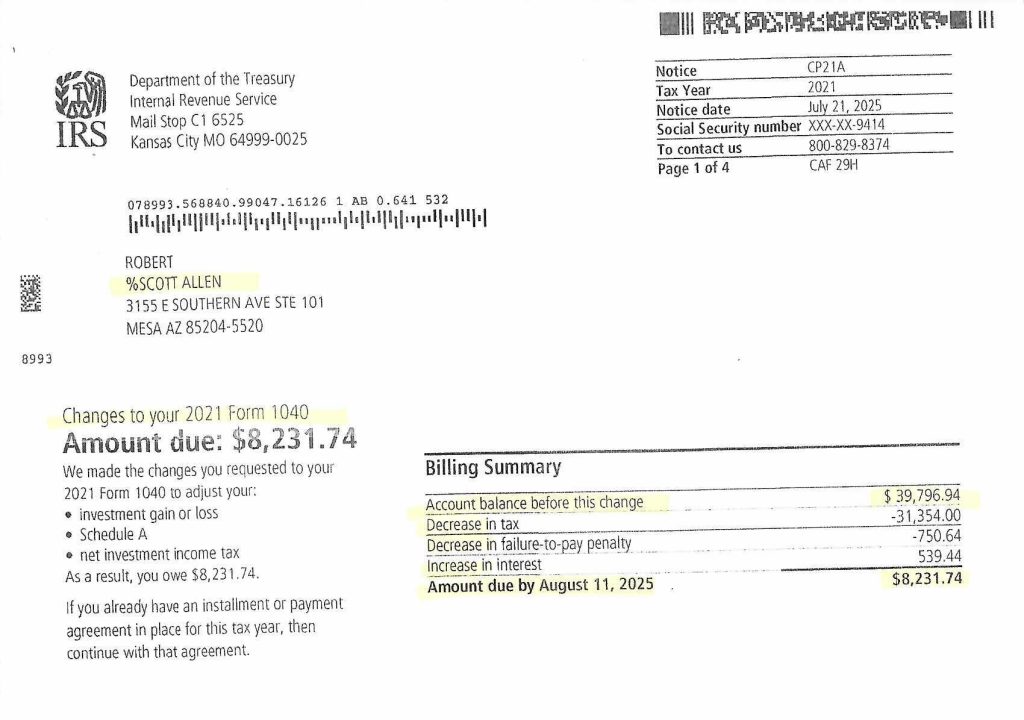
Robert came to Scott Allen, EA facing a daunting situation regarding his 2021 tax year. The IRS had assessed a massive liability against him. As seen in the recent CP21A notice dated July 21, 2025, the account balance before Scott Allen EA’s intervention stood at a staggering $39,796.94.

For the average individual, receiving a bill for nearly $40,000 can be financially devastating. It triggers fears of bank levies, wage garnishments, and property liens. However, Scott Allen, EA knows that an IRS notice is often just the opening opening salvo in a negotiation, not the final verdict.

Scott Allen, EA represented Robert and filed the necessary paperwork to correct the record. He reviewed Robert’s financial documents and identified that the IRS’s numbers were inflated because they did not account for:

  • Investment Gains or Losses: The IRS likely assumed the full sale price of investments was profit, ignoring the initial purchase price (basis).

  • Schedule A Deductions: The IRS standardizes deductions rather than itemizing legitimate expenses that the taxpayer is entitled to.

  • Net Investment Income Tax adjustments.

By preparing and filing a correct, accurate return that reflected Robert’s true financial situation for 2021, the results were transformative.

According to the official IRS billing summary:

  • Decrease in Tax: -$31,354.00

  • Decrease in Failure-to-Pay Penalty: -$750.64

The total amount due dropped from nearly $40,000 down to $8,231.74.

By hiring the right professional to handle his unfiled tax return in Chandler AZ, Robert saved over $31,000. This is not a loophole; this is simply ensuring the tax law is applied correctly and fairly.

Unfiled Tax Return in Chandler AZ

Unfiled Tax Return in Chandler AZ

Why You Need a Local Expert vs. National Chains

When facing tax problems, many people are tempted to call the 1-800 numbers heard on radio and TV ads. These “tax relief” companies often promise the moon, charging thousands of dollars in upfront fees, only to route the client to a call center where they become just another number.

Tax Debt Advisors, Inc. operates differently. As a local, family-owned business serving the Phoenix metro area since 1977, they understand the value of a handshake and a face-to-face meeting.

Scott Allen, EA acts as a buffer between the client and the IRS. Once he is retained and the Power of Attorney is filed, the client no longer has to speak to the IRS directly. This alleviates the immediate stress of harassing phone calls and aggressive letters. For a resident dealing with an unfiled tax return in Chandler AZ, having an advocate in a local office—someone who actually knows who you are when you call—makes all the difference.

The Dangers of Ignoring Unfiled Returns

Procrastination is the enemy of tax resolution. While Robert’s story ended in victory, it highlights the importance of acting sooner rather than later. The IRS penalties for failing to file are significantly higher than the penalties for failing to pay.

  1. Failure to File Penalty: This is generally 5% of the unpaid taxes for each month or part of a month that a tax return is late. The penalty creates a snowball effect that can quickly double the debt.

  2. Failure to Pay Penalty: This is generally 0.5% of the unpaid taxes per month.

  3. Loss of Refund: If a taxpayer is owed a refund, they only have three years from the original due date to file the return and claim that money. After three years, the excess money becomes the property of the U.S. Treasury.

Furthermore, ignoring the problem can lead to aggressive collection actions. The IRS has the authority to issue a levy against bank accounts, garnish wages, and file a Notice of Federal Tax Lien, which can destroy a credit score and make buying a home or car in Chandler impossible.

The Role of an Enrolled Agent (EA)

Many taxpayers are unfamiliar with the term “Enrolled Agent.” An EA is a federally-authorized tax practitioner who has technical expertise in the field of taxation and who is empowered by the U.S. Department of the Treasury to represent taxpayers before all administrative levels of the Internal Revenue Service for audits, collections, and appeals.

Unlike CPAs or attorneys, who may specialize in varying areas of law or accounting, an Enrolled Agent specializes specifically in taxation. Scott Allen, EA has dedicated his career to this niche. His expertise allows him to navigate the complex bureaucracy of the IRS to find the best possible resolution for clients with an unfiled tax return in Chandler AZ.

The Process: How Scott Allen, EA Resolves Unfiled Returns

If you are reading this and relating to Robert’s situation, you may be wondering what the process looks like. At Tax Debt Advisors, Inc., the workflow is designed to be transparent and efficient.

Step 1: The Consultation and Investigation It begins with a free initial consultation. Scott Allen, EA needs to understand the scope of the problem. Following this, he will conduct an investigation into the client’s IRS transcripts to see exactly what the IRS thinks is owed and what years are missing.

Step 2: Compliance You cannot negotiate with the IRS if you are not in compliance. This means all unfiled tax returns must be prepared and filed. As seen in Robert’s case, this step alone is often where the biggest savings occur. By ensuring all deductions, credits, and cost-basis information are included, the liability is stripped down to the legal minimum.

Step 3: Resolution Once the returns are processed and the true tax liability is established (like Robert’s new balance of $8,231.74), Scott Allen, EA works with the client to determine the best settlement option. This could be:

  • Installment Agreement: A manageable monthly payment plan.

  • Currently Not Collectible (CNC): If the taxpayer enters a financial hardship status, the IRS may agree to pause collections.

  • Offer in Compromise (OIC): Settling the debt for less than the full amount owed (if the taxpayer qualifies under strict guidelines).

Navigating Investment Income and “Schedule A” Issues

Robert’s case specifically highlighted adjustments to “investment gain or loss” and “Schedule A.” This is a common pain point for Chandler residents who may have day-trading accounts, cryptocurrency investments, or employee stock options.

When investment firms send a 1099-B to the IRS, they report the proceeds of the sales. Sometimes, the “cost basis” (what you paid for the stock) is not reported to the IRS. If you have an unfiled tax return in Chandler AZ, the IRS will tax you on the entire sale amount, not just the profit.

For example, if you bought stock for $50,000 and sold it for $48,000, you have a $2,000 loss and owe no tax. However, if you don’t file, the IRS sees a $48,000 gain and taxes you on that. Scott Allen, EA is meticulous in reconstructing these financial histories to ensure clients are not paying taxes on money they never actually made.

Similarly, Schedule A allows for itemized deductions such as mortgage interest, property taxes, state income taxes, and charitable contributions. The IRS will never automatically apply these for you. They default to the standard deduction. For homeowners in Chandler and Mesa, losing out on mortgage interest deductions can cost thousands in unnecessary tax payments.

A Legacy of Trust Since 1977

Tax Debt Advisors, Inc. is not a fly-by-night operation. The firm has been a staple in the local community since 1977. Being a second-generation family business, they treat their clients with the respect and empathy that is often missing in the financial industry.

They understand that good people can find themselves in bad situations. The goal is never to judge the client for falling behind, but to provide a clear, actionable path forward. When Scott Allen, EA takes on a case, he sees it through to the end.

Taking the First Step

The hardest part of fixing an unfiled tax return in Chandler AZ is picking up the phone. The fear of what might happen often paralyzes taxpayers into inaction. However, as Robert’s case proves, the reality is often much better than the fear. Robert likely spent nights worrying about a $40,000 debt that, in truth, was only $8,000.

By waiting, you risk letting the IRS seize control of your financial future. By acting, you put Scott Allen, EA between you and the government.

If you have received a CP21A notice, a CP2000 notice, or simply know that you have unfiled returns gathering dust, it is time to act. Do not let the IRS guess how much you owe. Let a professional calculate it correctly.

For residents in Chandler, Mesa, Gilbert, and the surrounding Phoenix areas, Tax Debt Advisors, Inc. is ready to help you resolve your IRS problems.

Contact Scott Allen, EA today. Stop worrying about the IRS and start working toward a solution that protects your assets and your sanity.


About Tax Debt Advisors, Inc. Tax Debt Advisors, Inc. is a family-owned tax resolution firm operating since 1977. Specializing in IRS representation, unfiled tax returns, and tax debt negotiation, Scott Allen, EA provides local, expert assistance to taxpayers in Arizona.

Written by Scott Allen

Is a Phoenix AZ IRS Tax Attorney necessary in my case?

Do You Really Need a Phoenix AZ IRS Tax Attorney to Resolve IRS Problems? Why Many Taxpayers Turn to an Enrolled Agent Instead

When faced with unfiled tax returns, IRS debt, or intimidating notices in the mail, many Arizona residents instantly assume they need to hire a Phoenix AZ IRS tax attorney. They picture a courtroom, aggressive legal action, and a high-priced legal bill that seems unavoidable. But the truth is far simpler: most IRS tax problems—especially those involving filing back tax returns and negotiating IRS payment arrangements—do not require an attorney.

In fact, taxpayers throughout Phoenix and the East Valley routinely find successful, affordable, and long-lasting solutions through a licensed Enrolled Agent (EA)—a tax professional fully authorized to represent taxpayers before the IRS. Scott Allen, EA of Tax Debt Advisors, Inc., has spent years helping individuals resolve IRS issues, file old tax returns, and negotiate payment plans without the unnecessary expense of an IRS tax attorney.

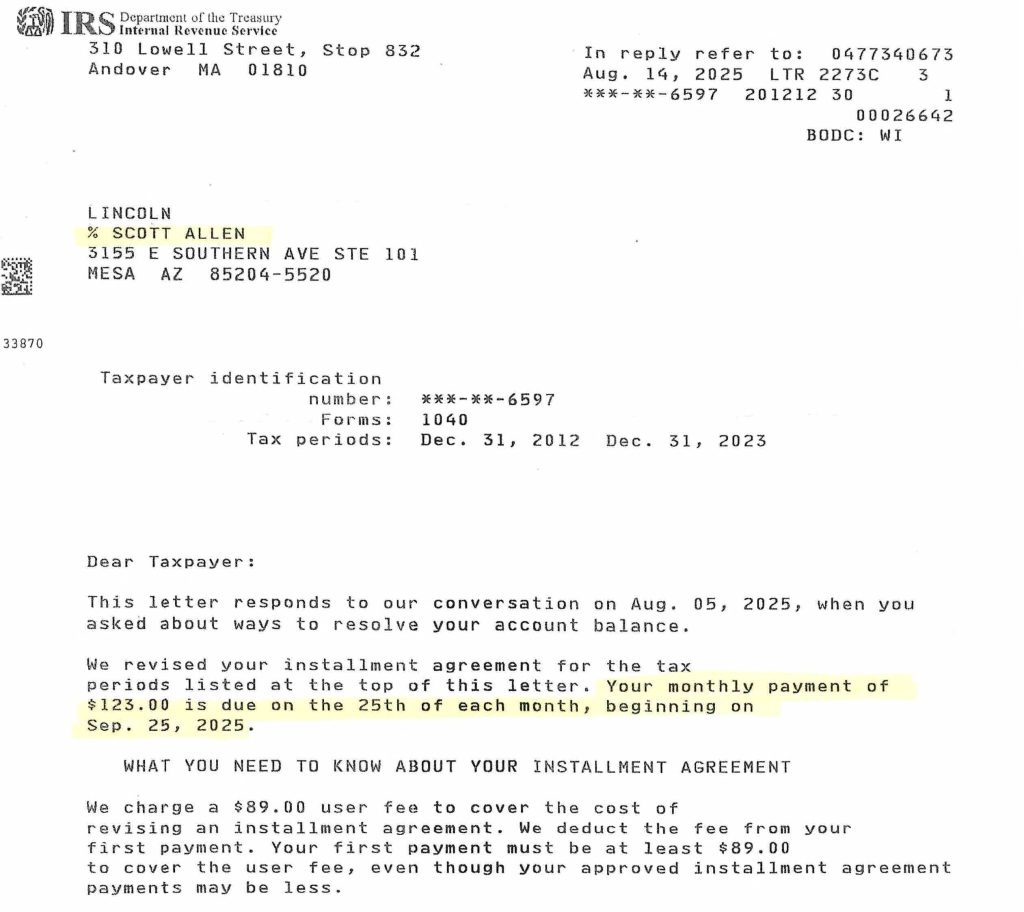
One recent success involves his work with a taxpayer named Lincoln, who came forward needing help with years of unresolved IRS issues. With the IRS threatening collection action, he needed a representative who understood the system and could put the pieces of his complicated tax situation together. Scott Allen, EA stepped in and did just that—guiding Lincoln through the process, filing the required returns, and securing an approved monthly installment agreement with the IRS.

Why You Don’t Necessarily Need a Phoenix AZ IRS Tax Attorney

Many taxpayers are surprised to learn that dealing with the IRS rarely involves legal disputes, lawsuits, or courtroom appearances. The overwhelming majority of IRS problems fall into three practical categories:

  1. Unfiled tax returns

  2. IRS balances owed

  3. IRS notices, audits, or collection actions such as liens or levies

None of these issues automatically require legal representation. Instead, what taxpayers truly need is:

  • Someone who understands IRS procedures

  • Someone who can communicate with the IRS on their behalf

  • Someone who can prepare accurate tax returns

  • Someone who can negotiate the best payment arrangement allowed under IRS rules

This is exactly what an Enrolled Agent is licensed to do.

The IRS grants Enrolled Agents the same authorization to represent taxpayers as attorneys and CPAs. The difference? EAs specialize exclusively in taxation, IRS procedure, and tax resolution—making them uniquely skilled for the exact problems struggling taxpayers face.

Therefore, when someone searches for a Phoenix AZ IRS tax attorney, what they often really need is a highly qualified tax representative—someone like Scott Allen, EA—who handles IRS matters every day and provides a more approachable, cost-effective, and personalized level of service.

Scott Allen, EA: Licensed to Represent Taxpayers Before the IRS

As an Enrolled Agent, Scott Allen is federally licensed by the U.S. Treasury Department. This designation authorizes him to represent taxpayers in all matters before the IRS, including:

  • Filing back tax returns

  • Responding to IRS notices

  • Negotiating installment agreements

  • Stopping wage garnishments

  • Releasing bank levies

  • Protesting IRS assessments

  • Submitting penalty abatement requests

  • Preparing Offers in Compromise

Scott Allen works hands-on with every client. Unlike large national tax resolution companies, he meets with taxpayers face-to-face, reviews their IRS transcripts, and builds a customized strategy designed specifically for their financial situation.

When Lincoln came to Scott, he needed an advocate who could help him understand the IRS notices he was receiving and communicate with the IRS on his behalf. Scott handled the entire process from start to finish, just as he does for every client seeking relief from IRS problems.

Solving IRS Problems Is Like Solving a Jigsaw Puzzle

Resolving IRS problems almost never happens in a single step. Instead, it requires a methodical, step-by-step approach—very much like assembling a jigsaw puzzle.

Many taxpayers try tackling IRS issues themselves and feel overwhelmed when the pieces don’t seem to fit. This is where an experienced representative makes all the difference. Scott Allen, EA has a structured process that ensures every piece is placed correctly and in the right order.

1. Finding the Corner Pieces: Obtaining IRS Transcripts

Just as a puzzle begins by locating the corners and edges, resolving tax debt begins with gathering IRS transcripts. These documents reveal:

  • What tax years have been filed

  • What tax years are missing

  • IRS balances owed

  • Whether the IRS has filed a substitute return

  • Whether collection action is imminent

This first step gave Scott a full picture of Lincoln’s tax situation. Without it, no IRS resolution can be accomplished correctly.

2. Filling in the Missing Pieces: Filing Back Tax Returns

Unfiled tax returns are one of the most common reasons taxpayers seek a Phoenix AZ IRS tax attorney, but these returns almost never require an attorney’s involvement. Instead, they require an experienced tax professional who understands how to reconstruct income, verify withholding, and secure accurate deductions.

Scott Allen, EA specializes in filing back tax returns and does so with precision. In Lincoln’s case, all necessary tax years were reviewed and updated. Filing these returns allowed Scott to move to the next step—negotiating a payment arrangement.

3. Seeing the Picture Take Shape: Establishing the Best IRS Resolution

Once all tax returns were filed, Scott helped Lincoln qualify for a monthly installment agreement that fit his budget. The IRS approved a payment plan of $123 per month, as shown in the copy of the IRS notice Lincoln received.

Like the final pieces of a puzzle snapping into place, this brought clarity, stability, and peace of mind to Lincoln’s tax situation.

PHOENIX AZ IRS TAX ATTORNEY

PHOENIX AZ IRS TAX ATTORNEY

4. Completing the Puzzle: Staying in Compliance

No IRS resolution is complete until future compliance is addressed. Scott works with clients to ensure they stay current on future taxes so their agreement remains in good standing. This final step ensures long-term success—not just a short-term fix.

Why Many Taxpayers Prefer an Enrolled Agent Over a Phoenix AZ IRS Tax Attorney

Choosing the right representative can significantly impact both the outcome and the cost of IRS resolution. Here’s why many individuals choose an Enrolled Agent like Scott Allen over hiring a Phoenix AZ IRS tax attorney:

1. EAs Often Cost Far Less

Legal representation can come with excessive hourly billing. Most IRS cases simply do not require that level of expense.

2. EAs Specialize in IRS Procedure

Enrolled Agents focus solely on taxation—not divorce law, criminal law, or general practice—making them highly experienced in the exact issues taxpayers face.

3. EAs Prepare Tax Returns

Attorneys generally do not prepare tax returns. Since most IRS problems begin with filing issues, Enrolled Agents provide both representation and tax preparation.

4. Personal, Local, Hands-On Service

Scott meets with clients face-to-face in Mesa and serves all of Phoenix and the East Valley. Clients are not pushed into a national call-center system.

5. Full IRS Representation Authority

Just like attorneys and CPAs, Enrolled Agents can represent taxpayers in all IRS matters.

A Real-Life Success: Lincoln’s IRS Resolution

Lincoln’s success is a perfect example of how an Enrolled Agent can deliver results without needing a Phoenix AZ IRS tax attorney. After reviewing his IRS transcripts, filing required tax returns, and negotiating directly with IRS Collections, Scott secured a manageable payment arrangement and stopped the mounting pressure from the IRS.

Lincoln no longer receives threatening letters. He no longer fears a levy. He no longer wonders what the IRS will do next.

His tax puzzle has been solved—piece by piece—thanks to the methodical approach and expertise of Scott Allen, EA.

You Have Options—and Legal Representation Isn’t Always Necessary

Searching online for a Phoenix AZ IRS tax attorney often leads taxpayers to believe their situation requires a legal battle. But most IRS problems are administrative, not legal. What individuals truly need is a knowledgeable, licensed representative who understands the IRS system and can put all the pieces together.

Scott Allen, EA has helped thousands of Phoenix-area taxpayers restore financial stability by:

  • Filing back tax returns

  • Stopping IRS collection actions

  • Negotiating affordable payment plans

  • Evaluating settlement strategies

  • Communicating directly with the IRS on their behalf

Just as with a jigsaw puzzle, solving IRS problems requires patience, precision, and a clear, organized strategy. With the right guidance, the final picture becomes clear—and the stress disappears.

If you or someone you know is struggling with IRS debt or unfiled returns, consider speaking with an Enrolled Agent before assuming you need an attorney. Scott Allen, EA of Tax Debt Advisors, Inc. continues to prove that an EA can offer the personalized, cost-effective, and knowledgeable representation taxpayers truly need.

Written by Scott Allen

A Queen Creek AZ IRS Debt Settlement

IRS Debt Settlement Queen Creek AZ – How Scott Allen EA Helped Douglas Resolve Six Years of Back Taxes

When taxpayers find themselves overwhelmed by IRS debt, the stress can be suffocating. Between the constant fear of wage garnishments, tax liens, and bank levies, many people simply do not know where to turn. This was exactly the situation Douglas, a Queen Creek, Arizona resident, faced before reaching out to Scott Allen EA of Tax Debt Advisors, Inc. Through diligent representation, careful preparation, and expert negotiation, Scott Allen EA successfully guided Douglas through filing six years of unfiled tax returns and secured a manageable IRS debt settlement that fit his financial reality.

This success story is not only a testament to professional tax representation but also an example of how residents in Queen Creek, AZ can find hope and resolution in what seems like an impossible tax situation.


A Tax Problem Years in the Making

Like many hardworking Americans, Douglas had fallen behind on filing his tax returns. Over time, one unfiled return became several, and before long, six years of unfiled taxes had accumulated. Life responsibilities, work commitments, and personal challenges often make it easy for these issues to snowball.

As an employee with a local company, Douglas soon began receiving increasingly aggressive notices from the IRS. The agency was threatening wage garnishments, bank levies, and tax liens—actions that could have devastated his financial stability. The thought of having his paycheck or bank account frozen caused serious anxiety, and Douglas knew it was time to seek professional help before it was too late.

That’s when he turned to Scott Allen EA of Tax Debt Advisors, Inc., a family-owned tax resolution firm serving Arizona taxpayers since 1977.


Why Douglas Chose Scott Allen EA

Douglas needed a local representative who understood both IRS procedures and Arizona taxpayers’ needs. He found that in Scott Allen EA, an Enrolled Agent licensed by the U.S. Department of the Treasury to represent taxpayers before the IRS in all 50 states.

Unlike many national tax resolution companies that advertise heavily but outsource client work to faceless call centers, Tax Debt Advisors, Inc. is a local family business based in Mesa, Arizona, serving nearby communities such as Queen Creek, Gilbert, Chandler, and San Tan Valley. Douglas appreciated being able to sit down face-to-face with a professional who genuinely cared about his case.

From the very first meeting, Scott Allen EA took the time to review Douglas’s IRS notices, assess his financial position, and develop a plan to bring him back into full compliance with the IRS—something the IRS requires before negotiating any type of debt settlement or payment plan.


Step One: Filing Six Years of Unfiled Tax Returns

The first step in resolving Douglas’s IRS debt was to reconstruct and file his six years of missing tax returns. Without current filings, the IRS considers a taxpayer “non-compliant,” which prevents any negotiation for an installment agreement or settlement.

Scott Allen EA worked directly with Douglas to gather all necessary financial documentation, including W-2s, 1099s, and IRS wage and income transcripts. Because of his experience and authorization as an Enrolled Agent, Scott was able to retrieve this information directly from the IRS on Douglas’s behalf.

Each return was carefully prepared to ensure accuracy and to minimize tax liability where possible. In some years, Douglas even had legitimate deductions and credits that the IRS had not factored in when they prepared “substitute for returns” (SFRs) on his behalf. By correcting these, Scott helped significantly reduce the total balance due.

After all six years of returns were filed and accepted, Douglas was officially back in good standing with the IRS—a critical milestone in any IRS debt settlement case.


Step Two: Stopping Levies, Liens, and Garnishments

Before hiring representation, Douglas faced the very real possibility of IRS collection enforcement. His employer had received preliminary warnings from the IRS about potential wage garnishments. These actions can remove a substantial portion of a paycheck, leaving little left to cover living expenses.

However, once Scott Allen EA was officially appointed as Douglas’s Power of Attorney (POA), all IRS correspondence and collection efforts were redirected to him. This immediately stopped the IRS from contacting Douglas directly and paused enforcement actions while a resolution plan was being negotiated.

Having a professional EA in your corner makes a dramatic difference in how the IRS handles your case. With his authorization to represent clients before the IRS, Scott Allen EA was able to communicate directly with IRS agents, request collection holds, and prevent garnishments and levies from taking effect.

Within a short period, Douglas’s fears of losing his paycheck and assets were replaced by a sense of relief and hope.


Step Three: Negotiating a Fair and Affordable Payment Plan

With Douglas now fully compliant on all back tax filings, Scott Allen EA moved on to the negotiation phase. Every IRS payment arrangement must be based on the taxpayer’s current financial situation, including income, expenses, and family size. Scott conducted a thorough financial analysis to determine what Douglas could realistically afford each month without creating further hardship.

After presenting a complete financial package to the IRS, Scott successfully negotiated a monthly installment agreement that reflected Douglas’s ability to pay. As of October 2025, the IRS formally accepted the proposal for automatic payments of $372 per month, drafted directly from Douglas’s bank account.

This agreement not only prevented further collection actions but also gave Douglas peace of mind that his debt was being resolved in a manageable, structured way. The IRS also charged a standard one-time user fee for setting up the agreement, which was included in the first payment.

For Douglas, this marked a turning point—a transition from fear and uncertainty to stability and control.

IRS DEBT SETTLEMENT QUEEN CREEK AZ

IRS DEBT SETTLEMENT QUEEN CREEK AZ


Living Debt-Free in Queen Creek, Arizona

Now that his IRS debt is under control, Douglas can focus again on what matters most—his life in Queen Creek, AZ. Known for its open spaces, beautiful parks, and strong sense of community, Queen Creek is a place where families can thrive.

Douglas enjoys spending his free time outdoors, exploring local trails and enjoying the small-town charm that Queen Creek offers. Free from the constant stress of IRS letters and the fear of losing his paycheck, he can once again appreciate the lifestyle he worked so hard to build.

Stories like Douglas’s highlight how professional representation can not only resolve tax issues but also restore a person’s sense of peace and confidence.


What an Enrolled Agent (EA) Does for Taxpayers

Many people are unfamiliar with the term Enrolled Agent, yet EAs are among the most qualified professionals authorized to represent taxpayers before the IRS. Enrolled Agents are federally licensed by the U.S. Department of the Treasury and are required to demonstrate extensive knowledge of tax law, ethics, and IRS procedures.

Unlike tax preparers who may only assist with filing returns, Enrolled Agents have unlimited representation rights. This means they can communicate directly with the IRS, attend hearings, and negotiate settlements on behalf of their clients. EAs are required to complete ongoing education to stay current on tax code changes and IRS enforcement practices.

When facing an IRS debt situation, having an Enrolled Agent like Scott Allen EA ensures that your rights are protected and that your case is handled with professionalism and precision.


The Family Legacy of Tax Debt Advisors, Inc.

Tax Debt Advisors, Inc. is a family-owned and operated tax resolution firm in Mesa, Arizona. Since 1977, the Allen family has helped thousands of Arizona residents resolve IRS problems related to unfiled tax returns, back taxes, audits, and garnishments. The firm is well-known throughout the Phoenix metro area—including Queen Creek, Chandler, Gilbert, and San Tan Valley—for providing honest, personalized service.

Scott Allen EA continues the family tradition of integrity and transparency, offering a free initial consultation to review each client’s tax situation and recommend the best course of action. Every case is handled personally, never outsourced, and each client receives individual attention from start to finish.


Why Local Representation Matters

In today’s digital age, many taxpayers are drawn to large, out-of-state “tax relief” companies that advertise heavily on TV and online. Unfortunately, many of these firms make unrealistic promises, charge large upfront fees, and fail to deliver results. By contrast, Scott Allen EA and his team at Tax Debt Advisors, Inc. work face-to-face with Arizona clients, ensuring accountability and direct communication.

For Queen Creek residents like Douglas, local expertise makes all the difference. Scott’s familiarity with Arizona’s economy, cost of living, and regional IRS offices allows him to craft solutions that are both practical and effective.


Take Control of Your IRS Debt Today

If you live in Queen Creek, AZ or the surrounding East Valley and are struggling with unfiled tax returns, IRS collection threats, or back tax balances, you don’t have to face the IRS alone. Just like Douglas, you can find relief and resolution with professional help.

Scott Allen EA of Tax Debt Advisors, Inc. is ready to assist you in filing past-due tax returns, stopping IRS enforcement, and negotiating a settlement or payment plan that fits your budget. Whether your debt is large or small, the first step toward peace of mind is reaching out for help.

Call today to schedule your free consultation and see how Scott Allen EA can help you achieve your own IRS debt success story.


IRS Debt Settlement Queen Creek AZ – Call Tax Debt Advisors, Inc. Today

📞 (480) 926-9300
📍 3155 E Southern Ave, Suite 101, Mesa, AZ 85204
🌐 www.taxdebtadvisors.com

Written by Scott Allen

Help with Phoenix AZ IRS Payment Plan

Phoenix AZ IRS Payment Plan Success Story – How Scott Allen EA Helped Teresa Resolve Her IRS Debt

When taxpayers fall behind with the IRS, the stress and uncertainty can feel overwhelming. Letters from the IRS begin to pile up, and bank accounts or paychecks can suddenly be at risk for garnishment or levy. Fortunately, for many Arizona taxpayers, help is available. One recent success story comes from Scott Allen EA of Tax Debt Advisors, Inc., who helped a client named Teresa secure a manageable IRS payment plan in Phoenix, AZ—bringing her much-needed financial peace of mind.


Understanding the Situation: Teresa’s IRS Problem

When Teresa first reached out to Tax Debt Advisors, Inc., she was anxious and unsure of where to turn. She had fallen behind on multiple years of tax filings and owed balances for several tax periods, including 2017, 2018, 2020, and 2022. The IRS had already sent numerous notices demanding payment, and Teresa feared that her wages or bank accounts could soon be garnished.

After seeing the professional reputation and local family roots of Scott Allen EA in Mesa, Teresa decided to hire him as her representative before the IRS. Scott’s firm has specialized in helping individuals and small business owners throughout the Phoenix metro area with tax debt resolution, back tax return preparation, and payment plans for over four decades.


What Is an Enrolled Agent (EA)?

Before diving into Teresa’s case, it’s important to understand what an Enrolled Agent (EA) is. An EA is a federally licensed tax practitioner who has earned the highest credential the IRS awards. Unlike CPAs or attorneys who are licensed by individual states, Enrolled Agents are authorized by the U.S. Department of the Treasury to represent taxpayers in all 50 states before the IRS.

EAs specialize exclusively in taxation—covering everything from tax preparation to audit defense and settlement negotiations. They have unlimited practice rights, which means they can handle any kind of IRS matter: collections, audits, or appeals.

In short, hiring an Enrolled Agent like Scott Allen EA gives taxpayers direct representation before the IRS—without having to face the agency alone.


How Scott Allen EA Helped Teresa Establish an IRS Payment Plan

After being hired, Scott immediately filed a Power of Attorney (Form 2848) with the IRS, officially authorizing him to speak on Teresa’s behalf. This was a crucial first step. With this authorization in place, all IRS contact went directly through Scott—stopping the stress and confusion of constant notices and phone calls.

From there, Scott began the process of reviewing Teresa’s IRS account transcripts and verifying exactly what years were unfiled and what balances were still owed. Once everything was confirmed, Scott worked directly with the IRS’s Memphis, TN service center to ensure all of Teresa’s tax periods were correctly included in one unified payment plan.

The attached IRS letter dated August 4, 2025, confirms that the IRS accepted Teresa’s updated installment agreement. The letter specifically states that the tax periods for 2017, 2018, 2020, and 2022 were added to her existing plan. The IRS agreed to continue deducting a manageable monthly payment of $290.00 directly from her checking account on the 14th of each month.

This was a tremendous victory. Not only did Scott Allen EA stop any potential collection actions, but he also helped Teresa achieve long-term financial stability by setting up a payment plan that fit her budget.

Phoenix AZ IRS Payment Plan Agreement

Phoenix AZ IRS Payment Plan Agreement


Stopping IRS Collections and Protecting Assets

For many clients like Teresa, the biggest fear is IRS enforcement—wage garnishments, bank levies, or even property liens. When taxpayers owe money and don’t respond, the IRS has broad authority to collect. However, once a taxpayer enters into an approved IRS payment plan, all enforced collection activity must stop.

By negotiating this installment agreement, Scott Allen EA ensured that Teresa’s income and bank accounts were protected. The IRS agreed not to pursue any further collection actions as long as she made her agreed-upon monthly payments.

This result is not only financially beneficial but emotionally freeing. The burden of IRS debt can take a serious toll on mental health and family relationships. Teresa finally had peace of mind knowing that she was in compliance with the IRS and no longer at risk of surprise collection actions.


Phoenix AZ IRS Payment Plan Options Explained

For Arizona taxpayers struggling with IRS debt, there are several types of payment plans (installment agreements) available:

  1. Guaranteed Installment Agreement – For balances under $10,000, taxpayers may qualify for an automatic plan without financial disclosure.

  2. Streamlined Installment Agreement – For balances under $50,000, the IRS often approves monthly payment plans up to 72 months.

  3. Partial Payment Installment Agreement – For taxpayers unable to fully pay their debt, this plan allows smaller monthly payments that may not cover the full balance before the statute of limitations expires.

  4. Currently Not Collectible (CNC) Status – In severe hardship cases, the IRS can temporarily suspend all collection activity.

Scott Allen EA reviews each client’s financial situation carefully to determine which payment plan option provides the most affordable and realistic path forward.


The Importance of Filing Back Tax Returns

Many taxpayers who owe back taxes also have unfiled tax returns. In fact, the IRS will not approve most payment plans until all required returns are filed. That’s why Scott Allen EA and his team at Tax Debt Advisors, Inc. specialize in preparing and filing back tax returns—even for multiple years.

For Teresa, ensuring that all prior-year tax returns were filed was a key part of the process. Once the IRS had complete information, it could properly assess her balance due and allow her to enter a compliant payment agreement.

Filing back tax returns not only brings taxpayers current but also helps them claim any refunds or credits they may have missed. Many clients discover that filing old returns actually reduces their total balance once all accurate deductions and credits are applied.


Why Choose Tax Debt Advisors, Inc.

Tax Debt Advisors, Inc. is a family-owned and operated firm based in Mesa, Arizona, proudly serving taxpayers across the greater Phoenix metro area. Founded over 45 years ago, the company has built its reputation on honesty, personalized service, and successful IRS resolutions.

Led by Scott Allen EA, the firm handles everything from unfiled returns and audit representation to payment plans and Offer in Compromise settlements. Every case is handled personally—no national call centers or cookie-cutter approaches.

Clients appreciate working with a local expert who knows how the IRS operates and has established relationships with IRS offices in Phoenix, AZ and across the Southwest.


The End Result: A Fresh Start for Teresa

Thanks to Scott Allen EA’s persistence and expertise, Teresa’s IRS nightmare finally came to an end. The IRS payment plan officially documented in the August 2025 letter provided the structure she needed to pay off her tax debt over time—without fear of levies, garnishments, or new penalties.

Today, Teresa is back on track, staying current with her tax filings and making steady progress toward full resolution. Stories like hers show that, with the right professional help, even serious IRS problems can be solved.


Get Help with a Phoenix AZ IRS Payment Plan

If you or someone you know is facing IRS debt, unfiled tax returns, or collection notices, don’t wait. The sooner you take action, the more options you’ll have.

Contact Scott Allen EA of Tax Debt Advisors, Inc. today to schedule a free initial consultation. As an Enrolled Agent, Scott can represent you directly before the IRS, stop collections, and negotiate a payment plan that fits your budget.

Whether you need help filing back tax returns or setting up a Phoenix AZ IRS payment plan, Scott Allen EA has the experience and local expertise to get you back in compliance and back to peace of mind.


Tax Debt Advisors, Inc.
3155 E Southern Ave, Ste 101
Mesa, AZ 85204
📞 (480) 926-9300
🌐 www.TaxDebtAdvisors.com

Helping Arizona taxpayers resolve IRS problems since 1977.

1 2 3 … 19